Terror Birds are an unseen monster species in CliffSide. However, the franchise frames them less as prehistoric curiosities and more as armed troublemakers who turn the frontier into a moving shooting gallery. Therefore, the species acts as a structural threat that lives just beyond town limits–fast, coordinated, and, most memorably, equipped with guns. In addition, the lore labels them as phorusrhacid descendants, which gives the joke a sharp edge; the gag lands because the design starts in paleontology and ends in banditry.
On the current CliffSide character roster, that framing lands especially well because the birds sit among on-screen leads and off-screen monsters alike, reading less as a one-note gag and more as a standing hazard built into the world’s ecology and road culture. As a result, Terror Birds stretch the show’s tone from slapstick brawls to running skirmishes where a stagecoach escort or a supply run can spiral once a flock crests the ridge. Spoiler: they never appear in the pilot; everything fans know comes from creator materials and bestiary-style sheets, which only amplifies their myth inside the setting.
Origin and first appearance
However, viewers first “meet” Terror Birds through creator materials rather than an episode scene, which is important in a show where Waylon usually acts as the audience’s loud, unreliable guide to danger. Here, by contrast, the lore gets ahead of the camera: the birds arrive as a production-side reveal, and that gives them the flavor of frontier rumor that everyone in town already knows to respect.
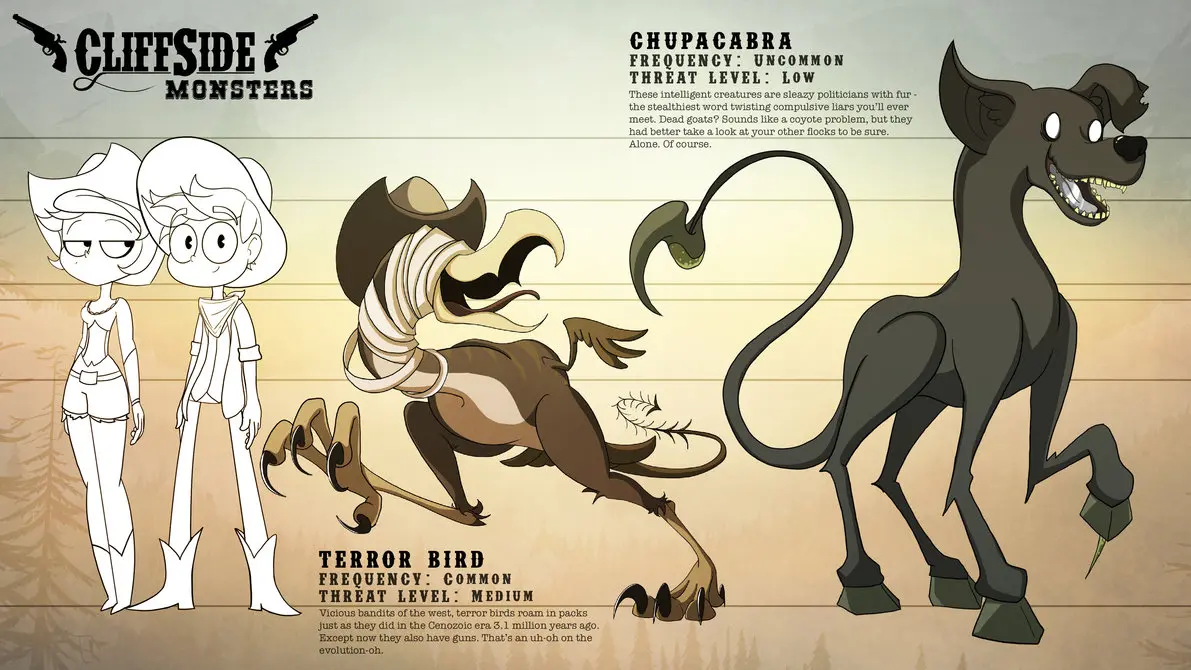
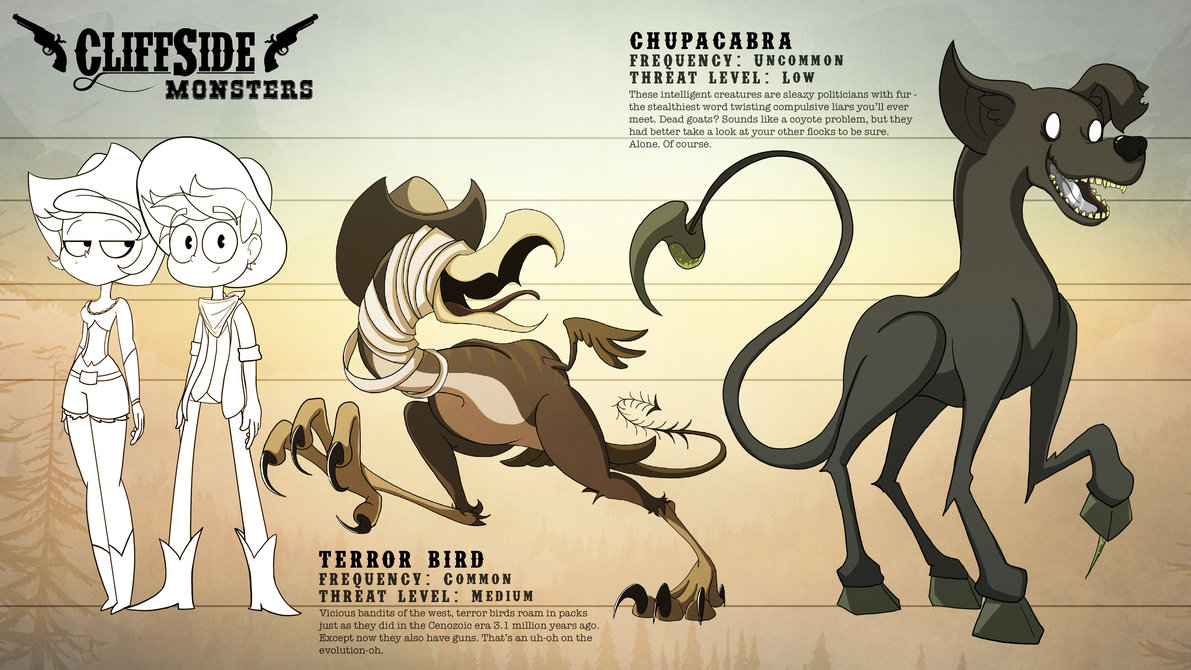
The current description also clarifies how they fit the pilot’s logic: if somebody like Jo Constance represents procedure, perimeter control, and clean arrests, Terror Birds represent the exact sort of open-country complication that makes tidy plans fall apart. Their baseline is crisp enough to feel like a show-bible note and vivid enough to play as an episode engine: vicious bandits of the West, roaming in packs like their Cenozoic ancestors, only now they also carry guns.
That matters because the pilot’s on-screen monster benchmark is still the Wendigos attack, while Terror Birds remain a paratextual escalation–proof that CliffSide’s streets are only one layer of risk and that the roads beyond town are built for flocks, ambushes, and rifle fire. Their “first appearance,” then, is conceptual rather than cinematic: a widening of the action map from alleys and rooftops to rail lines, canyon roads, and supply routes.
Personality and key traits
Then, because the information breaks into crisp beats, a table conveys the species cleanly. The metadata reads like something a sheriff’s office or Jo’s posse would pin to a wall before sending riders out after dusk: common, medium-threat, armed, and rarely worth underestimating.
| Trait | What it means in practice |
|---|---|
| Pack tactics | They hunt and move in coordinated flocks, echoing their phorusrhacid inspiration. In practice, the danger compounds with numbers; one spotter can become a swarm. |
| Bandits of the West | The birds are framed as outlaws, not wildlife. Consequently, they read as intelligent raiders that treat travelers as marks and the open road as contested turf. |
| Weapons: guns | The profile states they carry firearms. Therefore, skirmishes escalate from chase-and-peck to true shootouts, with chaos if a flock has decent aim. |
| Frequency: common | Encounters aren’t rare, which implies recurring patrols, curfews, and escort protocols on the edges of town. |
| Threat level: medium | They are dangerous but not apocalyptic; preparation and numbers can beat them, though underestimating them gets people hurt. |
Story arcs and development
Arc 1 – From creature feature to outlaw warfare
Start: The setting already balances monsters with western gunplay, as the pilot proves. Then: Terror Birds translate that mash-up into pure kinetic action–flocks that sprint like cavalry and spray gunfire like bandits, turning supply runs into chase episodes where even ordinary townsmen such as Dan McJaw-type law enforcers would be badly outmatched once the first shots land.
Meanwhile, their “common” frequency cues repeatability; writers can return to them without exhausting the premise because the birds are a logistics problem, not a prophecy. That makes them ideal for convoy episodes, escort jobs, and dusty-road skirmishes where a figure like Rustlin’ Bill could survive only if the group kept formation and treated every ridgeline as hostile.
Arc 2 – Paleontology with a punchline
Start: Real terror birds dominated as flightless predators across the Cenozoic. Then: CliffSide tilts that history into a western gag–“except now they also have guns”–without discarding the core: pack behavior, speed, and a cleaver-like beak silhouette. In the wider bestiary, that lets them sit naturally beside creatures such as Chupacabras: strange enough to be memorable, but still grounded enough to feel like residents of the same violent valley.
In addition, the joke lands precisely because the baseline feels plausible in genre terms. Terror Birds are funny the way frontier rumor is funny–half absurd, half practical–which is why they complement more psychological off-screen dangers like the Sirens: one species bends trust, the other weaponizes pursuit, and both make the outskirts feel unsafe in different ways.
Arc 3 – Common, medium, and everywhere you aren’t ready
Start: The metadata’s “Common” label reframes the flock as an everyday hazard rather than a season-finale boss. Then: the “Medium” threat tier signals that townsfolk can fight back if they respect the numbers–post sentries, ride in pairs, and know when to retreat. That same logic fits a world where even Death is treated less like a surprise and more like a force you plan around.
Consequently, the birds anchor stories where competence and planning–not prophecy or mysticism–decide who limps home. They also widen the show’s combat map: if Yannis helps define aerial threat, Terror Birds define the panic of open-ground pursuit, where legs, dust, and sightlines matter more than rooftops or altitude.
Arc 4 – Off-screen presence, on-screen pressure
Start: They remain unseen in the pilot and live in creator-authored monster sheets. Then: that absence lets them function as rumor and routine, the kind of threat every character treats as real even if the audience has not seen one yet. That unseen role also fits naturally alongside other species such as Migrants, which makes the flock feel like part of a larger off-screen ecology rather than a discarded concept.
As a result, Terror Birds expand the map and the mood: when CliffSide laughs, it often laughs with one eye on the ridgeline. That tonal background matters in a setting that also leaves room for stranger unseen pressures like Poltergeists; the birds keep the danger concrete, mobile, and gunmetal-loud.
Even in hypothetical matchups, the species works because it pressures different skills from the cast. A close-quarters predator like Cordie thrives by choosing terrain and controlling space, whereas Terror Birds force everyone into running fights where numbers and firearms erase the comfort of a single ambush.
They also fit the show’s habit of making side characters feel usable in worldbuilding. A named town volunteer such as Jesse Lankman instantly reads differently once the frontier includes armed flocks: every patrol, escort, or watch rotation starts to sound like a job nobody wants but somebody still has to take.
Relationships with other characters
| Name | Role vs. Terror Birds | Dynamics |
|---|---|---|
| Waylon | Protagonist vs. flocking raiders | His swagger and running commentary would be magnet bait for a coordinated ambush; a “clever plan” can dissolve when a dozen birds open fire. |
| Jo | Partner vs. repeat hazard | Her practical streak aligns with protocols: verify cargo, assign riders, and don’t argue with a timetable when the scrubland goes quiet. |
| Cordie | Ally vs. organized predators | The spider-girl embodies stealth predation; the birds flip the script with speed and numbers, forcing her to pick terrain rather than a single victim. |
| Death | Sheriff vs. road bandits | As law in CliffSide, he would treat the flocks as organized crime, not wildlife, writing rules around convoys, sentry rotations, and retaliation. |
| Wendigos | Other monsters vs. birds | The pilot’s Wendigo attack sets the on-screen combat baseline; the birds counter with mobility and firearms, broadening the threat taxonomy. |
| Yannis | Aerial predator vs. ground raiders | The pterosaur’s sky control contrasts with sprint tactics on the ground, mapping a vertical slice of the setting’s food chain. |
| CliffSide (location) | Town vs. periphery threat | The species occupies the surrounding areas of the Yosemite Valley setting, which makes every road out of town a calculated risk. |
Appearance, symbols, and recurring motifs
Visually, Terror Birds read as large, flightless hunters with long legs, a raptor-style beak, and a posture built for sprinting and striking. Concept sheets lean into dynamic silhouettes–arched necks, heavy heads, and slashing talons–to sell speed and impact before the gun gag even lands. That balance between threat and absurdity is part of what lets even joke-adjacent figures like Sheriff Pinecone belong to the same tonal universe without breaking it.
Therefore, recurring motifs gather around open terrain and motion: a coach in full gallop with shadows gaining, feather tufts caught on sagebrush, muzzle flashes strobing through dust. In a world that already knows how to turn a passerby into a gag, as the very existence of Background Street Crosser suggests, Terror Birds give the joke sharper teeth by making every road-crossing feel like a bad decision.
The species also fits the franchise’s larger outlaw backstory. Off-screen figures like Blueberry Bill deepen CliffSide’s criminal folklore, while Terror Birds turn that same heritage into a mobile threat that does not need dialogue to feel criminal.
Fandom and alternative names
- Terror Birds
- Terror Bird (singular)
- Phorusrhacids
- CliffSide Terror Birds (fan shorthand)
- Unseen Characters (label)
- Unreleased content (label)
- Птица ужаса (Russian)
- Птицы ужаса (Russian, plural)
Interesting details and quotes
- The monster sheet tags the species as “Unseen” and “Unreleased,” so public details come from concept materials rather than an aired scene.
- The weapons line literally lists “Guns,” which turns a paleontology reference into a western shootout in one beat.
- Frequency: Common and Threat Level: Medium imply repeatable logistics drama rather than a single doomsday event.
- The current CliffSide character hub now places Terror Birds directly among the series’ broader character set, reinforcing their role in the franchise’s active bestiary.
- The wider site taxonomy also groups them naturally beside off-screen threats such as Chupacabras, Sirens, Migrants, and Poltergeists.
- The pilot premiered on May 20, 2018, but Terror Birds remain absent from that on-screen debut.
- The habitat line places them in the surrounding areas of CliffSide, dovetailing with plots set on canyon roads and rail spurs.
- The species name nods to real phorusrhacids, grounding a comedy beat in recognizable natural history.
Vicious bandits of the west, terror birds roam in packs… Except now they also have guns.
That’s an uh-oh on the evolution-oh.