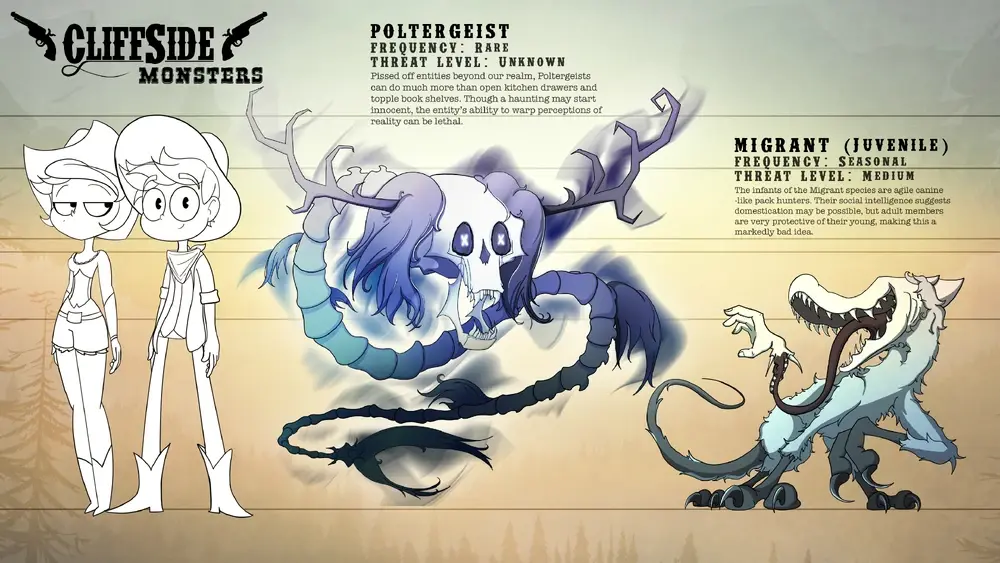
Poltergeists is the name given to a rare, reality‑warping ghost species in Liam Vickers’ animated western pilot CliffSide. Unlike the show’s on‑screen monsters, these entities have not appeared in an episode; they survive in official concept sheets and franchise documentation as unseen beings said to haunt the cliffs around town. That makes them less a throwaway idea than a durable piece of world‑building, one that expands the setting’s supernatural ecology and keeps future danger hanging over the frontier.
Public-facing reference material still keeps them in that liminal position. The broader CliffSide character index continues to list Poltergeists among the world’s documented creatures, while late‑2025 profile updates still describe them as rare ghosts with reality‑warping abilities rather than active episode antagonists. In practical terms, the canon has widened around them without yet moving them from concept into action.
Origin and release context
The pilot context matters here. Public series notes tied to Jo’s posse still anchor the project to its May 20, 2018 YouTube premiere and identify Liam Vickers as creator, writer, director, and animator, with Jesper Ankarfeldt on score. Because Poltergeists were never folded into that release itself, they remain part of the show’s “next layer” rather than its first impression.
The existing voice-cast hub also reinforces how tightly the pilot was built around a small central ensemble. That compact cast design helps explain why Poltergeists stayed off screen: the public episode spends its runtime establishing tone, chemistry, and threat hierarchy before it ever has room for a reality‑warping ghost story.
Personality and key traits
That focus on core players is crucial, because Poltergeists are easiest to understand by asking what kind of trouble they would create for someone like Waylon. A loud, self‑mythologizing narrator can bluff his way through gunfire and street chaos; he is much less equipped for a creature that bends perception itself. In other words, Poltergeists are dangerous not only because they can kill, but because they attack the show’s favorite tools–voice, perspective, timing, and confidence.
| Trait | What it means in CliffSide |
|---|---|
| Reality warping | The entity distorts perception and setting, going well beyond typical “noisy ghost” antics. Escalation can become lethal rather than mischievous. |
| Unseen in canon | They are acknowledged in official materials but still have no on‑screen scene to date. Their danger remains textual, conceptual, and intentionally unresolved. |
| Rare, threat unknown | Frequency is listed as rare and the threat level as unknown, signaling exceptional, unpredictable encounters rather than routine nuisances. |
| Cliffside haunters | Described habitat is the cliffs around town–implying territorial haunting grounds outside the main streets where the leads usually operate. |
| Documented, episode‑free | Late public profile refreshes reiterated the same core lore without introducing an episode appearance, which makes the species feel stable in canon but frozen in plot. |
Story arcs and development
Arc 1 – A threat defined by absence.
The pilot publicly locks much of its emotional rhythm around Jo Constance: pragmatism, clean decisions, and the ability to steady a scene after somebody else has broken it. Poltergeists matter because they would pressure exactly those stabilizing instincts. A gunslinger or deputy can aim at a target; Jo’s real challenge against a reality‑warping ghost would be proving that the target, the room, and even the witnesses are still what they seem.
Arc 2 – Monster contrast sharpens the species.
The pilot’s most memorable chaos engine is Cordie, a creature who turns flirtation, appetite, and comic violence into the same performance. Poltergeists sit at the opposite end of that spectrum. Where Cordie is tactile, loud, and immediate, the ghost species is defined by misdirection, atmosphere, and warped perception, which gives the world a broader threat vocabulary than claws alone could provide.
Arc 3 – The supernatural ceiling stays higher than the pilot can show.
Once Death enters the frame, CliffSide stops feeling like a quirky monster western and starts feeling cosmically unfair. Poltergeists reinforce that same tonal expansion from another angle. They are not the law of the universe the way Death appears to be, but they do belong to the same upper tier of menace where normal frontier logic breaks down and survival depends on reading the impossible correctly.
Arc 4 – Concept sheets gave them a stable place in the bestiary.
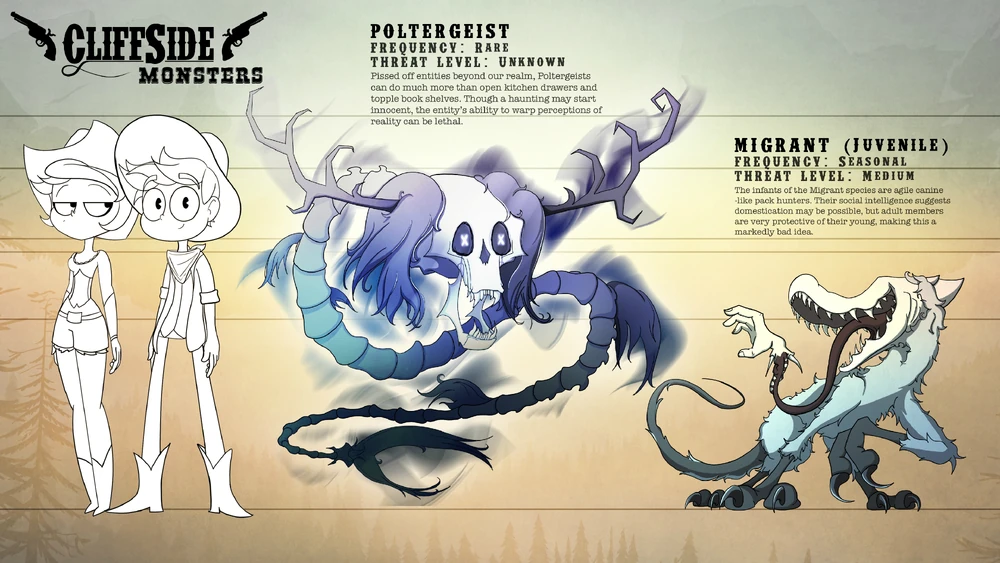
Official monster art placed a Poltergeist beside a juvenile Migrant, which is an important pairing. The Migrant embodies size, flesh, and ecological force; the ghost embodies distortion, invisibility, and mental danger. Together they show that the planned bestiary was never limited to one type of horror, and that Poltergeists were conceived as a distinct branch of the setting rather than a generic haunted-house add‑on.
Arc 5 – Their absence became a tone marker instead of a weakness.
Because the released pilot uses Wendigos as its first on‑screen monster benchmark, viewers get a vivid example of CliffSide’s physical threat language: swarms, pursuit, gunfire, panic, and motion. Poltergeists implicitly promise something harsher and quieter. They suggest an episode where the enemy does not need to sprint through town because it can turn the town itself into a bad reading of reality.
Relationships with other characters
| Character | Role vs. Poltergeists | Dynamics |
|---|---|---|
| Waylon | Potential adversary | The self‑styled outlaw survives by talking, reframing, and bluffing; Poltergeists would attack the very reliability of that performance. No encounter is depicted. |
| Jo Constance | Foil by temperament | Jo’s cooler, pragmatic style would contrast with perception‑warping chaos, highlighting her stabilizing role in crises. No meeting is shown in canon. |
| Cordie | Parallel “monster” status | Cordie proves that a monster can be ally, wildcard, and immediate physical threat; Poltergeists push the setting into less tangible, more disorienting horror. No direct link is documented. |
| Death | Thematic counterpoint | Death appears as a character, while Poltergeists represent disembodied hostility and warped perception. The juxtaposition broadens the supernatural palette without a confirmed interaction. |
| Wendigos | Comparative species | Wendigos establish CliffSide’s on‑screen predator baseline; Poltergeists extend that bestiary into metaphysical horror. No crossover scene exists to date. |
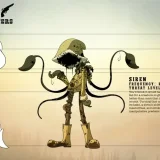
| Sirens | Unseen counterpart | Both species remain off screen in public canon, but Sirens manipulate voices and ego while Poltergeists distort reality itself, sketching two different branches of unseen danger. |
Note: No on‑screen encounters between Poltergeists and the characters above have been shown. That gap extends beyond the leads; even rank‑and‑file responders such as Dan McJaw have only been tested against more conventional public chaos, not against a haunting that could falsify what the whole town thinks it sees.
Place in the wider unseen bestiary
Poltergeists also read differently once you place them beside other unreleased species. The clearest comparison is Sirens, another rare, largely off‑screen threat built around manipulation rather than brute force. But where Sirens weaponize voice mimicry and social weakness, Poltergeists warp reality at the perceptual level, pushing the show from psychological trickery into outright ontological danger.
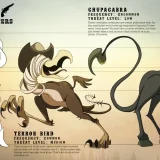
A second useful contrast comes from Chupacabras, which are framed as intelligent liars and rhetorical predators. That species threatens trust, negotiation, and the social fabric of the town. Poltergeists go one step further: they do not just twist what characters say or believe; they threaten the reliability of the world those conversations happen in. In a series already interested in unreliable bravado, that is a meaningful escalation.
Even the draft-only figure of Ares helps clarify where Poltergeists sit. Ares represents the road not taken–more banter, more creature interplay, more strategic chatter riding alongside bigger monsters. Poltergeists imply the opposite design choice: less talk, more dread, and a kind of haunting that would force silence, hesitation, and second‑guessing into a series that usually moves fast.
The show’s sense of humor makes that contrast sharper. A tiny gag figure like Sheriff Pinecone reminds viewers that CliffSide loves puncturing western swagger with absurdity. Poltergeists matter because they can reverse that trick. Instead of a joke dissolving tension, they would let tension swallow the joke, turning comic confidence into exactly the sort of false certainty that gets people killed.
They also benefit from the fact that the setting contains more unseen lore than the pilot could possibly stage at once. Entries such as Blueberry Bill show how much of CliffSide’s mythology survives in notes, side references, and expanded character catalogs. Poltergeists endure within that same shelf of half‑seen frontier lore, except their power set makes them feel less like a colorful footnote and more like a future centerpiece that never received its episode.
Appearance, symbols, and recurring motifs
Visually, Poltergeists still have no on‑screen model, but the available concept art already does a lot of work. Against the blunt materiality of species such as Terror Birds, the Poltergeist’s floating limbs, tapering lower body, and mask-like face announce an enemy built around dislocation rather than impact. The design implies motion without footing and presence without anatomy, which is exactly what you want from a creature whose most notable documented ability is reality warping.
That same design logic helps explain why fans keep returning to the species whenever the conversation shifts from what the pilot showed to what the world could still contain. Public discussion often circles back to spectacular threats like Yannis, but Poltergeists hold a different kind of fascination: they suggest an episode driven not by size or speed, but by uncertainty itself. In a frontier already populated by predators, lawkeepers, and cosmic riders, that makes them one of the setting’s cleanest unresolved ideas.
Fandom and alternative names
- Poltergeists – canonical species name.
- Poltergeist – singular usage on concept art and in discussion.
- Unseen monsters – a common descriptor reflecting their catalog status.
- Ghosts (species) – the formal classification used in the bestiary.
- Reality‑warping ghosts – a fandom shorthand built from the official ability listing.
- “Poltergeist haunting ground” – phrasing seen in community discussion.
- Полтергейсты – Russian‑language page title used in localization.
Interesting details and quotes
- The species is still publicly presented as unseen and unreleased rather than as a monster with an aired episode debut.
- Official fields associated with the creature list species: Ghost, frequency: Rare, threat level: Unknown, and ability: Reality Warping.
- Concept material pairs Poltergeist with a juvenile Migrant, making the contrast between intangible horror and animalistic menace explicit.
- The public pilot framework remains anchored to Waylon, Jo, Cordie, and Death, which helps explain why Poltergeists remain off camera.
- Compared with Sirens and Chupacabras, Poltergeists sit nearer the franchise’s metaphysical end of the monster spectrum.
- Design language favors drifting motion, a mask‑like face, and a cold spectral palette rather than claws, jaws, or visible musculature.
- No public voice, fight scene, or full episode model sheet for the species has been released.
- “Pissed off entities beyond our realm…” remains the sharpest official capsule line for their overall attitude.
- “Monsters and shootouts abound” is the kind of western promise Poltergeists complicate by shifting danger from gunfights to perception itself.