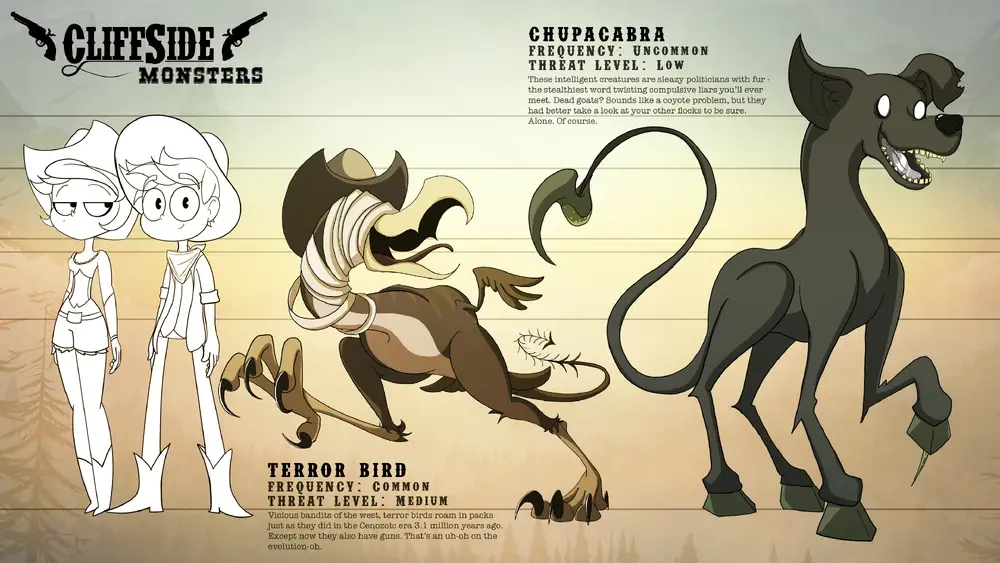
Chupacabras is a named predator species in CliffSide that the creators frame as intelligent, manipulative tricksters rather than simple monsters. Even without a single animated appearance, the species works as a tonal anchor by proving that danger in this setting is not only claws and speed but also rhetoric, scams, and social predation.
The species matters because of Ares, the unseen chupacabra whose draft-era role ties the entire concept directly to the main villain structure. Through him, Chupacabras stops being a generic monster note and becomes a concrete alternative version of the pilot’s antagonist dynamic.
The broader CliffSide character catalog now preserves the species and Ares as separate entries, which reinforces an important reading: the lore outlived the cut partnership. Chupacabras functions as a reusable species slot inside the franchise, while Ares remains the clearest individual example of how that slot might have played in story.
Origin and first appearance
However strange it sounds for a “monster” entry, Chupacabras makes its first impression in text rather than footage. Creator-facing descriptions pitch the species as clever, duplicitous predators–“sleazy politicians with fur”–which instantly separates them from the metaphysical authority embodied by Death. The point is clear from the start: some CliffSide predators win by force, but this one is designed to win by misdirection first.
Public materials still stop short of giving the species an on-screen debut, so Chupacabras remains a documentation creature even as the pilot gives its first monster benchmark to the invading Wendigos. That contrast gives the species a useful shape in the audience’s imagination: Wendigos establish visible chaos, while Chupacabras quietly expands the world’s social and verbal threat profile.
Personality and key traits
| Trait | Description |
|---|---|
| Manipulative rhetoric | The species is defined by talk: they twist words, posture, and negotiate like con artists. A chupacabra threat can arrive through deals and half-truths as easily as through claws. |
| Pack opportunists | They thrive near stronger predators and power structures, adding strategy rather than raw force. That makes them natural riders, whisperers, or handlers for larger threats. |
| Fast-talk survivalism | Their default survival tool is speed–of speech and of escape. They pressure others into the danger zone and try to vanish when the bill comes due. |
| Unseen yet canonical | The pilot era lists them in species notes but shows none on screen, keeping their image flexible while their behavioral profile stays fixed. |
| Ares as exemplar | Ares concentrates the template: loyal in early drafts, small enough to ride, and ultimately disposable in a town that punishes schemers without sentiment. |
Story arcs and development
Arc 1 – Buddy-monster drafts: the rider concept. Early outlines pair the species with Yannis, which immediately gives Chupacabras a functional niche inside the antagonistic machine. Instead of replacing brute force, the species would have sharpened it by adding chatter, scouting, and a trickster rhythm to aerial violence.
That same draft logic becomes easier to read through Ares, the named example who turns the species from abstract note into a specific relationship. He is the proof that the show once considered a faster, talkier villain dynamic built around monster partnership rather than pure dread.
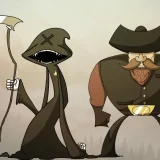
Arc 2 – Death takes the saddle: tone over banter. Production later pivots toward Death as the rider figure, and the meaning of the image changes at once. What had been a possible buddy-monster setup becomes domination, stillness, and inevitability, with silence replacing patter as the final form of menace.
Arc 3 – Cordie’s offscreen kill: comedy with teeth. Later commentary folds in a brutal coda by crediting Cordie with killing Ares offscreen. That single note sharpens the species retroactively: in CliffSide, fast talk may delay danger, but it does not protect anyone once a stronger predator decides the conversation is over.
Arc 4 – From species blurb to analytical tool. Because no aired episode locks the species into a final model, Chupacabras becomes especially useful when set against the unseen Sirens. Both species weaponize speech and psychology, but Chupacabras reads as a lower, dirtier frontier version–less supernatural seduction, more hustler logic in a monster skin.
The comparison gets sharper again when placed beside the unseen Poltergeists. Where Poltergeists push CliffSide toward reality-warping ghost horror, Chupacabras keeps the threat grounded in lies, leverage, and predatory social intelligence.
The wider bestiary also clarifies scale. Next to the unseen Terror Birds, which imply outward-moving armed chaos, Chupacabras feels less like a siege species and more like a parasite on bad judgment. It damages the town by getting inside its weak points instead of simply charging them.
The same is true when the species is set against the unseen Migrants. Migrants expand CliffSide’s world through size, timing, and regional catastrophe, whereas Chupacabras expands it through manipulation and small-scale corruption. One terrifies by scale; the other by intimacy.
Relationships with other characters
Against Waylon, a chupacabra reads like the perfect confidence-game predator. His bluffing, self-narration, and need for approval would give a liar species exactly the opening it wants, making him the kind of mark who could talk himself into the trap before the trap even moved.
Against Jo Constance, the dynamic flips. Her procedural calm, practical ethics, and low tolerance for nonsense make her the natural firewall against rhetoric-first predators, which is why the species works so well as a hypothetical foil for her even without a direct scene.
| Character / Entity | Role vs. Chupacabras | Dynamics |
|---|---|---|
| Yannis | Apex ally and potential mount | Species notes pair a named chupacabra with her in drafts; the dynamic implies strategy layered onto brute aerial power, with the smaller predator steering trouble from a front-row seat. |
| Death Itself | Tonal replacement | The cosmic rider takes the chupacabra’s slot, replacing chatter with inevitability; the switch explains why the pilot reads colder and meaner. |
| Cordie | Lethal spoiler | Commentary credits her with Ares’s offscreen death; the event signals that sunny affect does not limit her capacity for decisive violence. |
| Waylon | Easy mark by temperament | He never meets the species on screen, yet his craving for approval and habit of bluffing would make him ideal prey for a fast-talker. |
| Jo Constance | Negotiation firewall | Jo’s pragmatic ethics and low tolerance for scams make her a natural counter to the species’ rhetoric-first tactics. |
| Chupacabra Ares | Species exemplar | As Yannis’s best friend in outlines, he embodies the template–rider, chatter, disposable; his removal turns the species into lore. |
| CliffSide (the town) | Ecosystem that rewards lies | The setting’s chaos provides cover for schemes; nevertheless, it punishes duplicity quickly when stronger forces intervene. |
The town framework matters almost as much as the characters. Jo’s posse shows how shaky ordinary law becomes once the frontier gets weird, and that instability is exactly the sort of environment a manipulative species could exploit before anyone agrees on what is happening.
Even minor law-side figures like Dan McJaw reinforce the same pattern: CliffSide’s civic defenses look recognizable, but they are constantly one step away from being outclassed by monsters, panic, or bad information. A species built around persuasion would thrive in that uncertainty.
Appearance, symbols, and recurring motifs
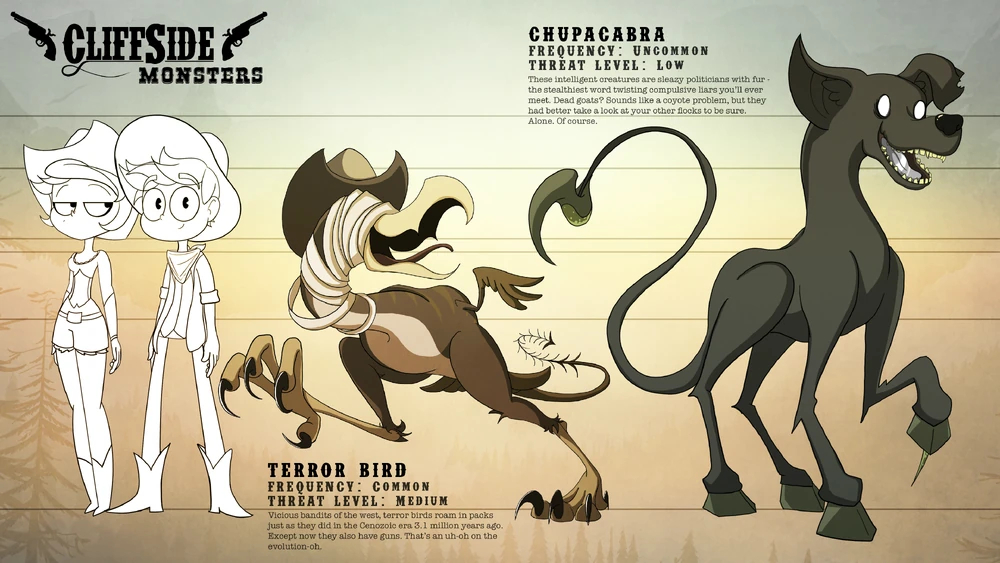
Visually, Chupacabras still has no locked on-screen model in the pilot era. The functional cues remain concrete, though: the creatures are small and agile enough to ride larger predators, and the poster reproduced above keeps them framed as a compact, mobile threat rather than a center-stage bruiser.
Motif-wise, the species fits neatly into the show’s larger pattern of talk colliding with consequence. Waylon’s outlaw fantasy is haunted by the myth of Blueberry Bill, and Chupacabras belongs in that same economy of bragging, false stature, and stories that turn dangerous when somebody else believes them too literally.
It also belongs beside joke-law symbols such as Sheriff Pinecone, because CliffSide loves reducing identity to a role, a prop, or a performance and then testing whether that performance survives contact with real threat. Chupacabras would thrive in exactly that gap between the pose and the consequence.
Fandom and alternative names
- Chupacabras – species label used in franchise materials.
- Chupacabra – singular form used in character notes, especially for Ares.
- Chupas – common shorthand in discussions and captions.
- Unseen species – tag applied because no individual appears on screen in the pilot.
- Chupacabras (unreleased) – catalog label for development-only entries.
- Чупакабра(ы) – Russian localization used in community posts.
- Chupacabra Ares – species-plus-name shorthand for the draft exemplar.
Interesting details and quotes
- The species is described as intelligent, manipulative, and compulsive liars, emphasizing rhetoric over muscle.
- Ares, a male chupacabra, was Yannis’s best friend and early-draft rider before the role shifted to Death.
- Spoiler: creator commentary states that Cordie kills Ares offscreen, a beat that sharpens the show’s dark comedy.
- The broader CliffSide catalog preserves separate entries for the species and for Ares, underscoring that the lore outlived the draft-specific pairing.
- Because none appear on screen in the pilot, the species still has no voice credits and no episode model sheet in public-facing materials.
- Compared with Sirens, Terror Birds, Migrants, and Poltergeists, Chupacabras reads as one of the franchise’s most socially oriented unseen threats.
These intelligent creatures are sleazy politicians with fur–the stealthiest word-twisting compulsive liars you’ll ever meet.
Fun fact: in early drafts of the pilot, Yannis had a Chupacabra best friend named Ares that rode around on her back instead of Death.