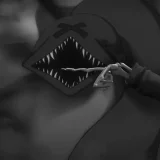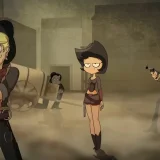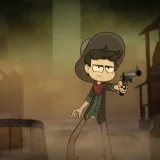
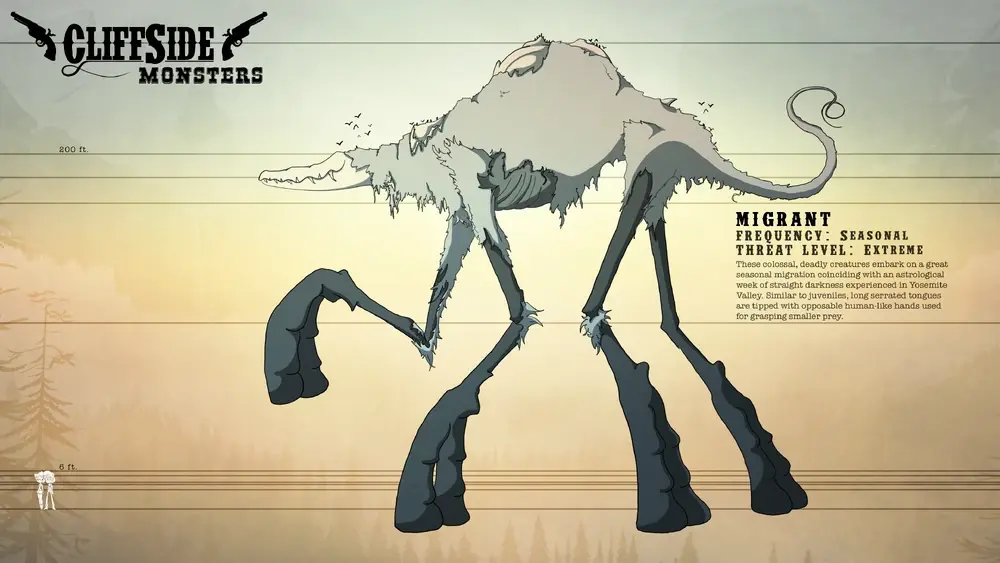
Migrants is an unseen monster species in CliffSide, Liam Vickers’ animated western-comedy pilot and world. However, they never actually appear on screen in the pilot; instead, the creator’s concept sheets and the show bible–style notes sketch them in striking detail as a looming ecological force. Therefore, the species functions less as a one-off villain and more as infrastructure for the setting: a seasonal threat that expands the world beyond the town limits and reframes the frontier humor with existential scale. The lore distinguishes between quick, pack-hunting juveniles and colossal adults that move through Yosemite Valley during a rare “week of straight darkness,” a beat that implies evacuation plans, curfews, and the kind of folklore small towns invent to cope. As a result, Migrants anchor CliffSide’s tone: monsters here are not just props for gags or shootouts–they are systems that the townsfolk must live around, outthink, or survive.
Personality and key traits
When the material breaks into compact beats, a table conveys it best.
| Trait | What it means in practice |
|---|---|
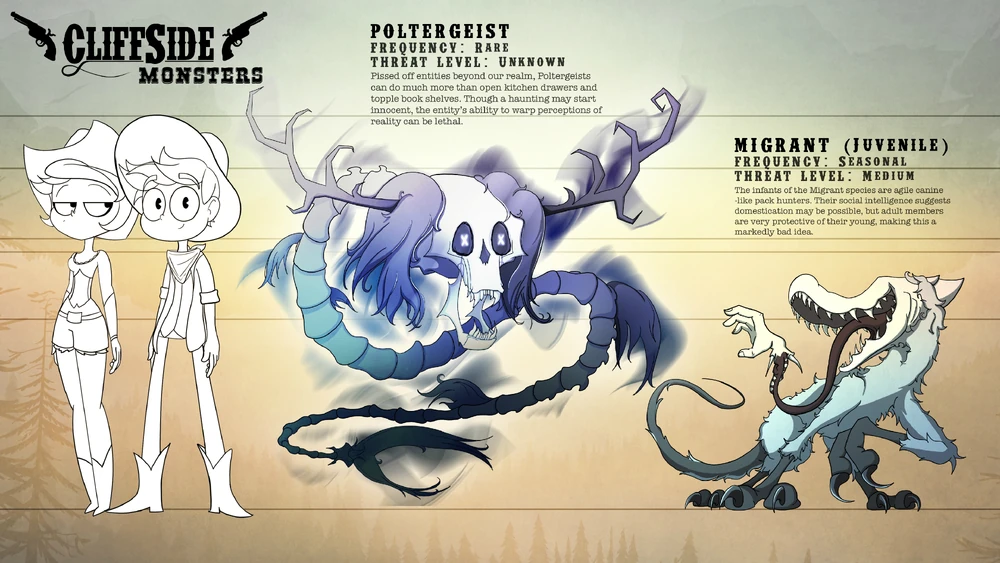
| Pack-savvy juveniles | The infants hunt like agile, canine pack animals. They show social intelligence high enough to tempt domestication, yet that notion collapses once adults enter the picture. |
| Protective adults | Adult Migrants guard their young, turning any attempt to approach or tame juveniles into a lethal proposition. As a result, “domestication” is explicitly marked as a bad idea in the notes. |
| Tongue-hand anatomy | Both stages share long, serrated tongues tipped with human-like opposable hands. Consequently, they excel at snatching smaller prey and manipulating obstacles at close range. |
| Seasonal migration | Adults migrate during an astrological week of unbroken darkness in Yosemite Valley, which implies a predictable (but terrifying) window when encounters spike. |
| Escalating threat | Threat tiers climb from “Medium” (juveniles) to “Extreme” (adults), with adults listed as the largest known species in the setting–towering over 200 feet. |
Key details are drawn from “Liam’s Description,” threat tiers, and trivia compiled for the species.
Story arcs and development
Arc 1 – Off-screen terror as worldbuilding
Start: The CliffSide pilot establishes a frontier town menaced by nonhuman threats, punctuated by a chaotic Wendigo incident within city limits. Then: creator notes and art reveal the Migrants as a separate, even larger category of danger that lives beyond the streets–the kind of menace you schedule your life around rather than duel at high noon. As a result, the species broadens the show’s stakes: even if Waylon survives another robbery gone wrong, the valley’s seasonal migration can still rewrite the odds, suggesting episodes built around preparation, retreat, or lockdown rather than a straight monster fight.
Arc 2 – Juvenile cunning vs. adult scale
Start: Juveniles read as fast, social, and–on paper–trainable in the way frontier folk sometimes try to break wild dogs or wolves. Then: the lore slams the door on that fantasy, emphasizing how ferociously adults defend the young and how quickly a “pet project” would become a funeral. As a result, the species embodies a thematic warning built into CliffSide: overconfidence kills. The same swagger that gets a wannabe outlaw into trouble at the bank would be fatal outside the stockade when an adult Migrant, hundreds of feet tall, answers a pup’s cry.
Arc 3 – The dark-week migration
Start: The notes flag a predictable rhythm–adults move en masse during a specific astrological week when Yosemite Valley experiences straight darkness. Then: that scheduling transforms Migrants into a seasonal plot engine, because a town can anticipate them, argue over how seriously to prepare, and still botch the response when the lights go out. As a result, the species gives CliffSide a ready-made “event” structure: supplies vanish, sentries rotate, and every porch light becomes a prayer as thundering silhouettes pass between granite walls. Spoiler: the migration detail comes from creator materials rather than the pilot proper, reinforcing that they are seeded as future-episode antagonists.
Arc 4 – Absence that builds dread
Start: The wiki places Migrants among “unseen characters,” which means audiences learn to fear them before ever seeing them. Then: concept art and scale callouts do the heavy lifting–gangly stilt-legs, a mountain-like torso, and that nightmare tongue-hand create a silhouette you can picture blotting out stars. As a result, the species works as an ambient pressure system on CliffSide: even comedic scenes sit under the shadow of a hazard so large it could step over the clock tower without noticing, while the town’s bravado reads more like coping.
Relationships with other characters
| Waylon – protagonist vs. off-screen apex threat – No canonical encounter exists, but his reckless outlaw bravado plays against a world where seasonal megafauna would reduce gunslinging to survival drills. |
| Jo – partner vs. existential hazard – Jo’s level-headed stance in the pilot contrasts with the species’ scale; preparation and restraint would be the only winning moves during a dark-week migration. |
| Cordie – ally vs. larger predator – The spider-girl’s predatory talents make a striking counterpoint, yet Migrants’ size and timing recenter the food chain far above her usual urban “hunts.” |
| Death – sheriff vs. regional catastrophe – As the town’s law, Death would theoretically manage response and order if a herd moved near CliffSide, underscoring his role as a system-level antagonist. |
| Wendigos – other monster vs. Migrants – Wendigos attack the town on screen and replicate; adults in the Migrant species dwarf them, reframing that pilot crisis as only a mid-tier threat. |
| Poltergeists – unseen entity vs. unseen giant – Both are listed as unseen; one warps perceptions while the other crushes landscapes, together mapping the show’s spectrum from metaphysical to physical danger. |
| CliffSide (location) – town vs. migratory route – The town sits in Yosemite Valley, and the notes place the migration in that valley’s week of darkness, binding the species to CliffSide’s calendar. |
Names and roles are taken from the pilot and core wiki entries; Migrants, Poltergeists, and Wendigos are listed species in the setting.
Appearance, symbols, and recurring motifs
Visually, Migrants split into a sinewy, canine-like juvenile and a colossal adult that reads like a walking landform on stilted legs. Then, across both stages, the signature “tongue-hand” sells the body-horror logic of the setting: a serrated, extensible tongue ending in an opposable human-like hand that can seize prey, grip beams, or test surfaces before the jaws close. In addition, notes call the adults the largest known species–over 200 feet–so the silhouette itself becomes a motif: a slumped, mountain-back bulk on cracked hooves that could stride over rooftops while a train rattles in the distance. As a result, the design pairs with the migration beat to produce a symbol set the show can return to: stars snuffed by a single step, porch lanterns swallowed by darkness, and a town whose bravest residents know when to stay indoors.
Fandom and alternative names
- Migrants
- Migrant (singular)
- Juvenile Migrant
- Adult Migrant
- Unseen Characters (wiki label)
- Мигрант (Russian)
- Мигранты (Russian, plural)
Interesting details and quotes
- The species is explicitly flagged as “unseen” and “unreleased content,” so everything we know comes from creator materials rather than aired episodes.
- Frequency is listed as seasonal; encounters spike during a specific astrological week in Yosemite Valley.
- Adults are “by far the largest known species” in the franchise, standing over 200 feet.
- Quote: “The infants of the Migrant species are agile canine-like pack hunters.”
- Quote: “These colossal, deadly creatures embark on a great seasonal migration…”
- The town of CliffSide is placed within Yosemite Valley, tethering the migration to the show’s main location.
- In contrast, Wendigos actually attack the town in the pilot, providing an on-screen benchmark for monster danger before Migrants ever appear.
- The pilot’s official channel tagline highlights “monsters and shootouts,” a framing that the Migrants’ large-scale ecology deepens beyond one-episode brawls.