

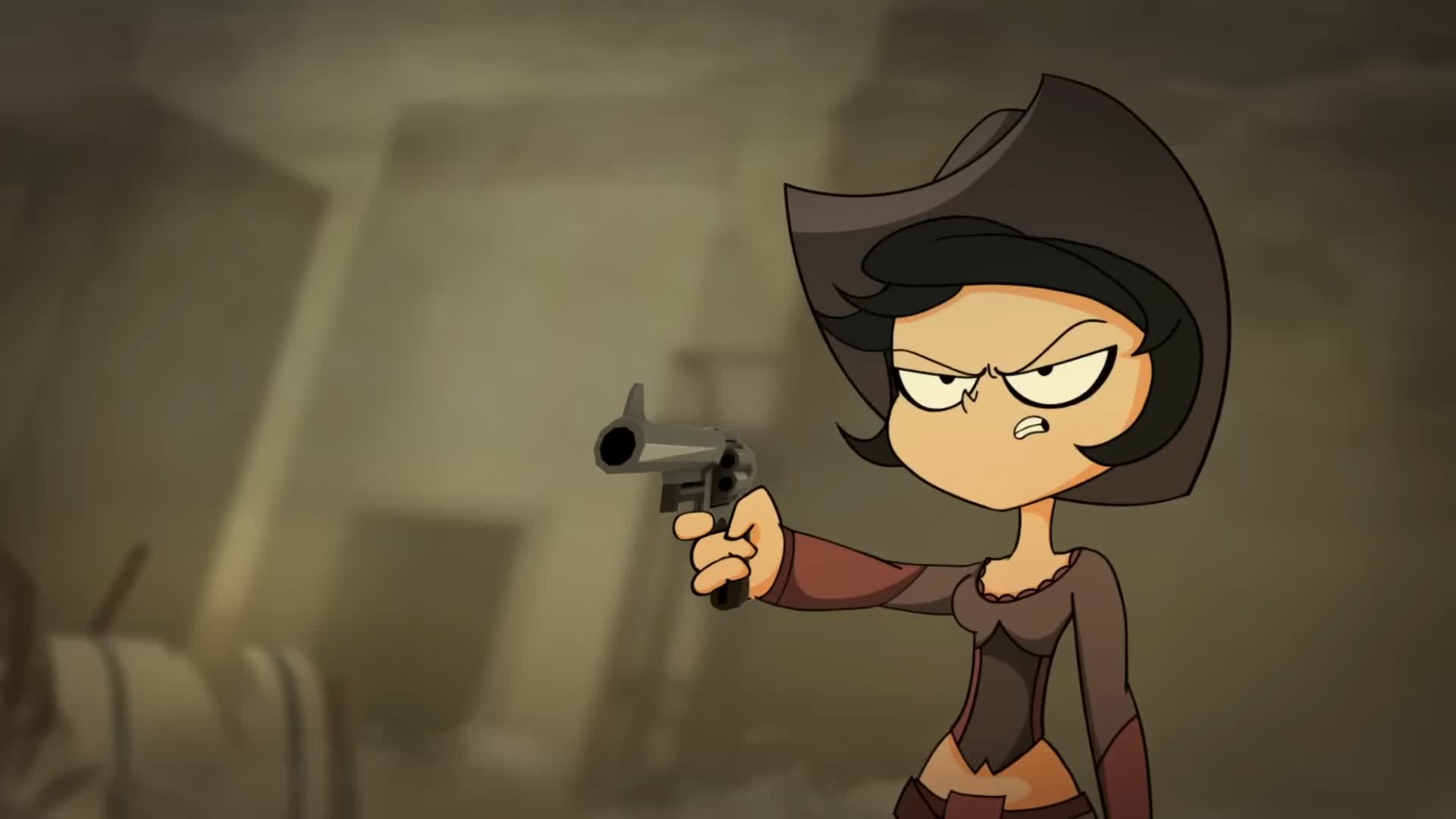
Jo Constance is the town’s calm law officer in CliffSide, the person who tries to keep rules intact while monsters, egos, and cosmic authority tear at them. However, she doesn’t grandstand or trade quips; she organizes, issues clear commands, and protects civilians even when the odds are terrible. Therefore, Jo Constance functions as the series’ human baseline. Her presence proves that the town still believes in procedure and consequence, and her decisions–when to advance, when to accept a surrender, when to get everyone out of harm’s way–show what responsibility looks like in a universe that favors predators and inevitability. In addition, the character frames the pilot’s tonal pivot: she briefly restores the familiar shape of a western standoff, only for the scene to outgrow human jurisdiction the moment Death rides in. As a result, Jo grounds the chaos without softening it; the audience measures danger by how far her authority reaches before the rules change.

Origin and first appearance
However noisy the pilot’s opening becomes, the story introduces Jo Constance with deliberate economy. Then a street showdown forms after Waylon’s swagger and Cordie’s eager devotion inflate a boast into a real bank job. The town needs someone to set terms; she answers, assembling a line of local lawmen and staking out a perimeter with steady posture and unhurried instructions. Next, the sequence invites viewers to expect a classic outcome–warnings delivered, weapons drawn, suspects contained. For example, her clipped “Back off.” resets the crowd and briefly pushes the episode into a familiar genre rhythm in which adults de‑escalate before anyone gets hurt. Consequently, the camera can show how quickly CliffSide punishes optimism. Cordie turns a door into a projectile, the line buckles, and the plan collapses; still, the officer holds the center, taking Cordie’s sudden surrender without gloating or panic. As a result, Jo’s first appearance defines the town’s human layer: level‑headed procedure works–right up until predators or Death decide the scene belongs to them.
Personality and key traits
| Trait | Description |
|---|---|
| Calm pragmatist | Then Jo speaks briefly and acts decisively. She contains chaos with posture and timing rather than speeches, choosing the option that leaves the fewest bodies on the ground. |
| Procedural thinker | However, she believes in perimeters, warnings, and clean arrests. Therefore, her plans look like checklists: establish line, define terms, accept surrender if it keeps civilians alive. |
| Protective ethics | Next, she prioritizes bystanders over pride. If pulling back preserves lives, she does it–no theatrics, no need to win the scene. |
| Dry authority | Meanwhile, the officer’s tone is clipped and professional. As a result, even outlaws treat her commands as real, at least until something bigger changes the weather. |
| Jurisdiction awareness | Finally, she knows when human law ends. Once Death rides in, she stops chasing a win and starts managing damage, which keeps people breathing for the next day. |

Story arcs and development
Arc 1 – “Posse muster: the last normal moment.” Start: A bank robbery coalesces from Waylon’s bluff and Cordie’s devotion, and the town teeters on panic. Then Jo Constance raises a posse, slots shooters, and turns noise into a legible standoff. As a result, the pilot briefly resembles a conventional western: the officer sets the rules, the suspects comply, the crowd stays behind the line. Therefore, this is the final beat where badges and shouted orders look sufficient; the scene demonstrates what CliffSide could be if monsters and metaphysics stayed polite.
Arc 2 – “When physics pick a side.” Start: Cordie treats the standoff as a lesson, catching a bullet with webbing and kicking a door into a spinning ram that detonates the formation. Then the human wall breaks; rank‑and‑file lawmen flee in self‑preservation. As a result, Jo adjusts in real time–she accepts the spider‑girl’s surrender when offered, holsters her pride, and prevents the skirmish from amplifying into a massacre. Consequently, the officer’s brand of courage looks different from cinematic bravado: she wins by keeping the town intact, not by posing over a defeated opponent.
Arc 3 – “Death rides in; law yields the room.” Start: The street quiets as Death appears mounted on Yannis, and the hierarchy of power resettles without a word. Then the officer recognizes the shift; she stops playing for the arrest and starts insulating bystanders from a force that doesn’t negotiate. As a result, human law keeps its dignity–no panic, no futile charge–yet it knowingly steps aside. Over time, this moment becomes the series’ yardstick for scope: when Jo’s practical authority recedes, the story has entered endgame.
Arc 4 – “Civic architecture in a monster town.” Start: Away from the bang‑bang of the pilot’s centerpiece, the character endures as a template for sustainable order: build teams, define roles, accept that some threats outrun procedure. Then fandom and analysis group her with named townsfolk–Jesse Lankman, Dan McJaw, Rustlin’ Bill–to map the human layer that still shows up when called. As a result, Jo’s development is less about personal melodrama and more about institutional resilience; the person becomes a plan, and the plan keeps CliffSide habitable between catastrophes.

Relationships with other characters
| Character / Entity | Role vs. Jo Constance | Dynamics |
|---|---|---|
| Waylon | Volatile minor under watch | She treats the braggart like a walking hazard to himself and others, trimming his room to grandstand and pushing him toward compliance rather than performance. |
| Cordie | Lethal romantic to manage | The officer recognizes devotion under the fangs; she takes Cordie’s surrender cleanly and keeps conditions firm enough to prevent another burst of chaos. |
| Death Itself | Superseding authority | She doesn’t compete with the rider; she pivots to triage when cosmic jurisdiction arrives, a choice that saves lives and preserves dignity. |
| Yannis | Mounted threat to contain | The apex predator becomes the rider’s vehicle; Jo positions people to avoid the creature’s lanes rather than pretending to outgun it. |
| Jesse Lankman | Rank‑and‑file backbone | He embodies the civic layer she counts on; his retreat under monster pressure teaches where human courage ends. |
| Dan McJaw | Posse regular | Another steady hand until physics pick sides; their shared retreat reads as rationality, not failure. |
| CliffSide (the town) | Constituency and burden | The setting needs someone who still believes in lines, warnings, and arrests; Jo bears that weight without theatrics. |

Appearance, symbols, and recurring motifs
Visually, Jo Constance reads as straight‑backed, spare, and practical–built for clarity in a crowded frame. However, the design avoids ornament; a brimmed hat, structured outerwear, holster at the hip, and steady hands telegraph “law officer” faster than dialogue can. Therefore, the character functions as a visual metronome: when she enters, the camera finds a horizon line and the scene’s geography makes sense; when she steps aside, the frame gives itself back to flying debris and predatory angles. Next, gesture economy does most of the storytelling–no flailing, no bravura spins, just the minimal motion required to point, warn, or accept a surrender. As a result, her look doubles as a symbol for procedural sanity in a place that often discards it. Finally, the recurring motif is constraint: short sentences, squared shoulders, and a willingness to holster pride so the town can survive the day.

Fandom and alternative names
- Jo Constance – full name used in character rosters and analyses.
- Jo – shorthand in episode breakdowns.
- Officer Constance – descriptive label emphasizing role over personality.
- Posse leader Jo – tag used when discussing the bank standoff.
- Law officer (CliffSide) – catalog phrasing for non‑speaking or brief‑speaking roles.
- Джо Констанс – common Russian transliteration in localized write‑ups.
- Town constable Jo – fan shorthand that underscores procedure and restraint.
Interesting details and quotes
- Function over flair: the character anchors geography and tone; her entrance signals that adults are trying to assert rules before the frame escalates.
- Non‑showy command: she issues brief directives and lets posture do the persuasion, which keeps scenes moving without speechifying.
- De‑escalation choice: accepting a clean surrender from a dangerous opponent prevents civilians from becoming statistics.
- Human scale vs. monsters: the officer’s retreat is strategic, not humiliating; she knows when the conflict has left civic hands.
- Team as tool: named townsfolk like Jesse Lankman and Dan McJaw form the repeatable backbone for her approach–show up, hold a line, survive.
- Genre clarity: the standoff starts as a classic western beat and becomes a CliffSide lesson about power; her conduct bridges both modes.
Back off.
– a clipped command that sums up her style: minimal words, maximum effect.I’m Two‑Bit Jerry! A gunslinger and an outlaw!
– Waylon’s boast that forces her to treat a child’s performance as a civic problem.