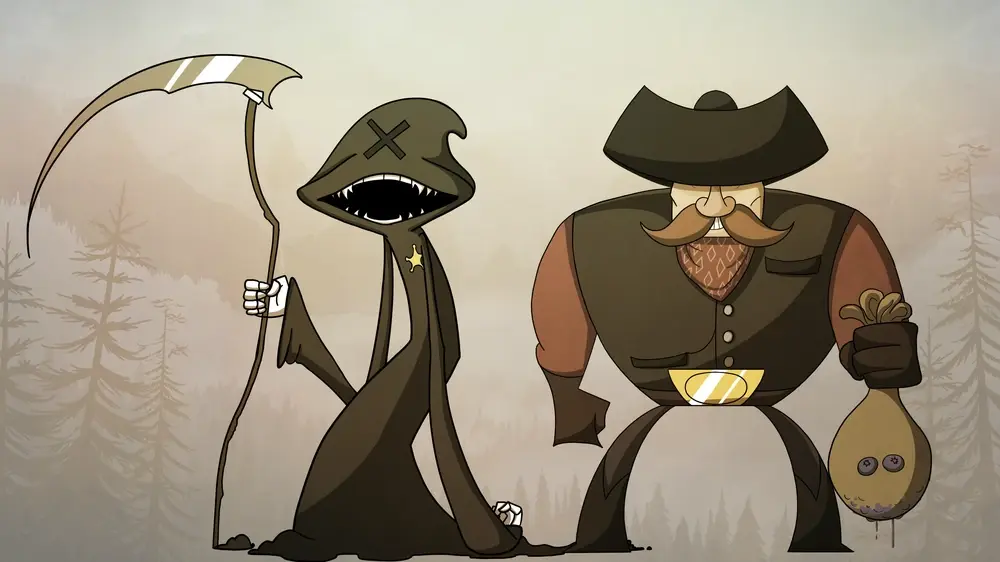
Blueberry Bill is an unseen outlaw in CliffSide who shapes the story more from the wings than the stage. He is not a rumor or a throwaway note: he is still identified as Waylon’s father and as the architect of the failed train heist that pushed the boy toward exile. That makes him less an absent extra than a structural force–the man who explains why bravado, guilt, and consequence keep colliding in the series.
That family link matters because Waylon is built out of performance. He talks like a legend, postures like a killer, and keeps discovering that neither act nor appetite can replace competence. Blueberry Bill gives that mismatch a source: the boy’s outlaw identity is inherited theater, not hard-earned authority.
The wider CliffSide character index makes his place in the mythology even clearer. Bill sits there beside the pilot’s visible cast and the setting’s unseen creatures alike, which reinforces that he is not discarded draft material; he is part of the world’s documented pressure system, an offscreen criminal whose decisions still bend the story.
Origin and first appearance
However contradictory it sounds, Blueberry Bill’s first appearance still happens in backstory and development lore rather than in the pilot’s frames. The chain of events is precise: Bill and Waylon attempt a train heist to steal a mysterious crate, the plan collapses, and the father bolts with the goods while leaving his son behind to absorb the fallout. Because Waylon is too young for the gallows, he is sent away instead, and the town becomes his punishment.
That punishment matters because the place that receives him is already defined by people like Jo Constance, whose calm competence exposes every bad lesson Blueberry Bill taught. Waylon does not stumble into a romantic outlaw frontier; he lands in a town where responsibility is real, witnesses remember, and swagger is only impressive until somebody has to clean up after it.
One of the cleaner bits of modern lore housekeeping is the distinction between Blueberry Bill and Rustlin’ Bill. The similarity in names once invited confusion, but the roles are sharply different: Blueberry Bill belongs to Waylon’s unseen family backstory, while Rustlin’ Bill is one of the visible local lawmen trying to keep public order from collapsing.
That separation also sharpens the civic side of the setting. The profile for Jo’s posse makes it easier to see the kind of world Bill dumped his son into: a rough frontier community that still tries to answer danger with badges, revolvers, and improvised lines of authority, even when monsters and panic keep proving how fragile those rituals are.
In practical canon terms, Blueberry Bill remains a lore character rather than a retroactively promoted on-screen antagonist. His status is unusually stable: the world keeps defining what he did, why it matters, and how it damaged Waylon, yet it still refuses to cash that history out as a direct scene or confrontation.
Personality and key traits
| Trait | Description |
|---|---|
| Manipulative pragmatist | He treats people, including his own son, as expendable tools. The heist matters less to him than survival and profit, so family loyalty collapses the moment danger becomes expensive. |
| Absent yet central | He never appears on screen, but his decisions drive the pilot’s premise and keep shaping how Waylon behaves. Blueberry Bill is pure cause without visible presence. |
| Old-West traditionalist | His brimmed hat, scarf, vest, holster, and heavy silhouette give him the clean outline of a classic outlaw. He represents the franchise’s western inheritance more directly than its monster comedy. |
| Documented offscreen figure | Even while remaining unseen, he stays fixed inside the public lore. That status makes him feel less like a dropped idea and more like a deliberate offscreen engine. |
| Family foil | Positioning him as Waylon’s father reframes the protagonist’s bravado as learned behavior. Every boast starts to sound like a child repeating the style of a man who never taught him restraint. |
| Signature prop humor | The blueberry satchel doubles as gag and brand. It turns a petty appetite into a memorable calling card and keeps the character suspended between threat and absurdity. |
Story arcs and development
Arc 1 – Train heist fallout: how a father makes a fugitive
The first and most important Blueberry Bill arc is the one he never physically appears in. He targets the sealed crate, uses Waylon’s hunger for approval as labor, and disappears the instant the job becomes dangerous. That betrayal writes the pilot’s starting wound in one stroke: the son keeps the humiliation, the father keeps the loot, and the exile becomes the real sentence.
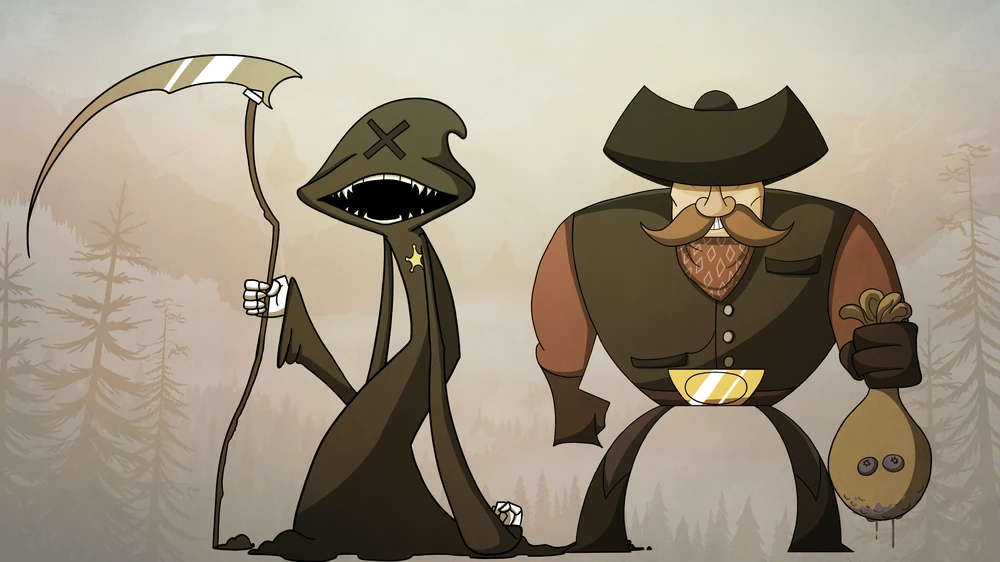
Early design material pairing Blueberry Bill with Death suggests that the project once entertained a version of CliffSide where human villainy and cosmic menace might share the antagonist load. The finished balance is cleaner. Bill becomes the origin of the damage, while Death becomes the force that makes excuses, hierarchy, and bluffing feel meaningless once the story hits its coldest register.
Arc 2 – Outlaw theater passed down the wrong way
A small but revealing echo of Bill survives in Sheriff Pinecone, the toy lawman inside Waylon’s make-believe train scene. That joke reduces outlaw mythology to literal playacting, which in turn makes Blueberry Bill’s influence feel sadder rather than bigger: the boy is still rehearsing a fantasy of robbery and pursuit instead of learning how to survive the town he was sent to.
Blueberry Bill’s absence also reframes Cordie. She is not his replacement, but she does exploit the same weak point: Waylon wants his persona believed. Bill used that need to stage a crime; Cordie uses it to turn outlaw talk into escalating real-world consequences. In both cases, the boy pays for taking performance too seriously.
Arc 3 – Legacy over presence
The wider menace of the town makes Bill’s betrayal harsher in retrospect. Once creatures like Yannis enter the frame, it becomes obvious that Waylon was not abandoned into ordinary frontier hardship; he was dropped into a place where local power already exceeds anything a petty train outlaw can control.
Even the pilot’s street-level threats strengthen that reading. The Wendigos establish CliffSide as a setting where bad timing, loud talk, and shaky aim can become a full public emergency in seconds. Bill did not just fail as a father; he sent a boastful, undertrained kid into a town where a single mistake can become a swarm problem.
The released pilot also benefits from staying lean. The credited ensemble on the CliffSide voice cast page remains compact, which makes Blueberry Bill’s invisibility feel like a structural choice rather than missing content: the episode lets other characters carry the sound and conflict while Bill survives as pressure in Waylon’s behavior.
Current place in the wider lore
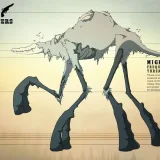
The broader bestiary has only made Blueberry Bill more interesting by comparison. The lore around Migrants expands the danger scale from town shootouts to seasonal megafauna, which means the place Bill abandoned his son to is no longer just quirky and violent; it is ecologically hostile on a valley-wide scale.
The same widening effect comes from unseen predators like Sirens, whose threat profile shifts the series from claws and gunfire toward manipulation, imitation, and ego. That makes Blueberry Bill feel even more thematically at home in CliffSide, because his favorite weapon was never brute force alone–it was persuasion aimed at somebody who wanted to be chosen.
With Poltergeists, the setting goes further still, into reality-warping danger that attacks perception itself. In that context, Blueberry Bill becomes the most human-scale version of a larger rule the series keeps repeating: confidence means very little in a world that can lie to your eyes, your instincts, and your sense of control.
Other unseen predators, including Chupacabras, reinforce the setting’s habit of pairing survival with deceit. Blueberry Bill belongs comfortably in that company. He is not a monster species, but his lying, baiting, and strategic abandonment make him function like one human note in CliffSide’s wider ecology of predation.
Even draft-oriented material such as Ares helps clarify why Blueberry Bill works better as absence than as a speaking co-villain. The franchise’s development history appears to have trimmed and redistributed menace until the cleanest emotional line remained: a father’s selfishness starts the story, but the town and its forces finish the lesson.
The result is a rare kind of cult-lore character: the more the world around CliffSide gets mapped, the more precise Blueberry Bill becomes. He is still absent, still voiceless, and still unrevealed in motion, but the surrounding cast and bestiary now make his narrative job easier to read.
Relationships with other characters
| Character / Entity | Role vs. Blueberry Bill | Dynamics |
|---|---|---|
| Waylon | Son | Bill’s betrayal during the train heist pushes Waylon into exile and cements his habit of overcompensating; the relationship is the story’s invisible wound. |
| Jo Constance | Pragmatic counterweight | She treats Waylon firmly because she understands what reckless mentorship produces. Bill’s parenting explains why Jo’s skepticism lands as necessary, not cruel. |
| Cordie | Catalyst and mirror | Her adoring brutality mirrors Bill’s selfishness from another angle: where the father used the boy for profit, Cordie weaponizes the boy’s self-image for chaos. |
| Death | Tonal replacement | The cosmic figure inherits dramatic weight that an on-screen human outlaw might once have carried, trading outlaw patter for inevitability and dread. |
| Yannis | Predatory backdrop | Creature threats like Yannis define the ecosystem Bill dumped his son into; his choices place Waylon under pressures far larger than one failed robbery. |
| Rustlin’ Bill | Name confusion only | A separate on-screen lawman with a similar name; mixing them up muddies the lore, so keeping the distinction explicit matters. |
| CliffSide | Consequence | The town is Bill’s longest-running off-screen relationship. By sending Waylon there, he keeps dictating danger without ever needing to return. |
Appearance, symbols, and recurring motifs
Visually, Blueberry Bill’s concept art presents a burly man with a broad frame, a big nose, and a brown mustache under a brimmed black hat that shadows his eyes. The wardrobe does as much storytelling as the silhouette: a red scarf, dark-brown vest over a red shirt, heavy gloves, a wide belt with a gold buckle, and dark trousers and boots read as practical outlaw kit rather than romantic frontier glamour. The most memorable prop remains the blueberry bag, which works as visual punchline and brand stamp at once. Set beside Death in early art, Bill symbolizes a clean axis of mortal greed against metaphysical authority, and that pairing keeps his design legible even without a single finished scene.
Fandom and alternative names
- Blueberry Bill – standard name in character lists and concept captions.
- BB – common shorthand in community discussion.
- Waylon’s father – descriptive alias used in bios and relationship tables.
- Unseen outlaw – status label reflecting his off-screen role.
- Documented unseen figure – a useful description for modern profile and index pages.
- Голубичный Билл – frequent Russian localization of the name.
- Blueberry Bill (original design) – tag for concept-art variants paired with Death.
Interesting details and quotes
- He is still treated as an unseen, unreleased-content figure, which explains the lack of voice credit, transcript lines, and direct pilot footage.
- The backstory ties him to a failed train heist and a mysterious crate; abandoning Waylon remains the cleanest origin for the boy’s exile.
- The broader lore around CliffSide makes that betrayal harsher, because the town is now easier to read as a place of civic fragility, monster pressure, and larger unseen threats.
- Early concept art pairing Blueberry Bill with Death suggests that the project once considered a more conventional outlaw antagonist before leaning harder into cosmic menace.
- The pilot itself premiered on May 20, 2018, and the released public footprint still traces back to that foundational installment rather than to a later on-screen return for Bill.
- Liam Vickers is the creator, writer, director, and animator most closely associated with the pilot, and he also voices Waylon; the compact credited cast helps explain why Blueberry Bill functions best as backstory pressure rather than another speaking role.
- The broader credited ensemble centers on Tess Rimmel as Jo, Joelle Jacoby as Cordie, and Carolyn DiLoreto as Yannis, which leaves Bill’s influence to travel through other performances instead of through his own scenes.
- The blueberry satchel remains his cleanest visual signature–instantly readable, mildly ridiculous, and memorable enough to survive without animation.
It was me! I’m Two-Bit Jerry! A gunslinger and an outlaw!
– Waylon’s boast lands differently once you know who taught him to treat outlaw style like identity.I once shot a man just fer lookin’ at me wrong!
– the tall tale sounds less like confidence than inherited outlaw theater.