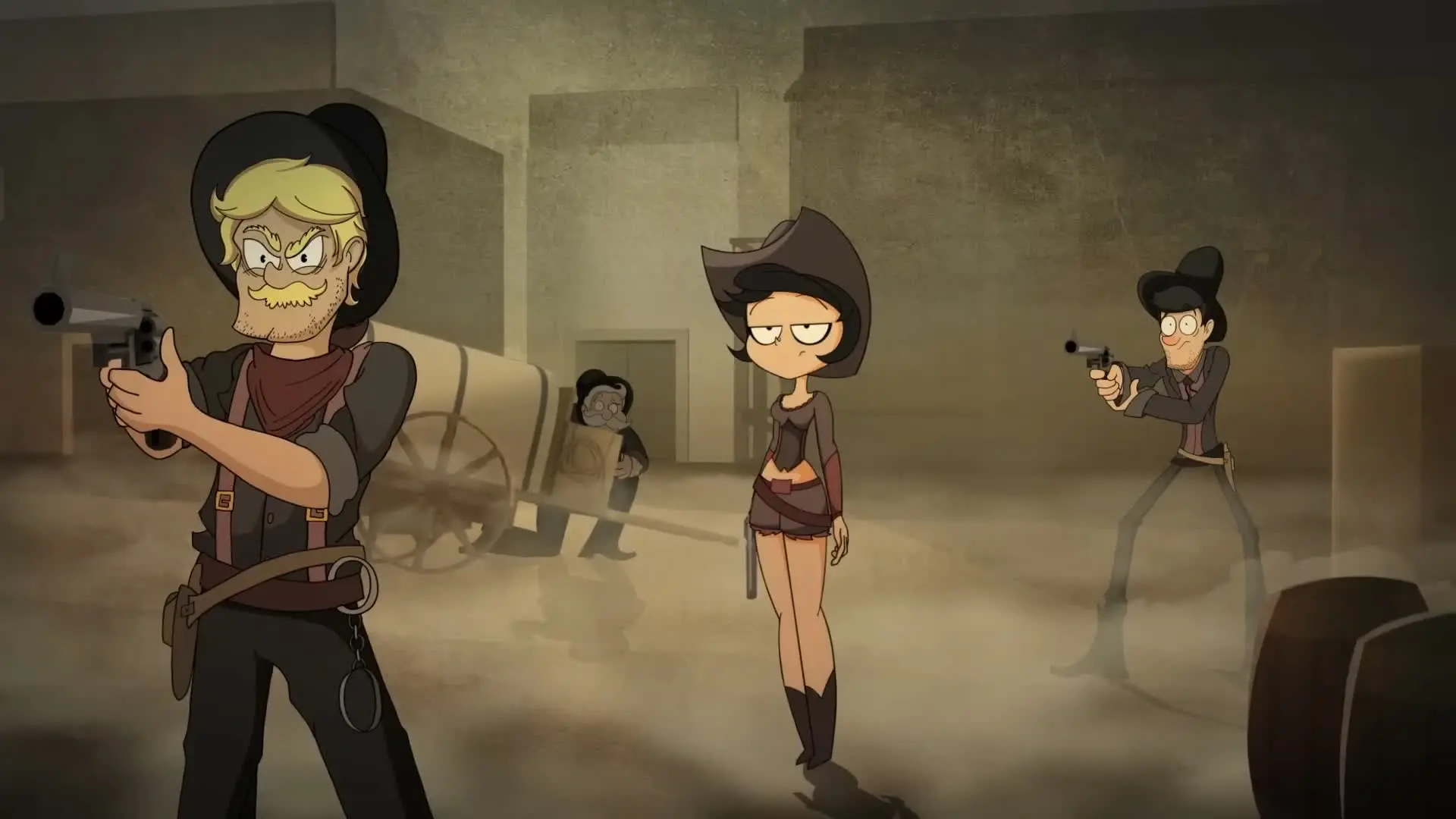
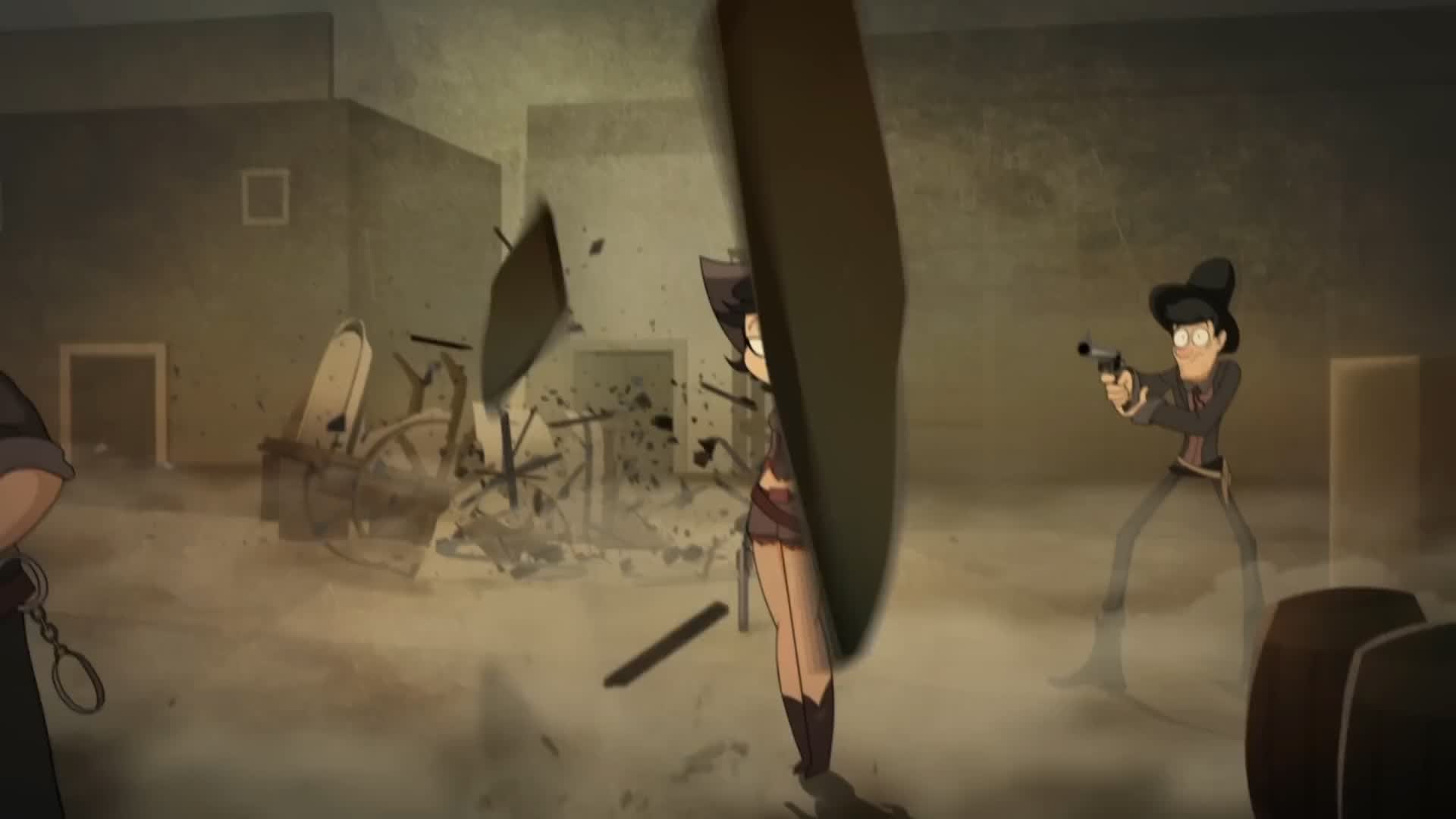
Jesse Lankman is a minor law enforcer in CliffSide who helps define how ordinary people behave when monsters, outlaws, and cosmic forces collide. He never speaks and never gets a hero beat; instead, the character lives through framing–he joins Jo Constance’s hastily raised posse during the bank crisis and then gets blasted out of formation when Cordie turns street furniture into weapons. That makes Jesse a tonal yardstick for the pilot: his presence proves there is still a civic reflex in town, and his retreat proves how quickly human order buckles under superhuman pressure.
That function has only grown clearer as the surrounding CliffSide cast materials continue to frame the pilot as a tightly built ensemble piece. The core spoken triangle belongs to Waylon, Jo, and Cordie, while Jesse remains deliberately voiceless; as a result, his black hat, gray coat, purple vest, and holstered revolver do almost all the storytelling the moment he enters the frame. In a pilot that runs only about eleven minutes, that kind of clean visual economy matters.
Personality and key traits
Within Jo’s posse, Jesse is less an individual subplot than a readable civic marker. He tells the audience that CliffSide still has townsmen willing to form a line when a bank goes hot, even if the line will not hold for long.
| Trait | Description |
|---|---|
| Civic-minded | Jesse answers Jo’s call without grandstanding. He takes his place in the firing line and signals that CliffSide still believes in gathering a posse before it draws blood. |
| Human-scale realist | When Cordie weaponizes a door and the air fills with debris, he retreats with the others. He models rational fear rather than martyrdom. |
| Non-speaking presence | The pilot gives him no dialogue and no reaction-heavy subplot. Consequently, he reads as a clear visual node–“town law”–instead of a detour. |
| Readable silhouette | The black hat, gray coat, purple vest, and holstered sidearm make him easy to track during busy crowd shots, which keeps the scene’s geography clean. |
| Alive, still around | His status remains alive after the chaos, implying that human institutions survive in CliffSide even if they lose ground whenever monsters show up. |
Story arcs and development
Jesse’s whole arc makes sense in relation to Waylon, because Waylon’s outlaw playacting is what turns background danger into a public crisis. Jesse enters the story only when somebody has to answer that performance with real law, real guns, and a real perimeter.
Arc 1 – “When law remembers its job.”
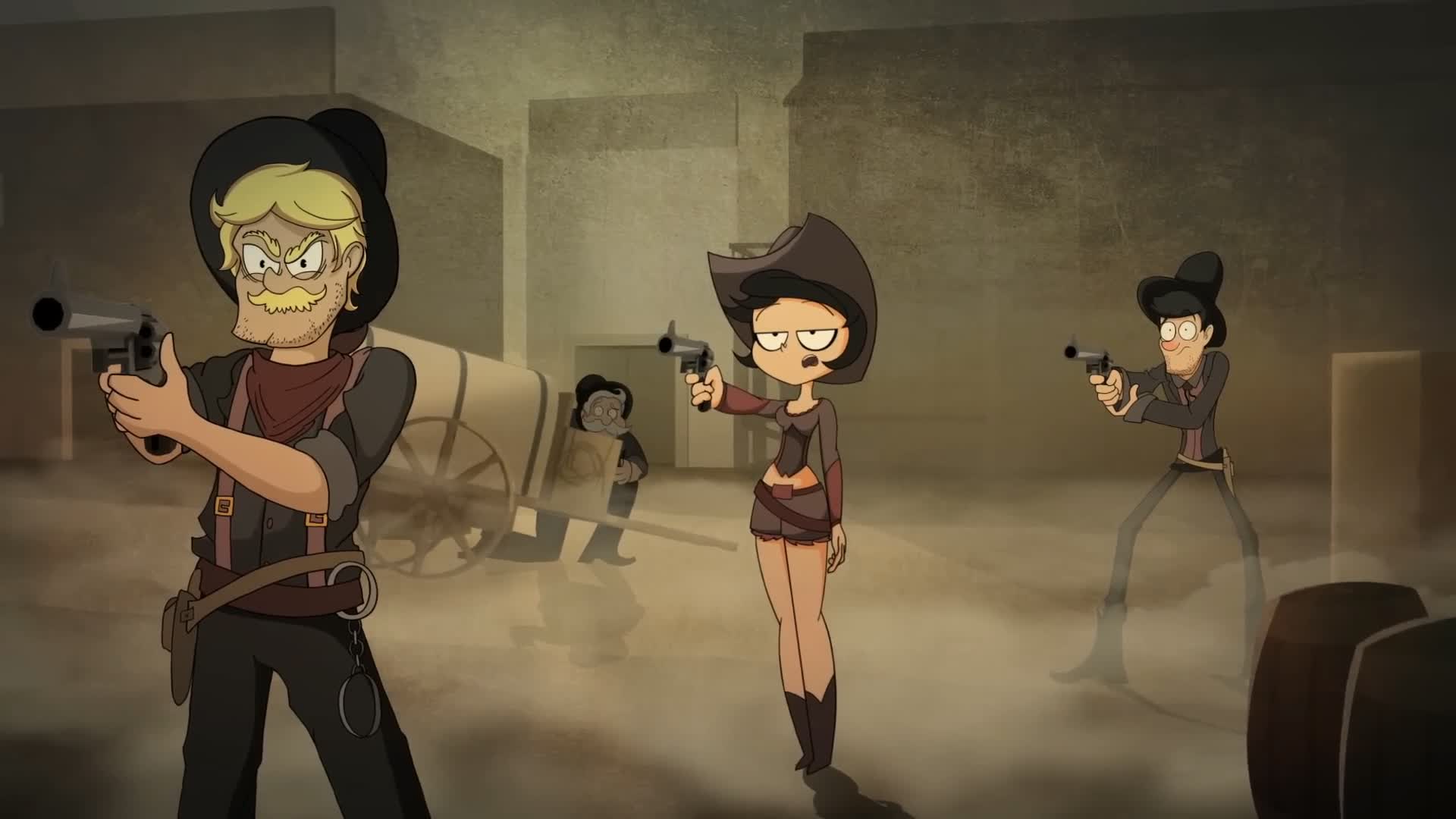
The bank scene begins to resemble a conventional Western once Jo Constance starts organizing bodies, issuing commands, and pushing armed locals into position. Jesse matters here because he sells the brief illusion that procedure might work: stand back, hold the street, aim steady, wait for the robber to fold.
That illusion is the adult answer to the toy-law fantasy embodied elsewhere by Sheriff Pinecone. Jesse is not a prop in Waylon’s imagination; he is the version of law that shows up when the joke has consequences, and that distinction gives his brief entrance surprising weight.
Arc 2 – “Wood beats will.”
The second arc belongs to Cordie, who treats the siege like a game and instantly rewrites the fight’s physics. Webs catch bullets, a kicked door becomes a projectile, and Jesse gets launched backward with the rest of the human wall, turning brave posture into slapstick retreat.
That beat also links him to Dan McJaw and the other named volunteers: they are not cowards so much as proof that normal people respond normally when the architecture itself starts attacking them. Jesse’s curve is therefore clean and memorable–muster, impact, exit.
Arc 3 – “Death enters; civilians exit.”
Once Death arrives, the episode stops pretending that human enforcement can own the scene. Jesse does not come back for that standoff, and the absence feels correct; the conflict has moved out of municipal hands and into a colder hierarchy.
The same handoff is reinforced by the arrival of Yannis, whose scale and menace push the action beyond a street-level shootout. By then, Jesse’s job is done: he has already shown where local law ends and where the pilot’s metaphysical frontier begins.
Arc 4 – “From face in the line to fandom’s baseline.”
After the pilot, Jesse is most often remembered alongside Rustlin’ Bill and the rest of the town’s human enforcement layer. That memory keeps him useful in fandom and character roundups: he is the sort of figure viewers point to when they want to describe CliffSide’s baseline courage before monsters take over the frame.
He also remains easy to place inside the broader CliffSide character index, where the contrast between ordinary lawmen, apex predators, and unseen creatures is especially sharp. Jesse’s “development” is archival rather than dramatic, but that archival afterlife suits a cameo built on clarity.
Relationships with other characters
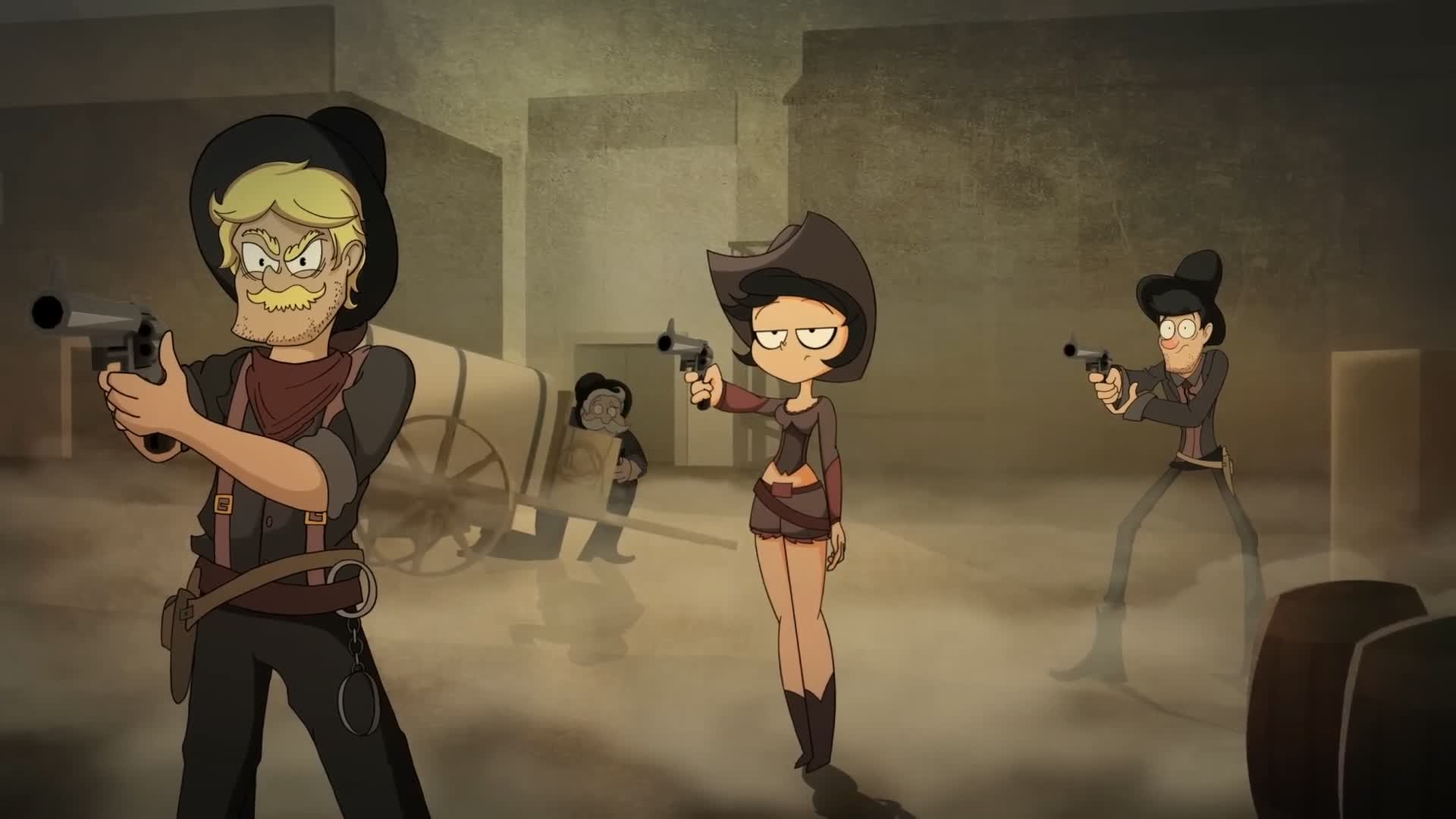
Even in a setting crowded with unstable authorities and half-joking law imagery, Jesse reads as part of a functional civic chain rather than a mascot. His place inside the posse defines him: he shows up when called, follows Jo’s lead, and disappears once the situation leaves the range of ordinary enforcement.
| Character / Entity | Role vs. Jesse Lankman | Dynamics |
|---|---|---|
| Jo Constance | Commander | She summons the posse and sets the rules of engagement. Jesse follows her lead until Cordie’s escalation shatters the line, after which Jo pivots to damage control. |
| Cordie | Immediate threat | Her door-and-web barrage turns the street into a pinball table. Jesse is literally thrown out of the fight, which frames her as a one-woman demolition crew. |
| Waylon | Indirect catalyst | The kid’s outlaw bravado lights the fuse that puts Jesse on the street. His boasts become the reason ordinary law must test itself and then retreat. |
| Death | Superseding authority | Once the rider arrives, human enforcement yields. Jesse’s disappearance from the frame signals the moment the conflict leaves civic hands. |
| Dan McJaw | Fellow posse member | They share the same arc–present for the muster, absent for the endgame–representing the town’s baseline courage and its rational survival instinct. |
| Rustlin’ Bill | Fellow posse member | Another recognizable townie in Jo’s line; together with Jesse he rounds out the “everyman law” image the pilot needs before it escalates. |
| CliffSide (the town) | Employer and crucible | The setting relies on citizens like Jesse to maintain a veneer of order, which makes their retreat an honest admission of the town’s true food chain. |
Appearance, symbols, and recurring motifs
Jesse telegraphs “town law” in one glance: black hat, dark hair, long gray coat, purple vest, black pants, boots, revolver. That grounded silhouette matters even more in a world whose outer edges include unreleased threats like Poltergeists; the stranger the bestiary gets, the more valuable a plain human outline becomes.
He is equally useful against the pilot’s on-screen rush of violence from Wendigos and other creatures that make the town feel one bad minute away from collapse. Jesse’s clothes do not just identify a person–they preserve visual geography, giving the audience a stable human landmark before chaos scrambles the street.
That readability also future-proofs the cameo against the wider lore, where manipulative, off-screen dangers such as Sirens expand the world beyond what the pilot can physically show. Jesse stays memorable precisely because he is simple, terrestrial, and instantly legible.
Production and canon context
The pilot’s compact production logic helps explain why Jesse works so well. The broader canon now includes concept-adjacent figures like Ares, but Jesse belongs to the cleaner core of what actually lands on screen: a named townsman, one sharp gag, one clear tactical failure, and a lingering impression that human law is trying its best.
That impression becomes even stronger when set against species pages for Chupacabras and other predators that make CliffSide feel older, meaner, and more layered than its runtime suggests. Jesse does not need extra lore to stay relevant; the expanding monster ecology makes his plainness more useful, not less.
The same is true of unseen categories like Migrants, which broaden the setting far beyond the bank and main street. In that larger canon, Jesse remains a baseline figure–the kind of human presence the series can place in a crowd whenever it needs to remind viewers what normal still looks like.
Fandom and alternative names
Because CliffSide’s crowd scenes are so readable, even brief lawmen develop a second life in discussion threads and recap culture. Jesse’s utility grows when fans compare him to louder airborne or predatory threats such as the Terror Birds: he marks the moment when a scene is still operating on human terms.
- Jesse Lankman – the full name used in character rosters.
- Jesse – shorthand in episode breakdowns.
- Lankman – surname used when listing Jo’s lineup.
- Posse regular – descriptive tag for his role during the bank siege.
- Non-speaking cameo – catalog note that explains his silent presence.
- Джесси Ланкман – common Russian transliteration in localized summaries.
- Town lawman – fan descriptor emphasizing human scale.
Interesting details and quotes
As a supporting figure, Jesse benefits from the pilot’s unusually precise staging. One silent lawman in a well-placed coat can do a great deal of work in a world that swings from grounded street trouble to cosmic absurdity in seconds.
- First episode: Pilot; voice: none; status: alive; affiliation: Jo’s posse; occupation: law enforcer.
- The CliffSide pilot premiered on May 20, 2018 and runs roughly eleven minutes, which helps explain why Jesse is built almost entirely through staging rather than dialogue.
- Liam Vickers is credited as creator, director, writer, and animator, with Jesper Ankarfeldt on score.
- The principal spoken roles around Jesse are Liam Vickers as Waylon, Tess Rimmel as Jo, and Joelle Jacoby as Cordie, while Jesse himself has no credited voice.
- His most visible action is involuntary: a door-launched projectile sends him flying, a gag that doubles as a lesson in CliffSide physics.
- The costume–black hat, gray coat, purple vest–exists to be readable in chaos; it is a design choice that makes his flight easy to track.
- He carries a revolver but never gets a clean draw, underlining how verbal escalation and monster speed erase fair-fight expectations.
- Grouped with Dan McJaw and Rustlin’ Bill, he forms a trio fandom uses to map the town’s human layer under Jo’s practical leadership.
- Because he never speaks, editors can use him as a visual function: prove law exists, then prove it cannot win–not without help from forces beyond it.
Wut in TARNATION is goin’ on?
– Jo’s flare of anger when the bank mess suddenly becomes personal.Spider girl isn’t coming.
– Jo reasserts procedure once the larger supernatural crisis has passed.I’m Two-Bit Jerry! A gunslinger and an outlaw!
– Waylon’s swaggering self-brand that indirectly sends Jesse to the bank.No it wasn’t… it was horrifying… I’m going to eat you now.
– Cordie’s cheerful threat style, the ::contentReference[oaicite:2]{index=2} nergy Jesse’s line simply cannot counter.