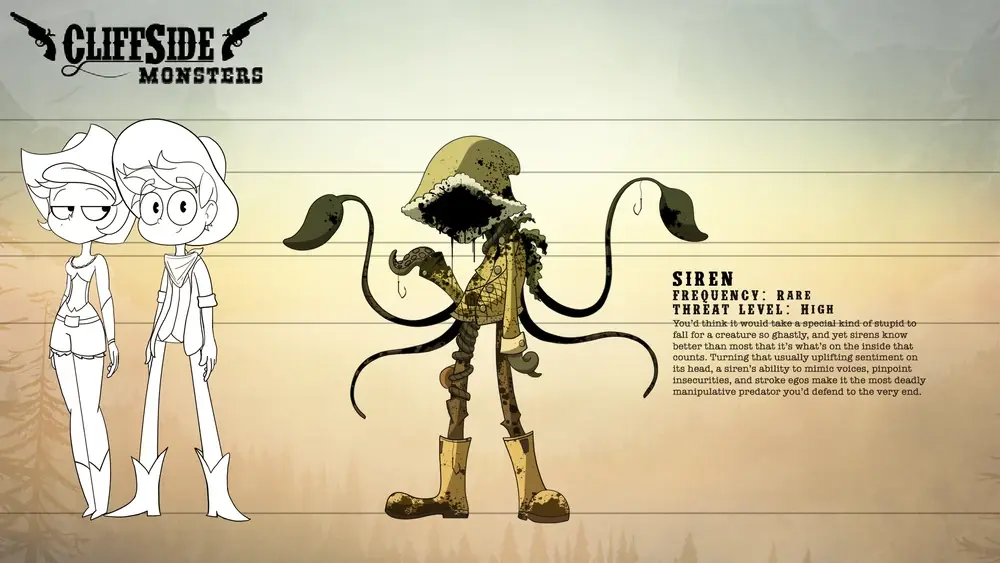
Sirens are an unseen predator species in CliffSide. However, the show never features them on‑screen in the pilot; instead, the creator’s notes and a concise “Liam’s Description” present them as rare, high‑threat manipulators that weaponize imitation and flattery. Therefore, the species functions as a psychological hazard rather than a brawler: they mimic voices, locate insecurities, and stroke egos until a victim will “defend [them] to the very end,” reframing the town’s danger from claws to conversation. In addition, the entry classifies them as an unseen presence from the monster‑infested areas surrounding the town of CliffSide, which sits in Yosemite Valley; that geography matters because the series often contrasts bustling street gags with wilderness threats just off‑camera. As a result, Sirens expand the show’s thematic range–where a joke about narration can become a survival risk once a creature copy‑pastes your voice and tells your friends exactly what they want to hear.
Personality and key traits
Then, because the material compresses into distinct beats, a table communicates it best without fragmenting the prose style.
| Trait | What it means in practice |
|---|---|
| Voice mimicry | They reproduce familiar voices convincingly, inviting impersonation, false alibis, and baited ambushes. In a town that plays with narration, that ability is explosive. |
| Ego exploitation | They pinpoint insecurities and stroke egos, turning compliments into shackles. Targets may actively defend the predator that is grooming them. |
| Rare but lethal | The classification pairs low frequency with high threat, implying event‑episode usage: few sightings, huge consequences. |
| Unseen presence | Everything known comes from creator notes and art rather than aired footage, which bakes rumor and hearsay into their design. |
| Peripheral habitat | They occupy the areas surrounding CliffSide, aligning them with off‑street encounters on roads, cliffs, or woods near the Yosemite setting. |
Story arcs and development
Arc 1 – From physical horror to social horror
Start: The pilot stakes its tone on visible danger–a Wendigo incident in town, complete with replication and a gag where a monster reacts to Waylon’s voiceover. Then: the Sirens entry pivots the franchise into psychological terrain by making manipulation, not mauling, the point of contact. As a result, the world of CliffSide reads bigger and meaner: townsfolk can kill a creature with bullets yet still lose to a voice that flatters them into opening the wrong door.
Arc 2 – Infiltration and the trust economy
Start: The core ability–credible voice mimicry–immediately threatens the town’s trust networks, from posse coordination to “who’s actually talking to me right now.” Then: because the species couples imitation with ego stroking, the trap doesn’t need speed or claws; it just needs a target with pride or doubt. As a result, Sirens serve as plot engines for mistaken identity, baited reconciliations, and heists undone by the sweetest‑sounding lie in the room–stories that fit a western‑comedy where bravado and banter already run hot.
Arc 3 – Unseen status as suspense
Start: Their classification as unreleased and unseen teaches audiences to fear them without a single on‑screen encounter. Then: that absence invites the show to weaponize sound design–calls from the canyon, a partner’s voice past the lantern, a plea from behind thin walls. As a result, the species sits ready for a bottle episode or night‑time lockdown, where characters must verify identities in the dark and the punchlines arrive with a shiver rather than a gunshot.
Arc 4 – Worldbuilding alignment with setting
Start: Location notes place CliffSide inside Yosemite Valley, with a monster‑infested forest and rail lines beyond town. Then: Sirens’ “surrounding areas” habitat slots neatly into that geography–waystations, timber routes, and cliff roads become ambush theaters. As a result, the species underlines the frontier premise: civilization is one street wide, and the moment you step off it, the wilderness tests not your aim but your judgment.
Relationships with other characters
| Name | Role vs. Sirens | Dynamics |
|---|---|---|
| Waylon | Protagonist vs. manipulative predator | His outlaw bravado and narrating habit make him a prime mark; a flattering imitation could lure him into risk before he realizes the voice isn’t real. |
| Jo | Partner vs. confidence gamer | Her pragmatism contrasts with ego bait; a focus on proof and procedure would counter a Siren’s attempts to divide the crew. |
| Cordie | Ally vs. psychological predator | The spider‑girl embodies physical predation, while this species attacks cognition; together they map the show’s food chain across body and mind. |
| Death | Sheriff vs. infiltrator | As law in CliffSide, he would read voice mimicry as a public‑order hazard, because false commands and witness statements can implode cases. |
| Wendigos | Other monster vs. Sirens | Wendigos replicate and attack en masse; Sirens work one mind at a time. The contrast ranks threats across spectacle and subtlety. |
| Poltergeists | Unseen vs. unseen | Both are cataloged as unseen; one warps perceptions of reality, the other weaponizes social cues. Together they sketch the franchise’s metaphysical tier. |
| CliffSide (location) | Town vs. surrounding predators | Because the town sits in Yosemite Valley, any voice on the trail or along the tracks becomes suspect once Sirens are in play. |
Appearance, symbols, and recurring motifs
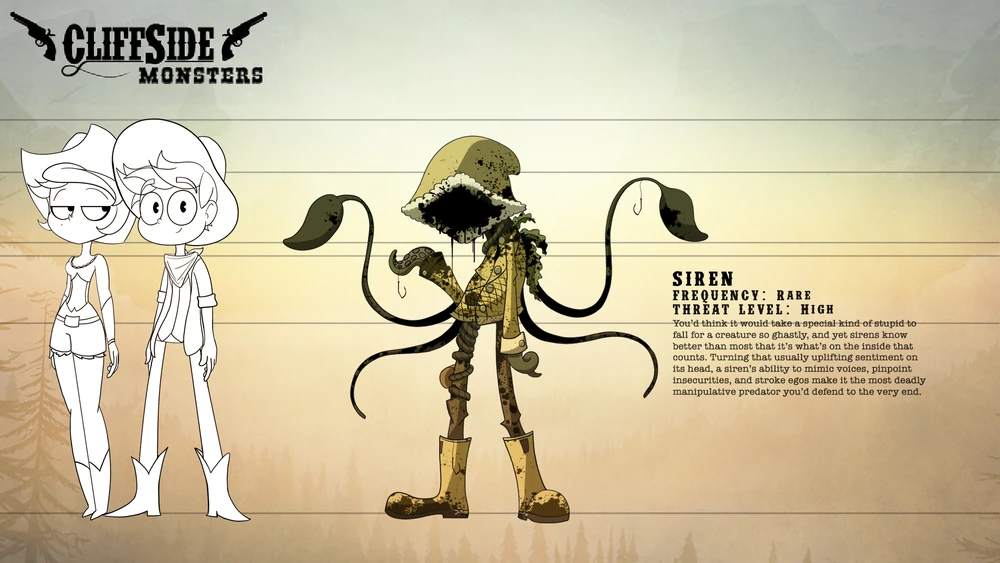
Visually identifying Sirens remains deliberately vague; the description calls them “ghastly” but foregrounds method over looks. Then, the species’ iconography reads as sonic and social rather than anatomical: echoes in canyons, a friend’s perfect timbre from just out of sight, a compliment that lands too precisely on a sore spot. In addition, their rare frequency paired with high threat suggests the show would deploy them sparingly, turning each encounter into an exercise in verification–passwords at doors, cross‑checks in the dark, and comedic bits that double as tests of trust. As a result, Sirens travel with motifs the series already uses well: talky characters, unreliable narrators, and scenes where a voice off‑screen changes the game long before a body enters frame.
Fandom and alternative names
- Sirens
- Siren (singular)
- Unseen Sirens (category shorthand)
- Sirens (CliffSide)
- Unreleased content (label)
- Сирены (Russian)
- Сирена (Russian, singular)
Interesting details and quotes
- The entry explicitly marks the species as unreleased content and unseen, so current details come from creator‑provided material rather than broadcast episodes.
- Classification lists Frequency: Rare and Threat Level: High, hinting at low‑count but high‑impact encounters.
- Sirens are said to inhabit the areas around CliffSide, grounding them in the Yosemite Valley wilderness that borders the town.
- The pilot’s Wendigo sequence includes a monster reacting to Waylon’s voiceover–proof that in this setting, voices themselves can be compromising.
- The gallery associates Sirens with a “Monsters Page” concept plate, aligning them with the broader bestiary developed for the show.
- The franchise catalogs multiple unseen species (for example, Poltergeists and Migrants), placing Sirens on the psychological end of that spectrum.
- Because the series remains inactive, Sirens continue to live in lore rather than aired canon, which amplifies their mystique.
A siren’s ability to mimic voices, pinpoint insecurities, and stroke egos
defines them as consummate manipulators.You’d think it would take a special kind of stupid to fall for a creature so ghastly…
flips a feel‑good trope into a horror setup.