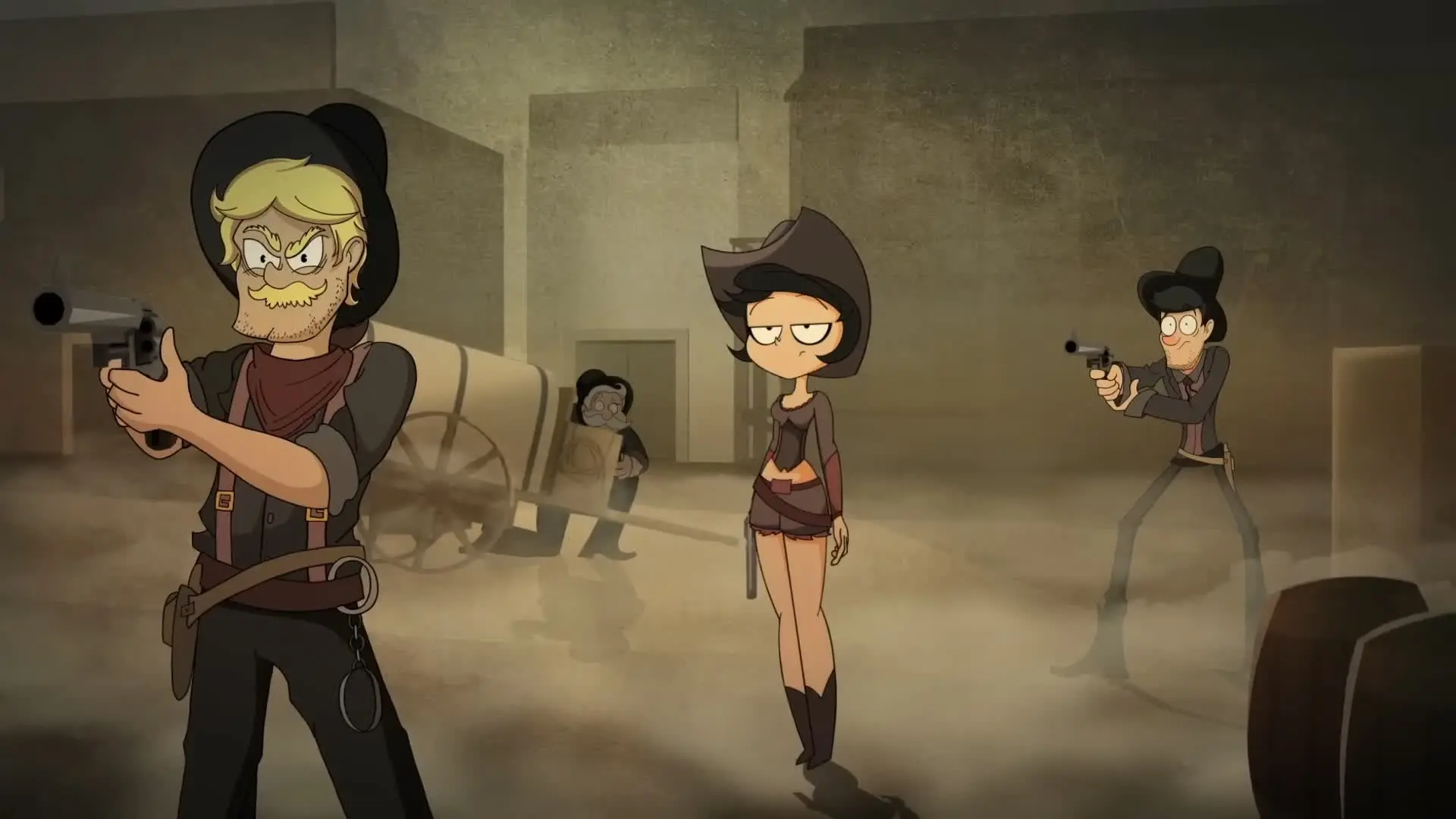
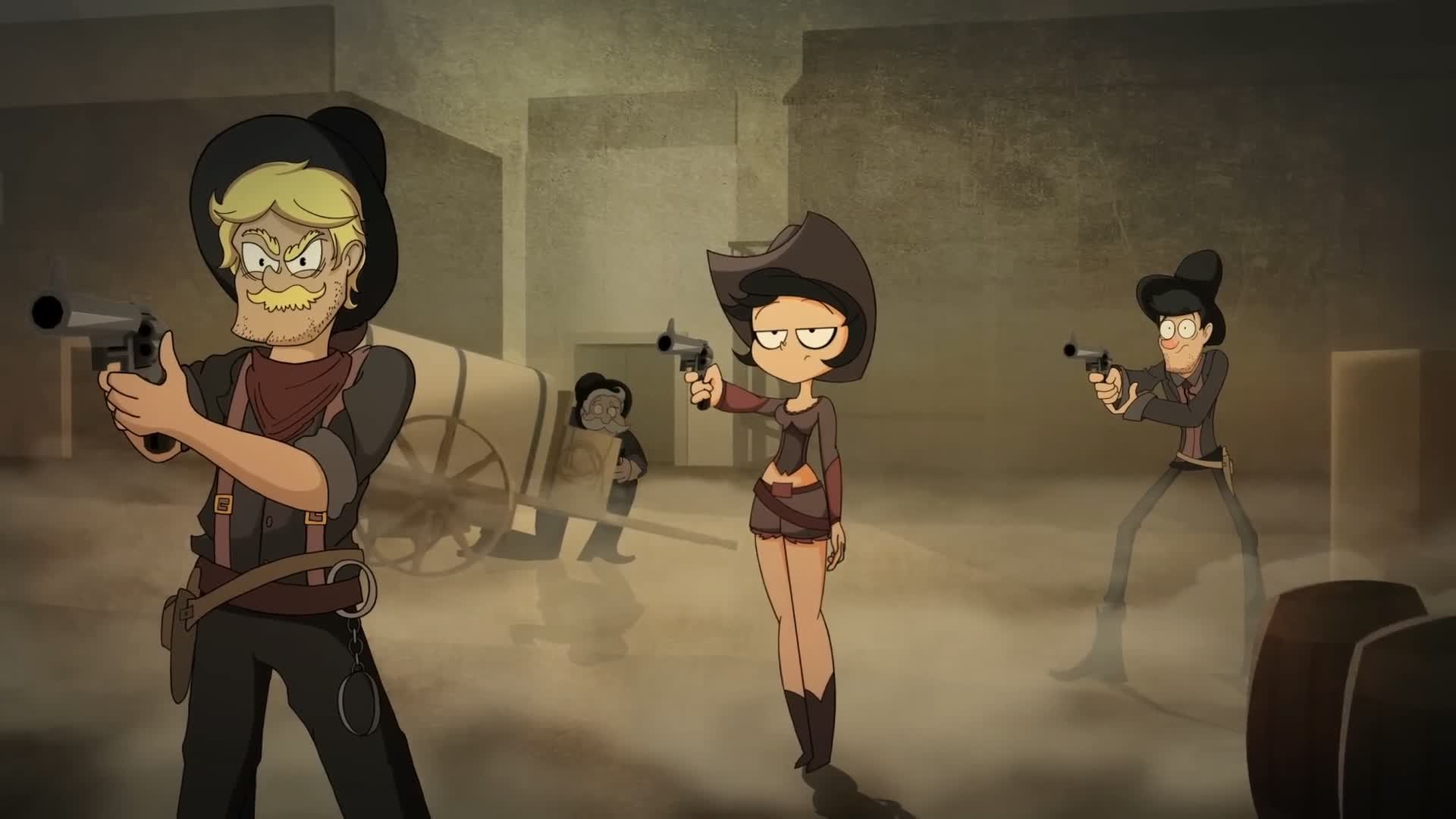
Dan McJaw is a minor human law enforcer in CliffSide whose brief, silent cameo clarifies the show’s stakes. Unlike the monsters and cosmic figures that dominate the frame, he represents the town’s ordinary answer to extraordinary chaos: gather a line, point guns at the problem, and break formation the moment the world stops behaving like a normal Western.
Placed beside Jo Constance, Dan reads as the rank-and-file layer of local order. He is not the strategist, not the moral center, and not the one who adapts fastest under pressure; he is one of the men who show up because the town still expects procedure to matter.
That function becomes clearest inside Jo’s posse, where Dan helps sell the idea that CliffSide can still answer danger with badges, revolvers, and a firing line. The humor is that the civic reflex remains sincere even when the odds are already absurd.
The bank siege only materializes because Waylon keeps treating outlaw mythology like a performance he can step into and out of at will. Dan enters after the bravado has already done its damage, which makes him part of the cleanup crew for someone else’s ego.
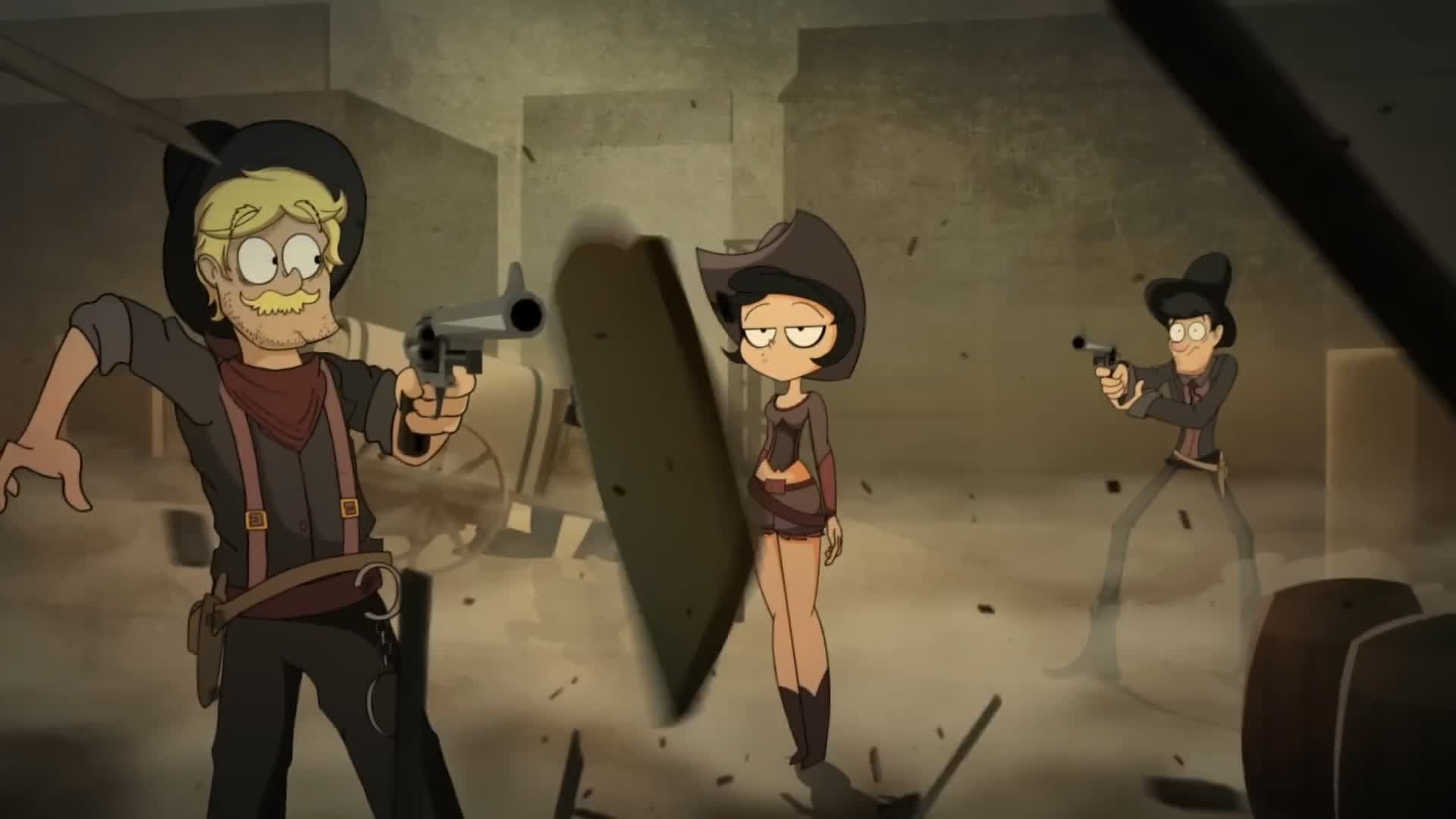
Then Cordie literalizes the fantasy, and Dan’s role snaps into focus. Her webbing, speed, and door-flinging violence turn him from a serviceable lawman into a clean visual measurement of how little human preparedness matters once a predator starts enjoying herself.
Origin and first appearance
On the current CliffSide character index, Dan sits among townies, sheriffs, monsters, and lore-only species, which neatly explains his narrative value. He is not presented as a biography-heavy figure; he is presented as part of the town’s readable human layer.
The same pattern shows up on the CliffSide voice-cast page. The public cast index highlights the speaking side of the pilot, while Dan remains exactly what the episode makes him: a silent body in the law line, useful because he never competes with the principals for attention.
That contrast is sharpened by the production context on Joelle Jacoby’s CliffSide profile, which places the pilot’s YouTube premiere on May 20, 2018. Dan’s cameo belongs to that original burst of character definition, where a few seconds are enough to show how fast the town’s human confidence collapses once monster energy stops being hypothetical.
He also reads especially well beside Jesse Lankman, another non-speaking lawman whose job is less “win the fight” than “prove the town tried.” Together they give the bank sequence a civic baseline before the episode starts hurling bodies and debris through it.
Personality and key traits
| Trait | Description |
|---|---|
| Civic-minded follower | He answers the town’s call without fanfare and takes his place in line, signaling duty rather than heroics. |
| Self-preserving realist | When Cordie turns the street into a mess of splintering wood and flying debris, he retreats instead of pretending courage can replace leverage. |
| Human-scale lawman | His revolver, handcuffs, hat, and scarf read as ordinary enforcement tools, not monster-hunting gear, which makes the gap in power immediately legible. |
| Non-speaking presence | He has no dialogue and no subplot, so the bank scene can stay clear and fast while still feeling populated by real townsmen. |
| Visual clarity | The red scarf, gray coat, and purple suspenders keep him easy to track in crowd compositions, giving the chaos one more readable human silhouette. |
Story arcs and development
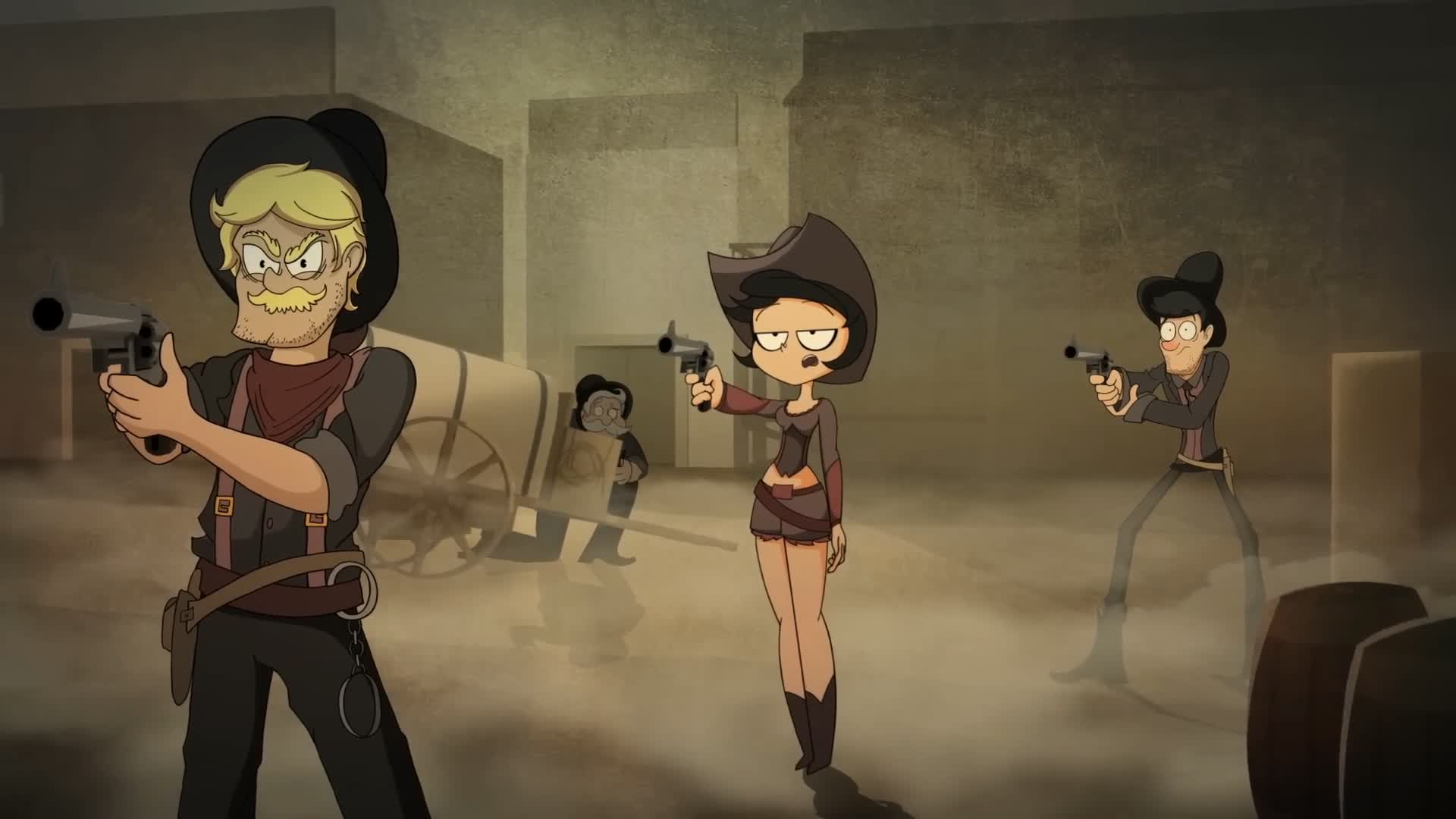
Arc 1 – “Before higher authority arrives.” Dan steps into the bank-standoff beat as though local law still has jurisdiction, and that illusion holds right up until Death becomes the scene’s ultimate reference point. His brief confidence matters because it gives the episode something recognizable to strip away.
Arc 2 – “The retreat is the point.” Long before the mounted spectacle of Yannis dominates the street, Dan has already served his purpose. The instant bullets get swatted aside and the bank itself becomes a weapon, he stops reading as a deputy in control and starts reading as a rational human being caught in the wrong genre.
Arc 3 – “One of the line, not the star.” Read alongside Rustlin’ Bill, Dan becomes part of a miniature type rather than a lone cameo: the ordinary volunteer lawman who answers the call, lasts one burst of real escalation, and vanishes once the frame belongs to bigger players.
Arc 4 – “Cameo as structure.” His disappearance from the climactic stretch echoes the lesson attached to the Background Street Crosser: in CliffSide, even figures who seem safely peripheral can be used to demonstrate how unforgiving the setting becomes when stronger forces move through it.
Relationships with other characters
| Character / Entity | Role vs. Dan McJaw | Dynamics |
|---|---|---|
| Jo Constance | Commander | She calls the posse and sets the plan; Dan follows her lead until the street stops obeying human tactics. |
| Cordie | Immediate threat | Her door-and-web barrage turns his job from orderly enforcement into a survival decision, and he reacts accordingly. |
| Waylon | Indirect catalyst | Waylon’s boasts create the problem Dan is summoned to contain, which makes the deputy part of the fallout from another person’s performance. |
| Death Itself | Superseding authority | Once the cosmic rider enters, local law leaves the center of the frame; Dan’s absence marks that jurisdictional handoff. |
| Jesse Lankman | Fellow posse member | They stand together before the retreat, giving the town a believable law-and-order layer before monster force breaks it apart. |
| Rustlin’ Bill | Fellow posse member | Another recognizable volunteer in Jo’s line, useful for showing that CliffSide’s ordinary humans still try to answer violence with structure. |
| CliffSide (the town) | Employer and crucible | The setting relies on men like Dan to pretend normal rules still apply, right up until the evidence says otherwise. |
Place in the wider setting
Dan’s cameo stays useful because CliffSide’s broader threat map keeps expanding around him. Predators like the Wendigos already establish that the frontier can shift from comic nuisance to survival problem in seconds, so a calm-looking deputy is never just set dressing.
His modest design becomes even more telling when placed against roaming hazards like the Terror Birds. In that company, Dan’s handcuffs and sidearm look less like solutions than rituals of civilization trying to keep its posture.
The contrast sharpens again with manipulative species such as the Sirens, whose danger would break the kind of straight-ahead, badge-first order Dan represents even without a single shot being fired. He belongs to a world of visible suspects and clear confrontations; CliffSide does not.
That mismatch grows larger once lore-only escalators enter the conversation. Reality-bending entities like the Poltergeists make Dan’s cameo feel almost documentary: he shows what normal human law looks like before the setting widens into stranger categories.
The same logic applies to unseen megafauna such as the Migrants. Dan matters because he anchors the bottom of the scale; without someone visibly ordinary in uniform, the show’s larger horrors would carry less human weight.
Even the franchise’s slyer monster pages, including the Chupacabras, reinforce why Dan works as a control sample. He is built for rules, paperwork, warnings, and visible suspects, while the wider ecology around CliffSide is full of creatures that reduce that mindset to wishful thinking.
Appearance, symbols, and recurring motifs
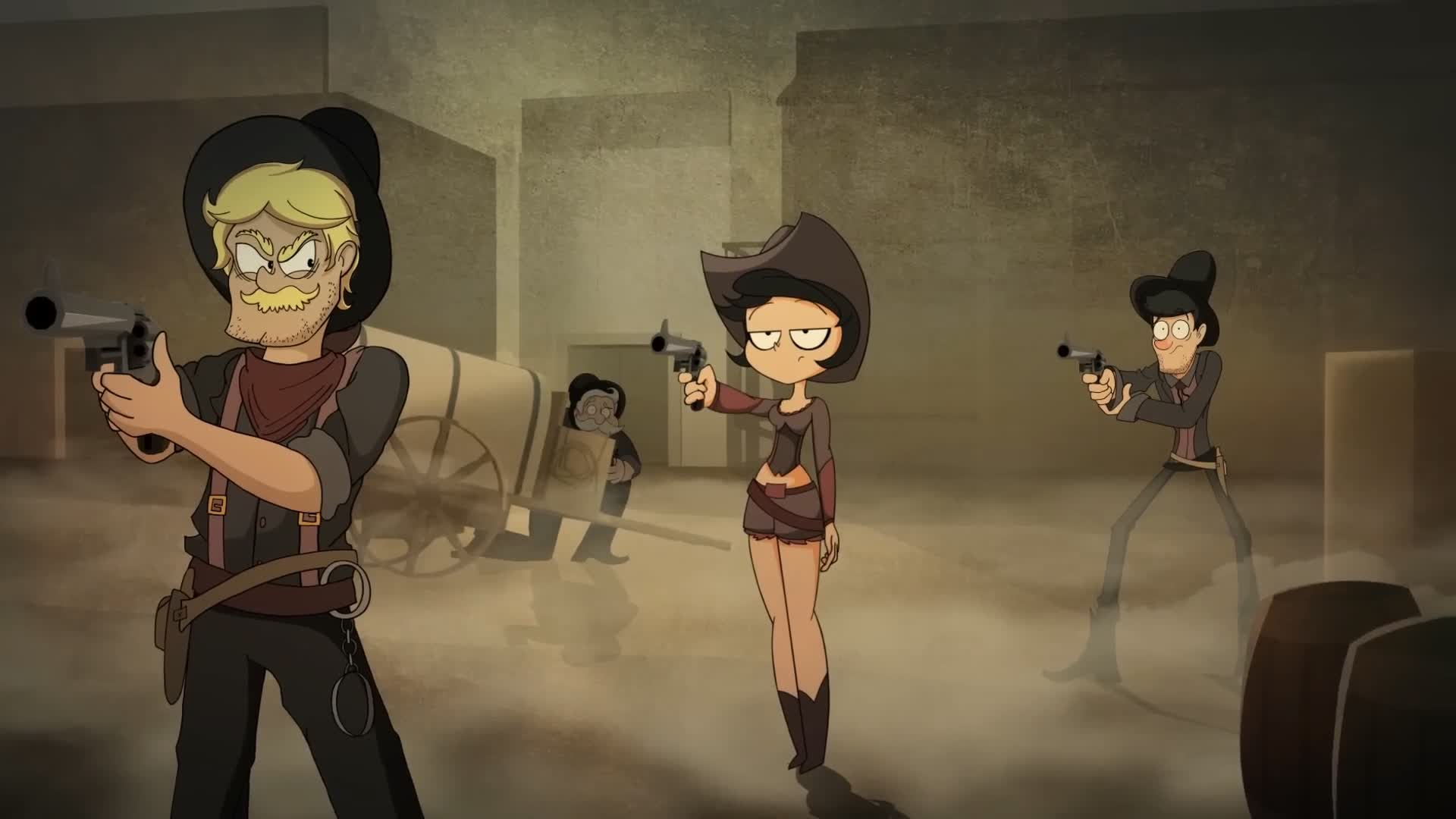
Dan McJaw presents a crisp, traditional Western silhouette that reads at a glance. He is a tall blond man with a mustache and light tan skin, wearing a black cowboy hat and a red scarf over a short-sleeved gray coat; dark pants hang from purple suspenders, and a holstered revolver plus handcuffs complete the uniform.
Those details do more than dress a background extra. The red scarf cuts cleanly through dust-toned backgrounds, the short sleeves sell “working deputy” rather than ceremonial lawman, and the cuffs remind viewers that CliffSide still imagines arrest as a meaningful concept even when the episode barely allows it to function.
That is why his turn and retreat land so well. The hat, scarf, and badge-adjacent gear are symbols of civic optimism–the belief that hardware, posture, and routine might hold. When he runs, the visual breaks on purpose, and the costume itself seems to concede that the town’s ordinary tools have reached their limit.
Fandom and alternative names
- Dan McJaw – formal name used in character lists.
- Dan – shorthand in discussions when context is clear.
- McJaw – surname-only reference in posse lineups.
- Dan McJaw (non-speaking cameo) – descriptive label emphasizing his silent role.
- Дэн Макью – common Russian localization.
Interesting details and quotes
- First appearance: the pilot; role: minor law enforcer; affiliation: Jo’s posse; status: alive.
- Dialogue: none, which is why he functions more as silhouette and timing than as an individual subplot.
- The current CliffSide cast indexing centers the speaking roles, which fits Dan’s lack of a credited voice entry.
- Production context tied to the pilot places Dan’s appearance in the original YouTube release cycle dated May 20, 2018.
- His most important action beat is the retreat, triggered when Cordie turns the bank door and surrounding debris into weapons.
- Design notes: black hat, red scarf, gray coat, purple suspenders, holstered revolver, and handcuffs – an instantly readable lawman during a busy set piece.
- Grouped with Jesse Lankman and Rustlin’ Bill, he helps map the recognizable human layer beneath CliffSide’s monsters and cosmic authorities.
I’m Two-Bit Jerry! A gunslinger and an outlaw!
– Waylon’s boast that helps ignite the crisis Dan joins and then abandons.