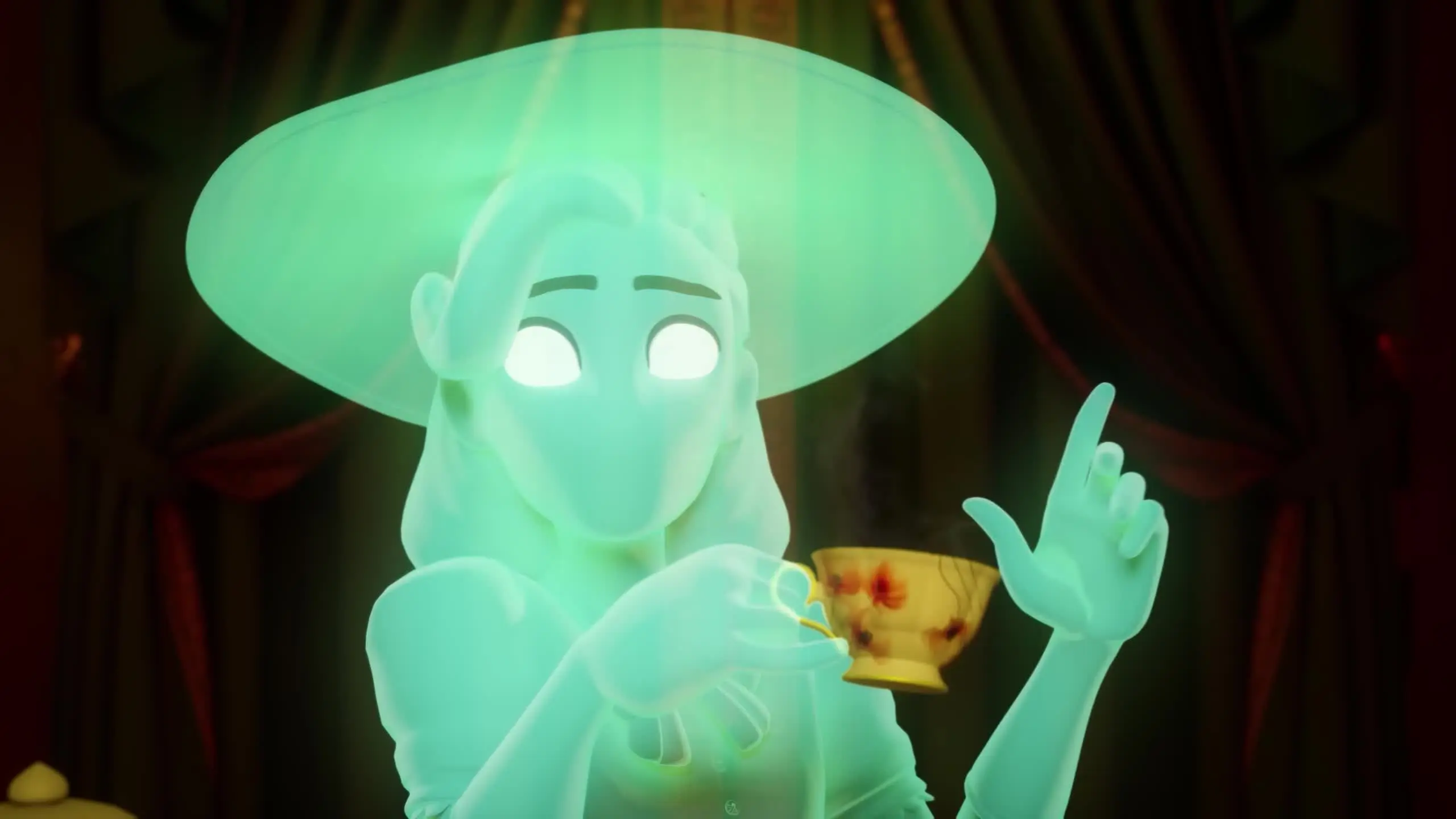
Martha Mildenhall first appears in the teaser titled “POMNI WAKE UP TIME TO GO ON AN ADVENTURE,” but fully debuts in Episode 3, The Mystery of Mildenhall Manor. As an NPC ghost who welcomes the visitors into Mildenhall Manor, she immediately shifts the episode’s tone from pure haunted-house spectacle to something gentler, sadder, and unexpectedly human.
Within the broader run of The Amazing Digital Circus, that tonal shift still feels unusual. Martha arrives in a series that often hides pain beneath manic color and noise, yet she makes the room quieter instead of louder. That alone is enough to make her stand out among the show’s many one-episode creations.
Visual Design and Aesthetic: The Translucent Cyan Ghost
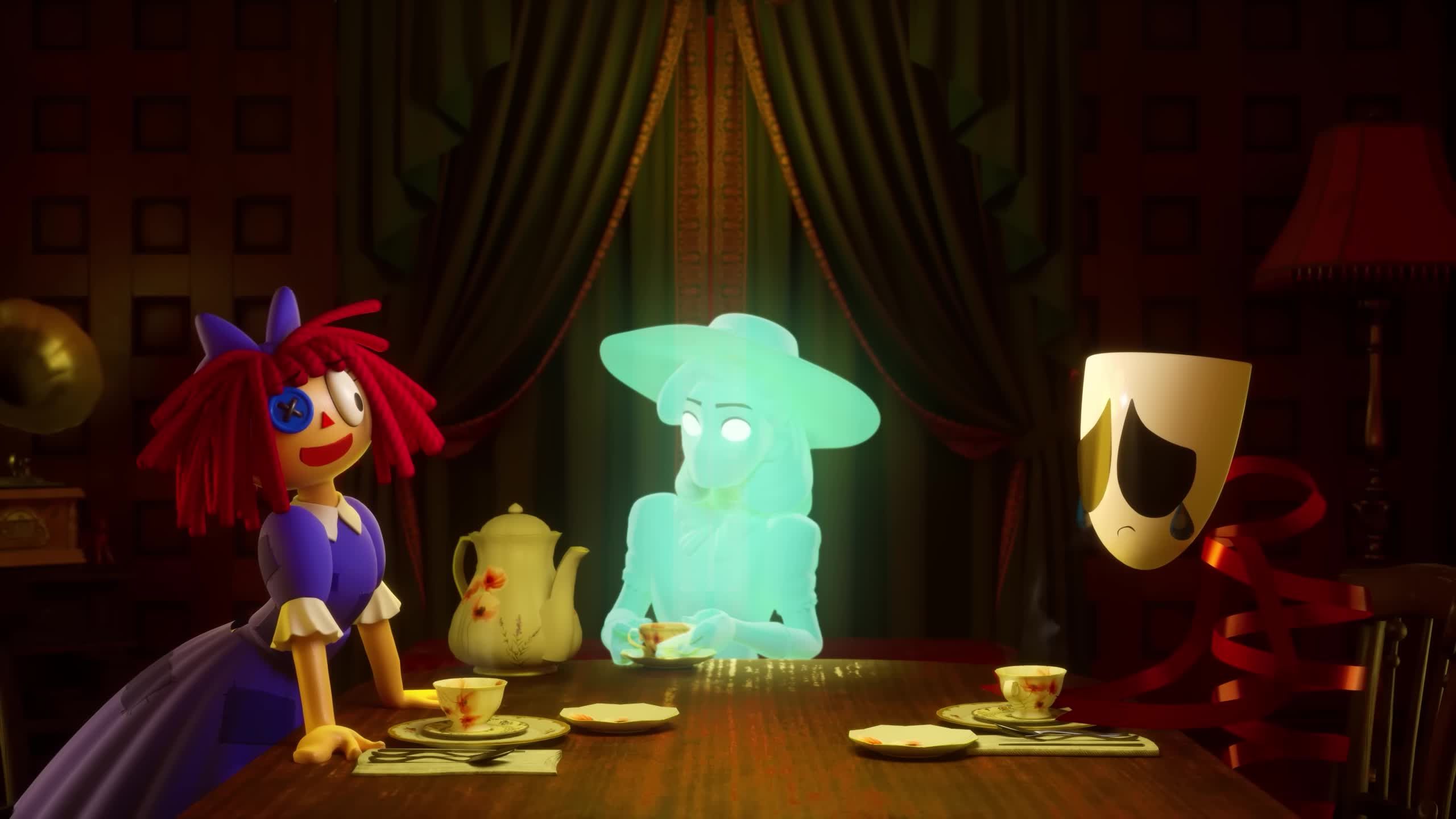
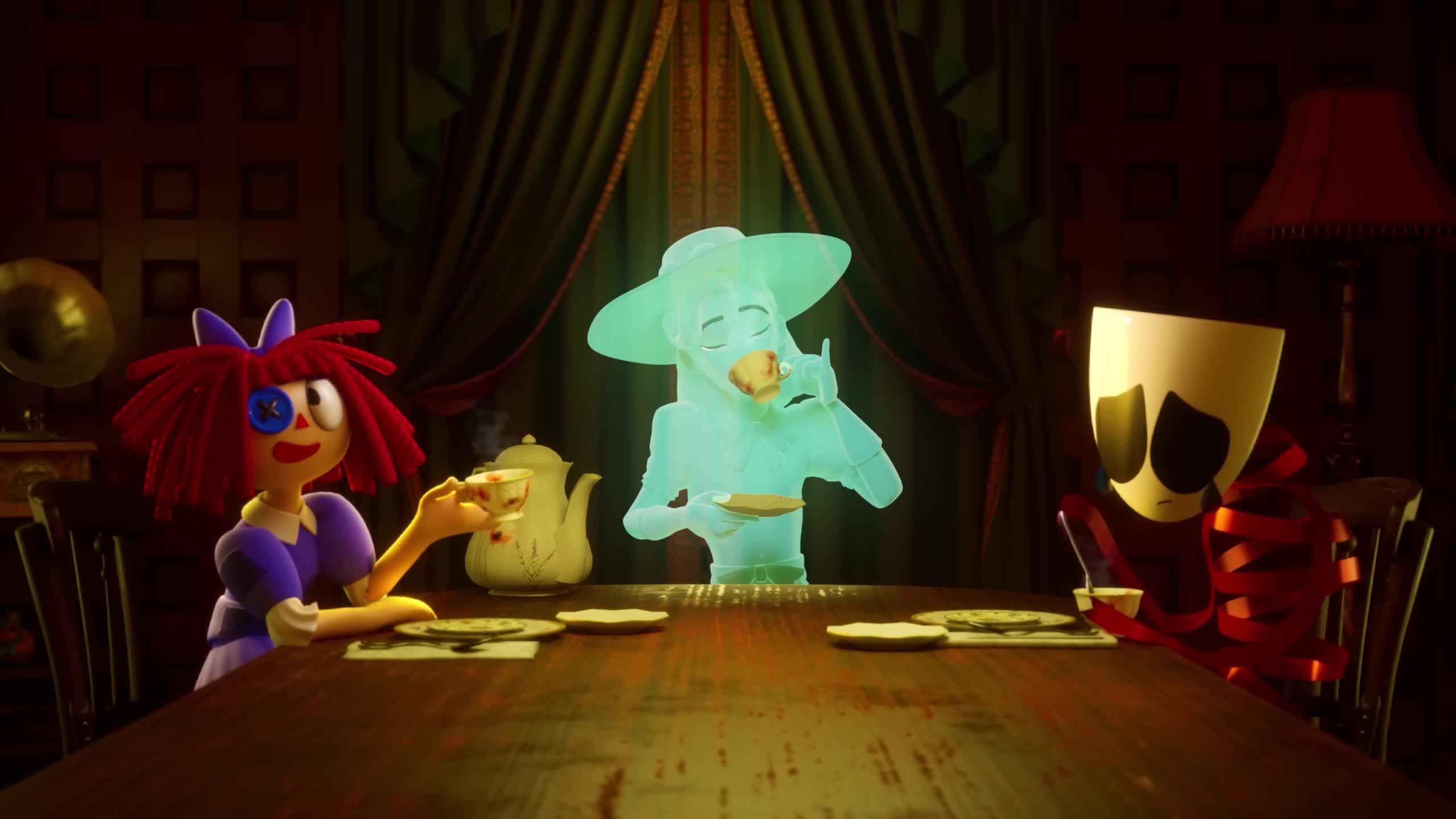
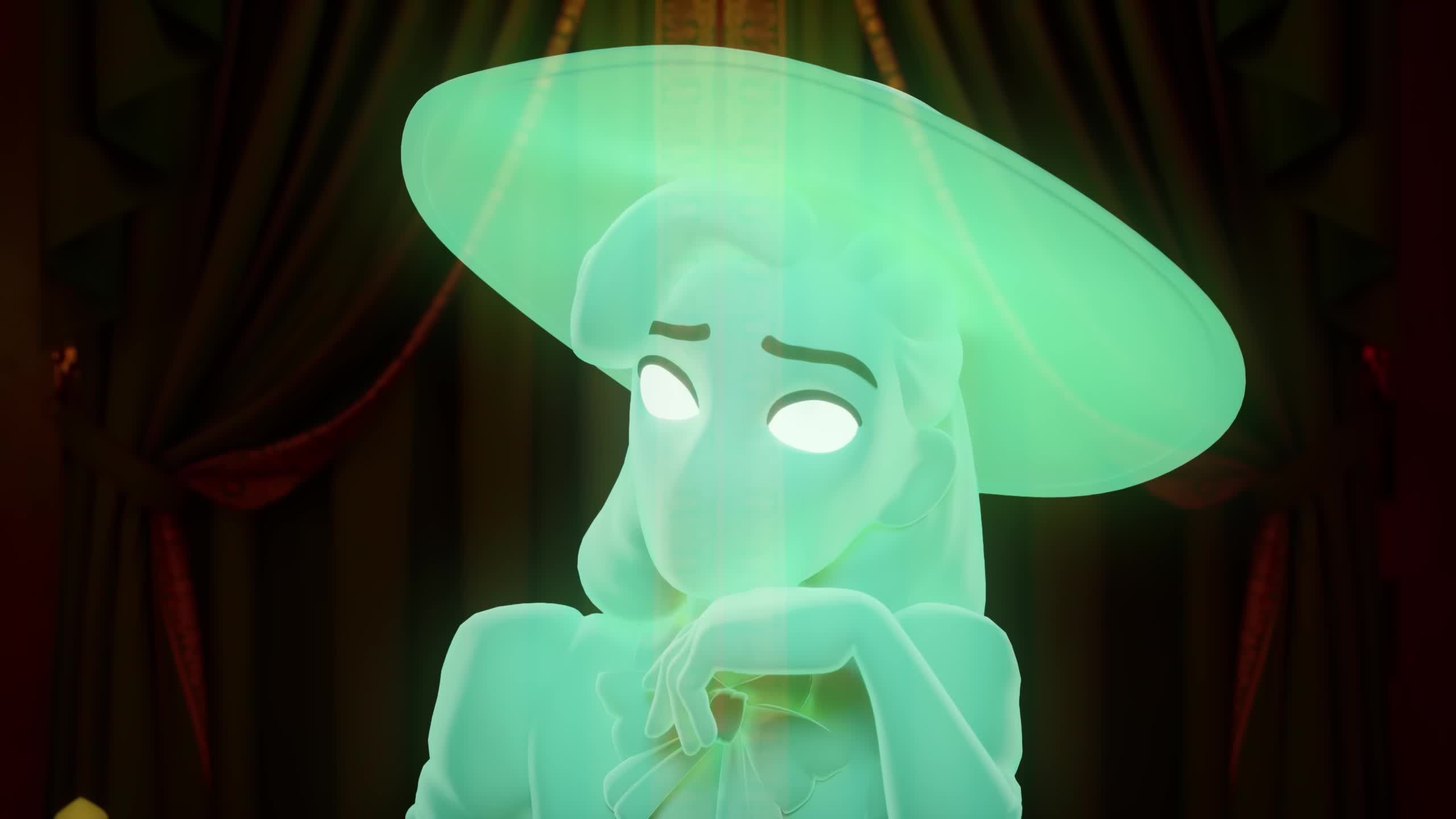
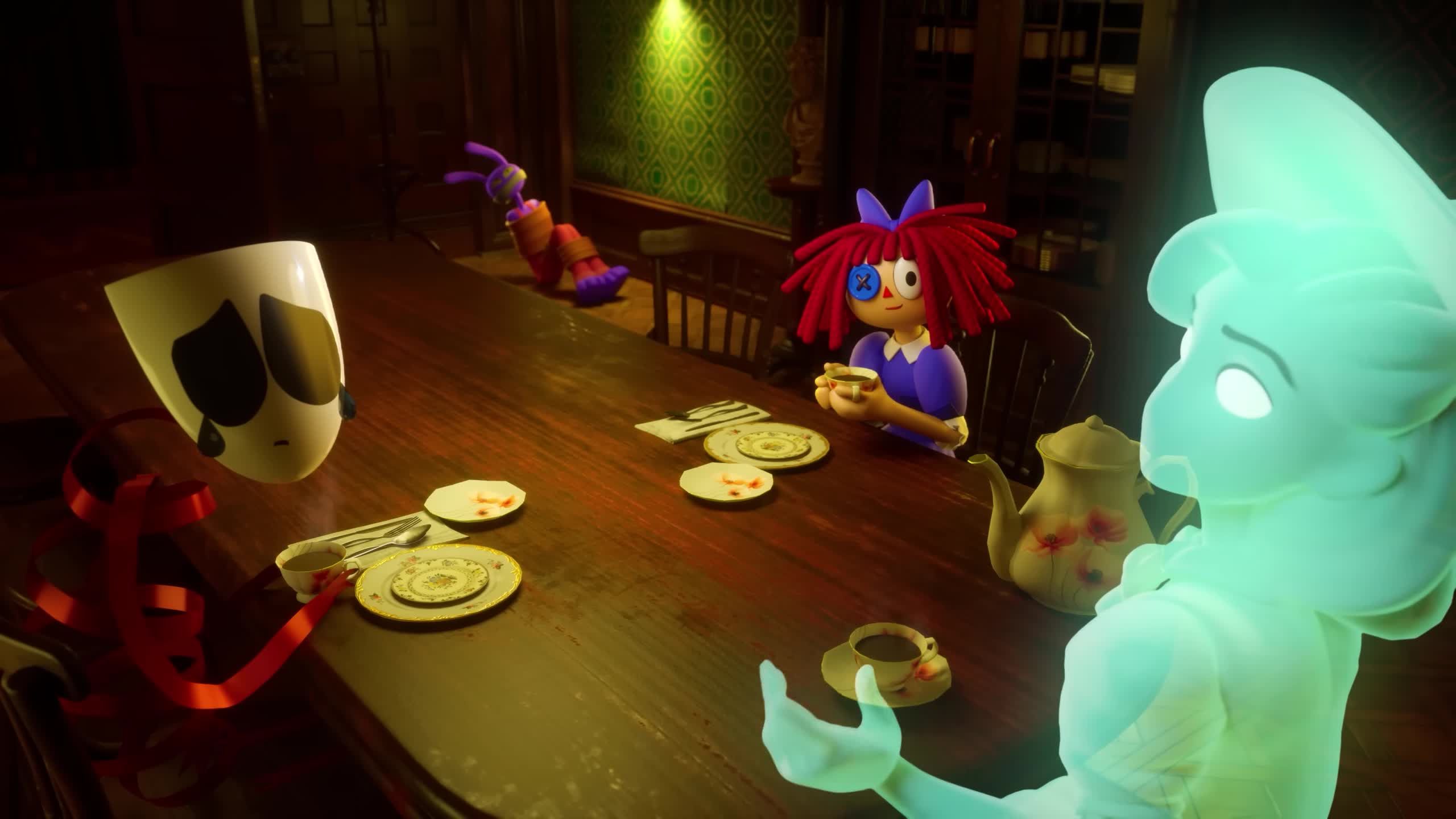
Visually, Martha appears as a softly glowing translucent cyan ghost, her upper body faintly illuminated in the dim manor. She wears a wide-brimmed hat, a knee-length dress with ribbons, and solid white eyes framed by dark brows. There is no visible mouth, yet she speaks with composed clarity, which makes her feel more haunting and more comforting at the same time.
That design choice matters because Martha is never pushed into the same exaggerated comic register as much of the cast. Even next to more chaotic figures like Bubble, she reads as controlled, poised, and almost ceremonial, as if the manor has preserved not just her ghost but her manners.
Backstory and Role: The Tragic Fate of Baron Mildenhall’s Wife
Martha is introduced as the deceased wife of Baron Theodore Mildenhall. Her death is one of the bleakest twists in the manor storyline: the Baron, consumed by obsession and fear, mistakes her for the creature he is hunting and kills her by accident. The detail defines Martha’s role at once. She is not a vengeful ghost, but the quiet emotional center of a tragedy built on paranoia.
The tragedy also lands because it reaches the audience through frightened visitors rather than through exposition alone. For Pomni, Martha becomes proof that a circus quest can contain real emotional wreckage, not just puzzles and jump scares.
Personality Highlights: Kindness, Tea-Loving, and Gentle Wit
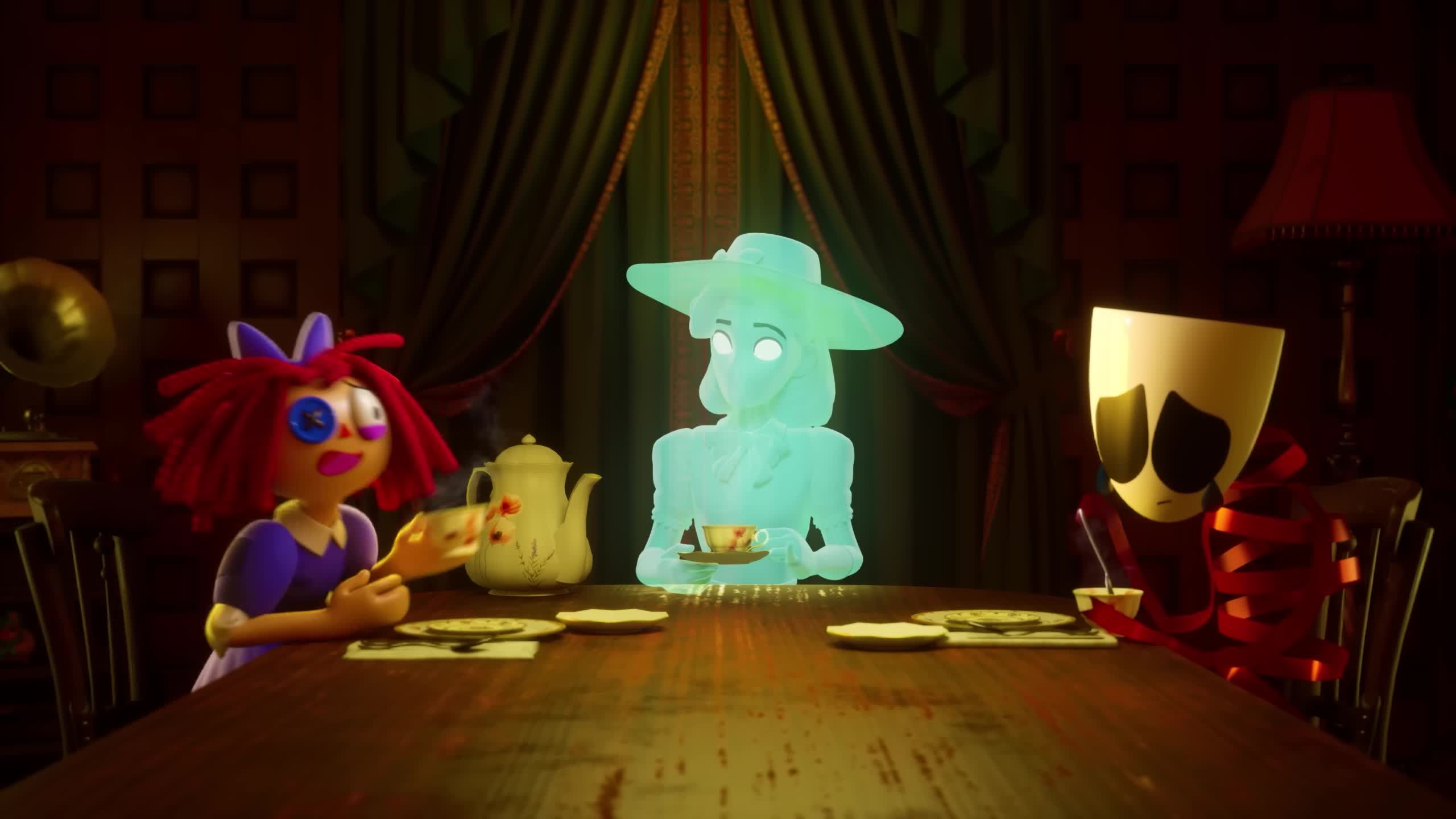
Her most memorable scenes come from the way she receives Ragatha with patient warmth rather than theatrical menace. In a series full of overstimulating chaos, Martha feels calm, deliberate, and deeply attentive, which makes her hospitality stand out even more strongly.
That same hospitality extends to Gangle, turning their tea scene into one of the rare moments in the series where an NPC encounter feels sincerely restorative instead of transactional. Martha does not simply guide the heroes through a spooky map; she makes the manor feel briefly lived-in, as though grief has not fully erased its humanity.
That man could turn a 57-second story into a Greek tragedy.
Her wit is dry rather than sharp, and even her remarks about Jax land more as gentle bemusement than criticism. That balance of grace and humor is a major reason she remains memorable despite limited screen time.
That restraint is especially striking in a show that often expresses distress through collapse and distortion, from Kaufmo onward. Martha represents a different kind of damage: not frenzy, but sorrow that has settled into routine.
Voice Acting: Marissa Lenti’s Portrayal
In English, Martha is voiced by Marissa Lenti, whose performance gives the character warmth without draining away the uncanny edge. The casting becomes even more interesting once you realize that the same actor also voices Gangle, which gives Martha’s tea scene an extra layer of softness and control.
The wider Digital Circus voice cast adds another layer to Martha’s presence. Current credits also list dubbed performances for the character in Dutch, French, German, Hindi, Polish, Russian, Latin American Spanish, and Ukrainian, which is notable for such a contained NPC role.
Martha and the Haunted Ecology of Mildenhall Manor
Martha’s presence works especially well because she is not the manor’s only spectral figure. Alongside Ghostly and the other eerie elements of the episode, she helps create an atmosphere where the house feels haunted by personality rather than by noise alone.
The result is a version of horror built less on attack than on mood. Martha makes the manor feel inhabited, not merely cursed, and that distinction is what gives the episode much of its melancholy.
Current Place in the Story Through Episode 8
With the series now up to The Amazing Digital Circus Episode 8, Martha still remains one of its most self-contained and effective NPCs. She has not returned as a central player, but the story around her has not been forgotten.
That memory becomes explicit in Fast Food Masquerade, where the manor adventure is directly brought up again rather than treated as a disposable side quest. The reference matters because it tells viewers that the emotional bruise of Episode 3 stays with the cast.
A quieter continuation arrives in Untitled, where the manor material survives through callback imagery instead of a full revisit. By then, Mildenhall Manor already feels less like a one-off map and more like one of the series’ lasting emotional landmarks.
By Episode 8, even Angel flashes back during Caine’s musical montage, chasing Pomni in a rapid reminder that the manor’s horrors are still part of the circus’s memory. Martha is not on-screen in that beat, but the reprise keeps the emotional weather of Mildenhall Manor alive.
Martha’s Symbolic and Narrative Significance
Martha also reveals an unusually tender side of the cast, particularly in how characters like Kinger and the others move through the manor’s horror from very different emotional angles. Where some characters react with panic, confusion, or fascination, Martha embodies steadiness. She is the reminder that the episode’s real tragedy is not the monster itself, but what terror does to people.
That is also why she contrasts so effectively with Caine and the circus at large. Caine’s adventures usually turn distress into spectacle, while Martha briefly interrupts that pattern with empathy, patience, and domestic calm. In a world built on performance and manipulation, she feels almost startlingly sincere.
She also belongs to the small group of NPCs who linger emotionally after their plots end. Like Gummigoo, Martha makes the series feel interested in the inner lives of beings who were supposed to exist only as quest furniture.
Fan Response and Lasting Appeal
Though she remains a minor character, Martha has endured as one of the series’ most warmly received one-off NPCs. Her design is instantly recognizable, her dialogue is highly quotable, and her tea scene remains one of the clearest examples of how The Amazing Digital Circus can merge horror, humor, and melancholy without losing tonal control.
Part of that appeal comes from contrast. In a show that can pivot from brittle panic to severe psychological collapse, Martha offers a form of quiet emotional clarity that feels rare. She does not soften the series so much as reveal another register it can play in.
Connection to Broader Circus Lore and Themes
Martha underscores one of the series’ central ideas: even in digital horror, traces of tenderness and ordinary human behavior still survive. Her ghostly presence turns a frightening setting into a space of emotional contrast, making the manor episode feel less like a detached side quest and more like a concentrated study of guilt, compassion, and the cost of fear.
That is why she still matters deep into the current run. As later episodes push the series closer to its endgame, Martha continues to represent something the circus cannot fully erase: courtesy, grief, and the possibility that even an NPC can carry the emotional truth of an entire story.