The Black Hand is the overarching antagonist in The Gaslight District. However, the character never appears as a speaking figure or a monster on screen; it exists as a mark—an eldritch rune—that resurrects the island’s dead while condemning them to slow decay. Therefore, the Black Hand operates like a constitutional law written on flesh: it grants the Rotlings practical immortality, shapes their economy and violence, and turns every fatal blow into a temporary setback.
Official materials now frame the show as a supernatural crime comedy created by Nick Szopko, and that label fits what the broader world of the district already suggests: the Black Hand is horror in concept, but in practice it functions like infrastructure, bureaucracy, and folk religion at the same time. Since the pilot debuted on April 18, 2025, the mark has remained the cleanest explanation for why the district can turn gunfights, funerals, and civic ritual into the same grim joke.
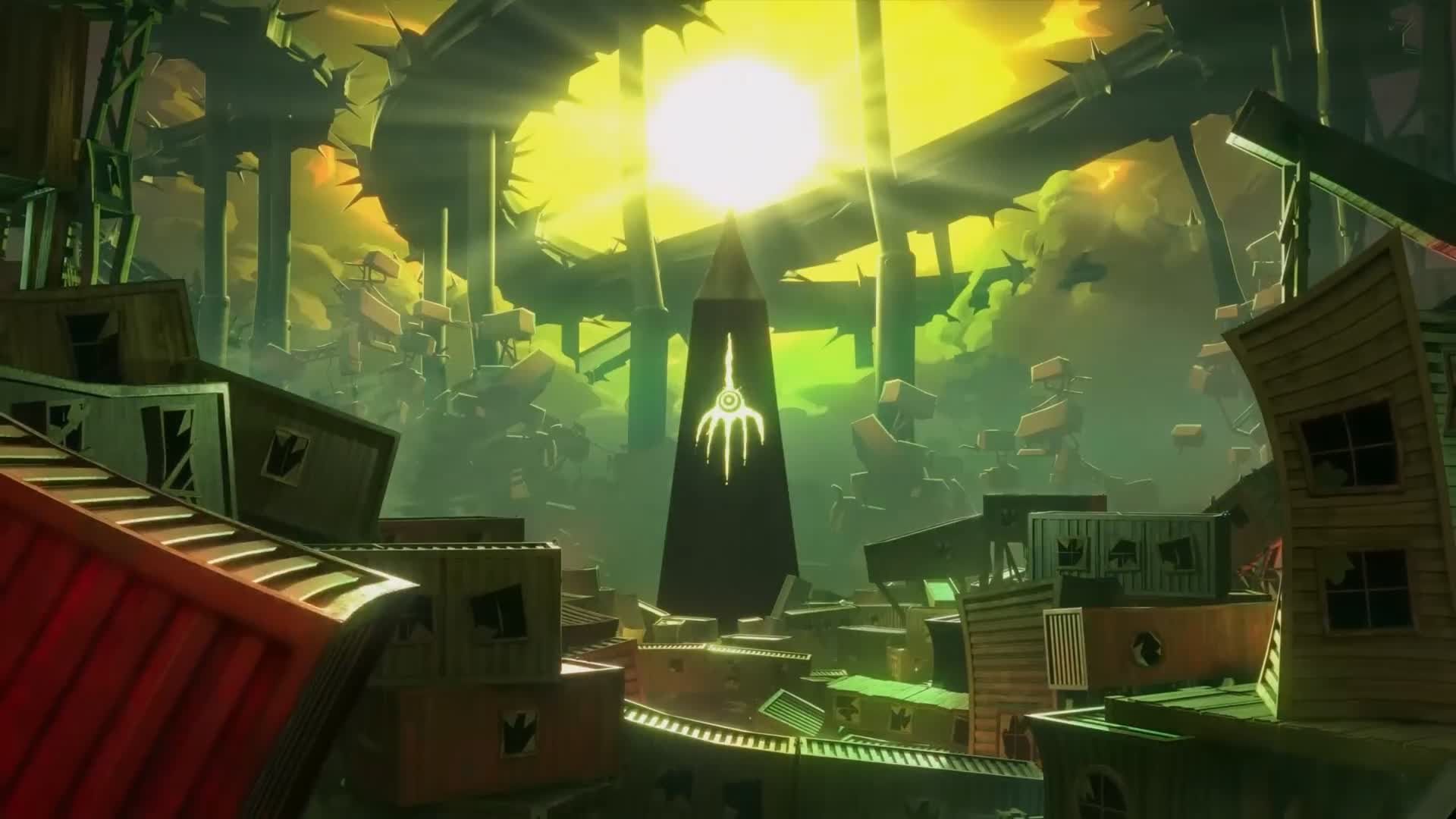 Open image: Black Hand — sunlit monolith in a warped shanty maze; clawed eye
Monuments and street props turn the Black Hand into civic scenery.
Origin and first appearance of The Black Hand
However much the pilot dazzles with angels and Virtues, viewers first meet the Black Hand as iconography, not anatomy. That choice suits the wider cast of the district: in this city, institutions arrive before explanations. Start with street theater: a town crier jingles a bell etched with runes while wearing a green cap stitched with the Hand’s insignia; passersby wave placards; and a stage worker hoists a sign that screams “HUMAN DEATH CEREMONY.” Then the camera keeps finding the same motif—an open palm with an eye set in the center—printed on props and clothing around the square.
As a result, the antagonist arrives as a brand that everyone accepts, the way a government seal appears on money and warrants. The pilot then folds the symbol into plot mechanics. When named guards such as Joshua or ordinary Rotlings go down, death behaves less like an ending than an interruption. Consequently, the Black Hand’s “first appearance” is really a chain of appearances: a rune on a hat, a glyph on a bell, and a rule the audience learns before anyone fully explains it. Life returns in the district, and the cost of that return is visible rot.
Personality and key traits of The Black Hand
| Trait | What it looks like |
|---|---|
| Unseen governance | The Hand issues no speeches and sends no emissaries; instead its rune appears everywhere and its law—resurrection with decay—governs every fight and funeral. |
| Curse-as-contract | Its “gift” binds the district: you will live again, but you will rot. The bargain underwrites the Smiling Dead’s bravado and the island’s fatalism. |
| Symbolic saturation | Hats, bells, posters, and graffiti carry the five-fingered hand with an eye in the palm. The icon functions like a civic seal and a warning label at once. |
| Rival to Heaven | Angels and Virtues police order from above, but the Hand’s mark keeps the dead moving below. The series stages their systems in collision without giving the Hand a mouthpiece. |
| Selective mercy | Rotlings revive; a true human does not. That asymmetry powers the island’s paranoia and explains why a “Human Death Ceremony” could exist at all. |
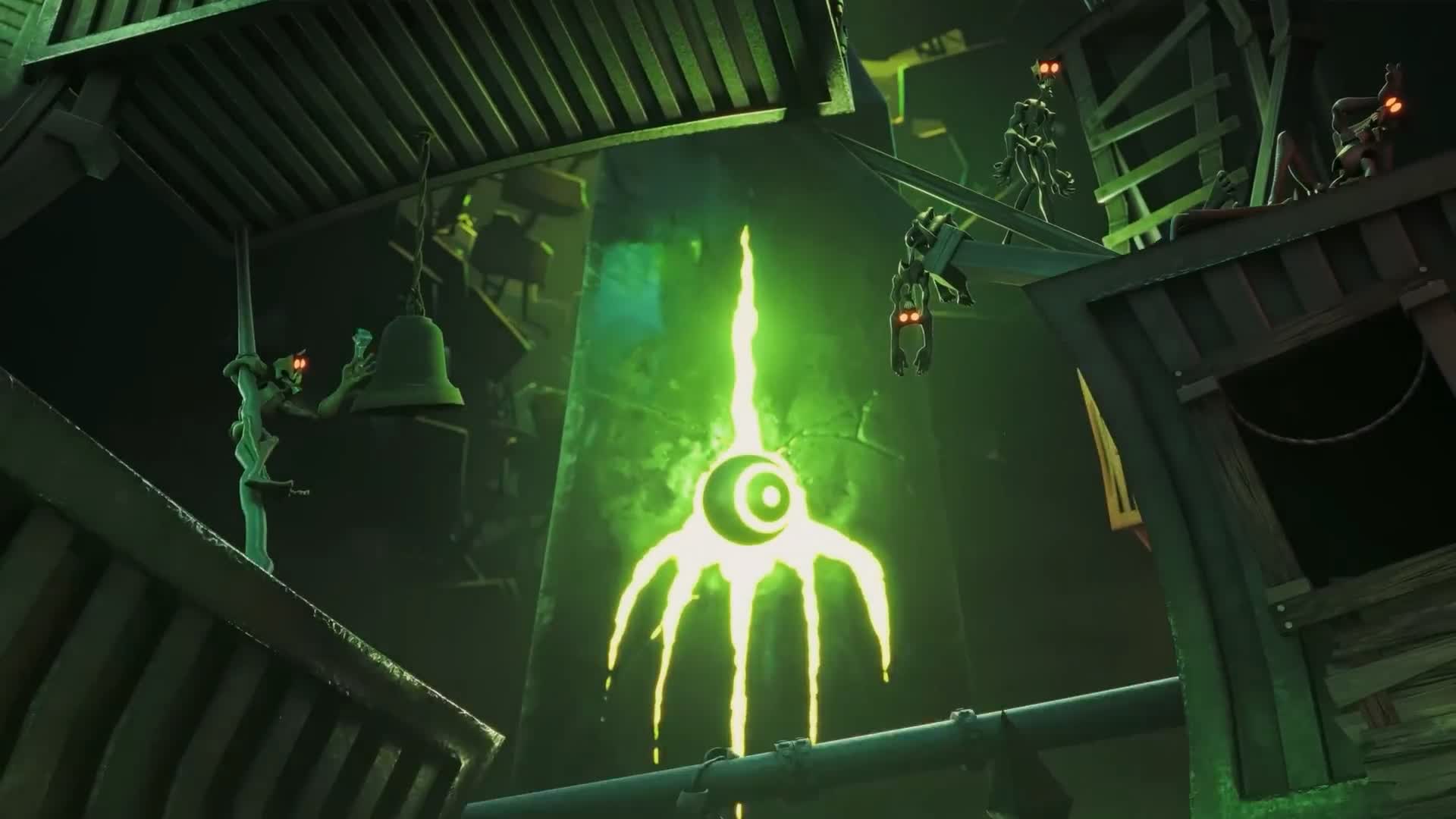 Open image: Black Hand, Litterbugs — green sigil blazes on a tower as red-eyed
Public ritual shows how the Hand rules by symbol, not by speech.
Story arcs and development
The law written on bodies (Pilot worldbuilding)
From the opening street scenes, Rotlings wear the Hand’s mark and treat death like disruption rather than departure. That logic becomes concrete whenever characters such as Mud keep moving through damage that would flatten any ordinary crime story. The show doesn’t need a lecture on metaphysics; it just lets bodies fall apart and come back badly. As a result, fights escalate faster because consequences are temporary, and intimidation shifts from “I can kill you” to “I can keep killing you.”
Cult, commerce, and compliance (Civic saturation)
The symbol is not hidden; it is branded into daily life. Town criers ring it, vendors wear it, and the economy keeps working because everyone assumes tomorrow belongs to the same curse. That is why the world around Ken the Butcher feels so stable and so rotten at once: butcher shop hospitality, gang logistics, and public ritual all operate under a rule nobody voted for and nobody escapes. The antagonist does not need a throne when it has a logo on every corner.
Collision with Heaven’s order (Angels and Virtues)
Angels descend like storms, and Diligence enforces protocol inside Paradise Lost with the energy of a bureaucratic executioner. Yet the Hand’s rule collides with that regime at every level. Rotlings that Heaven shreds can still reassemble; institutions can punish, process, and quarantine them, but they cannot restore the district to a clean mortal logic. The pilot makes that conflict legible without turning it into a debate scene.
The same limit applies in the clinic. Temperance can repair bodies, classify them, and keep dangerous secrets moving through the system, but even that porcelain control stops at the edge of the Hand’s contract. The result is one of the series’ sharpest ideas: medicine, law, and divine force can manage the curse, but none of them can repeal it.
Prophecy pressure and the human exception (Ceremony and fallout)
The city fears a prophecy about a human and death precisely because the Hand’s promise does not cover humans the way it covers Rotlings. That loophole is what makes Melancholy Hill such a destabilizing presence. Her black blood is not merely a secret identity detail; it is evidence that the district’s supposed universal law has boundaries, and once a system shows a boundary, panic rushes in to test it.
The ceremony itself turns that fear into spectacle, and the reveal of Ramiel pushes the panic into the open. A ritual designed to calm the crowd instead proves that Heaven is still active, that prophecy can mutate onstage, and that the Hand’s silence does not make it passive. Nobody speaks for the mark, yet its loopholes move crowds, scams, and counterattacks all the same.
Aftershocks after the cleanup (Post-credits pressure)
The pilot’s cleanup work also deepens the Hand’s menace. When Jack the Rat is cemented and dumped into the sea, the punishment feels practical, but it also underlines the real problem of the district: in a resurrection economy, disposal is not the same thing as resolution. The post-credits sting turns that into a threat, suggesting that the Hand keeps every bad decision circulating longer than the people who made it would like.
Relationships with other characters
| Entity / Character — role vs. The Black Hand | Dynamics |
|---|---|
| The Smiling Dead — beneficiaries | Ken the Butcher’s family lives and fights under the Hand’s contract. Their swagger and survival tactics assume resurrection on delay, not denial. |
| Melancholy Hill — exception and threat | Mel’s black blood marks her as different from Rotlings, and the island’s fear of a “true human” exposes the Hand’s limits. Her existence pressures the system the mark sustains. |
| Angel Mother — rival power | She claims divine custody over eggs and angels, while the Hand claims the streets through its curse. Their forces meet through proxies—swarms and storms below a rune-stamped city. |
| Diligence — containment apparatus | The Virtues’ leader tries to enforce order inside Paradise Lost. It can mobilize guards and procedures, but it cannot repeal a resurrection rule the Hand already set. |
| Temperance — medical technocrat | The doctor repairs bodies and keeps oaths in a porcelain clinic; even so, the clinic treats symptoms of rot that flow from the Hand’s bargain. |
| Town Crier — public herald | A minor figure whose bell and cap carry the Hand’s insignia, he demonstrates how civic messaging normalizes allegiance to an unseen power. |
| Paradise Lost — opposing institution | The citadel polices belief and biology from above; the Hand polices outcomes from below. Their overlap is where the pilot’s worst nights happen. |
Appearance, symbols, and recurring motifs of The Black Hand
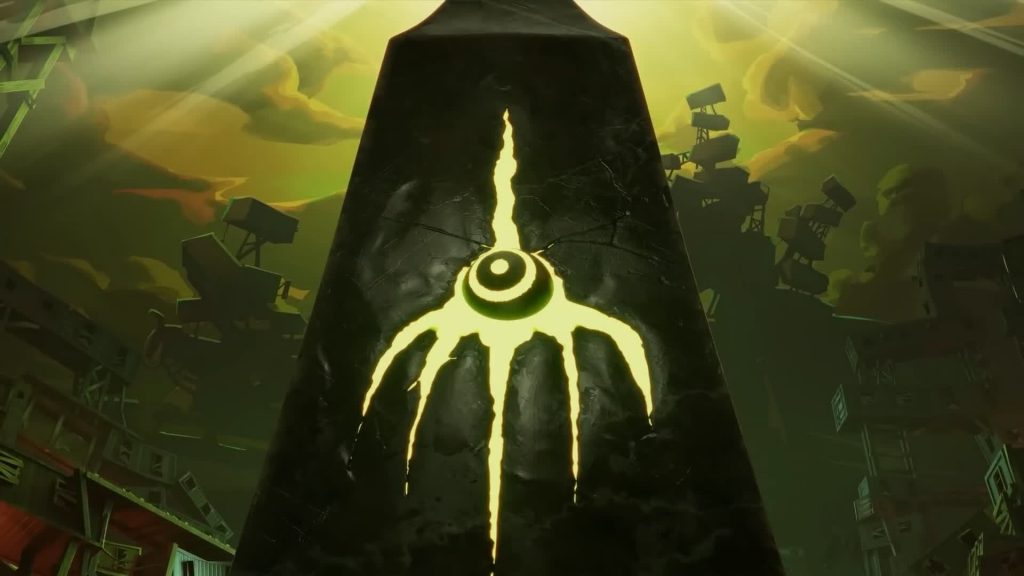
Visually, the Black Hand is a rune: an open palm with a pupil-like eye set in the center, often rendered in dark ink with acid-green accents. The show rarely isolates the symbol for glamour shots; instead it treats the glyph like a civic watermark. That matters because the district’s whole design language is organized around rival claims of ownership: the Hand marks the street, while halos, feathers, and beaks announce the reach of Angel Mother and Heaven above it.
Placement matters just as much as shape. The hand-eye mark turns up on headwear, bells, posters, and ritual props because saturation is the point. Citizens should feel watched, protected, and trapped at once. Bodies complete that motif. Even characters built for grotesque comedy, from patched-up Rotlings to dough-fed bruisers like Breadhead, end up proving the same rule: immortality here is not youth or freedom, only ongoing management of damage.
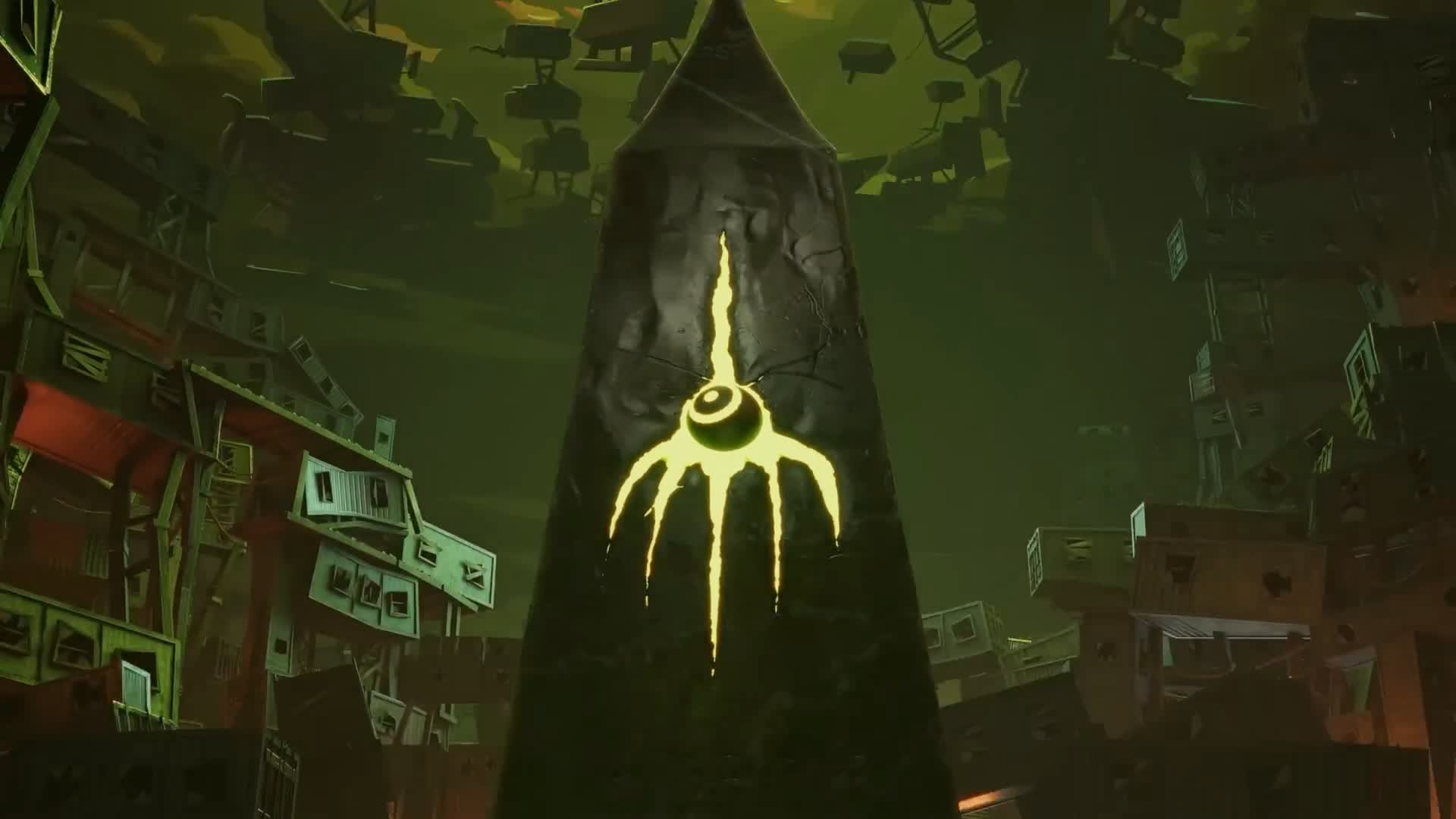 Open image: Black Hand — cracked obelisk with dripping eye-and-claw emblem amid stacked shacks
Decay and return: how the Black Hand frames bodies and streets.
Fandom and alternative names
Fan language around the Hand has only sharpened since the pilot launched. The project has since been officially greenlit, the pilot has pushed past the twenty-million-view mark on YouTube, and even the voice-cast listings leave the Hand without a credited performer. That absence suits the character: viewers keep naming it, translating it, and theorizing about it precisely because it behaves more like a law than a person.
- The Black Hand — primary name used in credits, wikis, and discussion.
- The Hand — shorthand in recaps and threads.
- The Mark — catch-all for the resurrection rune and its contract.
- Mark of the Beast — fan nickname that emphasizes the curse aspect.
- Чёрная Рука (RU) — Russian-language localization used in community posts.
- La Mano Negra (ES) — Spanish-language paraphrase in fan spaces.
- Hand-Eye Rune — descriptive label for the symbol itself.
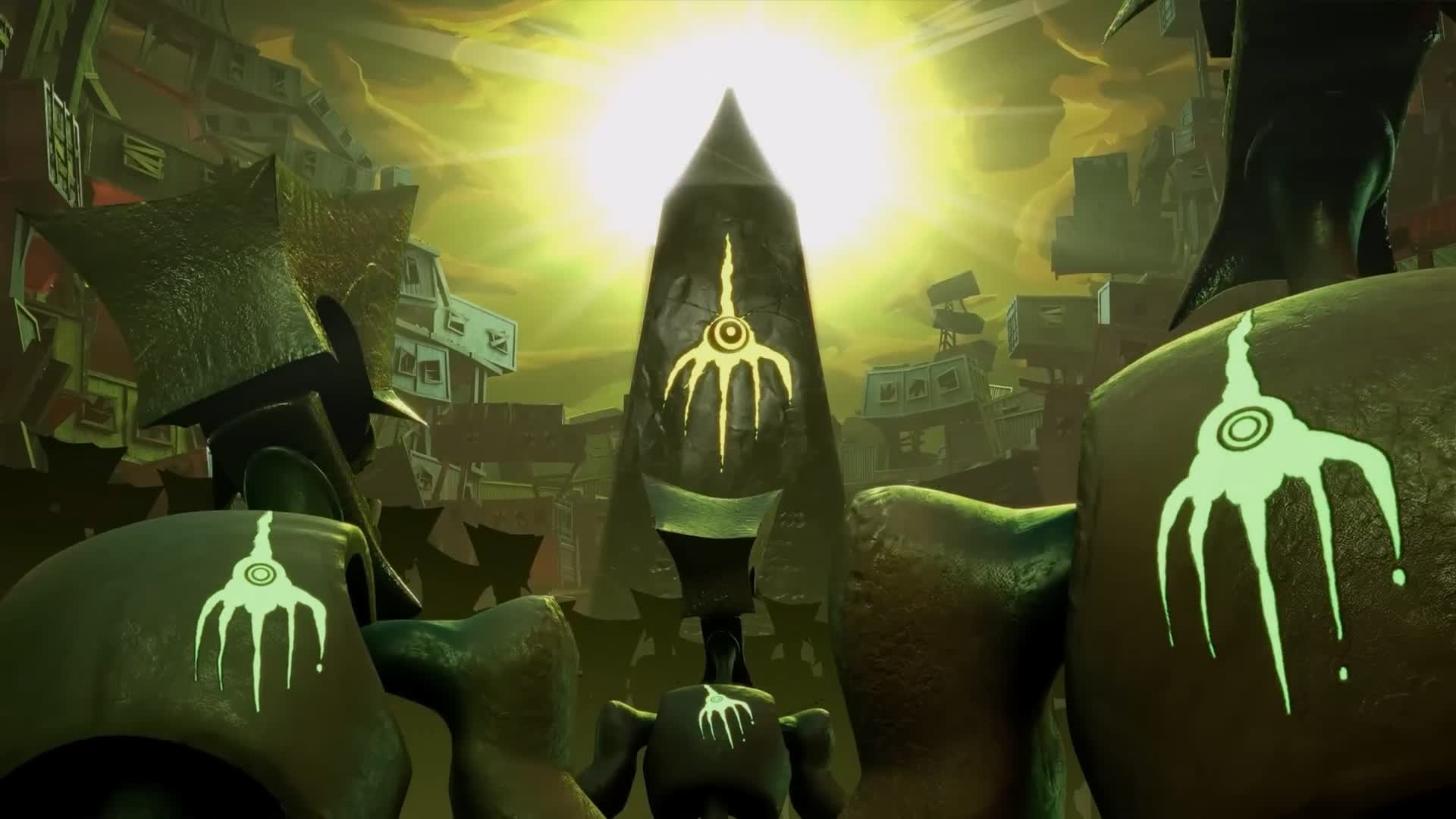 Open image: Black Hand, Rotlings — eye-and-claw totems stand before a blazing sun above
Interesting details and quotes
- Overarching antagonist: materials and community summaries consistently frame the Hand as the show’s big bad—present everywhere, personified nowhere.
- Mechanic, not monster: it never speaks or fights; it writes rules. Resurrection plus rot explains why both heroes and guards can be “killed” and still finish a scene.
- Official framing: Glitch describes the series as a supernatural crime comedy created by Nick Szopko, which clarifies why the Hand can function as cosmic horror and black-comic plot engine at the same time.
- Current status: the pilot debuted on April 18, 2025, and later greenlight news made the Hand’s long-term purpose an even bigger point of speculation.
- Icon with an eye: the sigil is a five-fingered palm with a single, greenish eye at the center, a design that sells surveillance and sanction in one stroke.
- Public saturation: the pilot seeds the rune on a town crier’s hat and paraphernalia, using background dressing to tell the audience what runs the streets.
- Human exception: fear of a “true human” reveals the mark’s limitation and powers the island’s spectacle politics, including the ceremony staged to quiet panic.
- Rival systems: angels can annihilate and Virtues can triage, but neither cancels the Hand’s aftercare; that balance of powers drives the show’s largest set pieces.
- No voice, no actor: the Hand has no credited performer; its dialogue is policy embedded in resurrection timing and civic imagery.
- Quote (signage):
HUMAN DEATH CEREMONY
— a stage banner that makes the Hand’s loophole a public obsession. - Quote (placard):
Fear the Human
— a street sign that turns rumor into law enforcement for an unseen sovereign.
Totems, prophecy, and decay keep the Black Hand present even when it never takes the stage itself.