Angel Mother is the matriarch of Heaven in The Gaslight District and the commanding presence behind the angel swarms that turn Paradise Lost from fortress into kill zone. She enters the story not as a distant emblem of holiness, but as a mother who speaks like a sovereign, treats blood as evidence, and turns prophecy into custody law. In a series built on gang logistics, fake ceremonies, and undead street survival, Angel Mother is the figure who makes the religious side of the world feel frighteningly practical. When she speaks, angels do not deliberate; they descend.
That threat feels even larger now because the public The Gaslight District episode guide still lists only one released episode. Angel Mother therefore occupies a rare dramatic position: she is fully introduced, undeniably active, and still structurally unresolved. She has already declared her claim over Mel, already launched Heaven’s storm, and already benefited from the public fallout of the hatch. Nothing in the released story has diminished her authority. If anything, every surrounding piece of lore has made that authority heavier.

Confrontation that frames Angel Mother as Heaven’s commanding voice over Melancholy Hill.
Angel Mother at a glance
| Topic | Details |
|---|---|
| Role in the story | Matriarch of Heaven, claimant over Mel, and commanding authority behind the angel swarms. |
| Primary function | Theological antagonist who turns prophecy into active pursuit and family language into a weapon of ownership. |
| First major appearance | The pilot, during the stairway and nest sequence above Paradise Lost. |
| Main conflict | Retrieving what Heaven believes belongs to it: Mel, the stolen egg, and later the newborn chick that makes the lie impossible to hide. |
| Core methods | Command voice, swarm coordination, intimidation, public reframing, and overwhelming aerial force. |
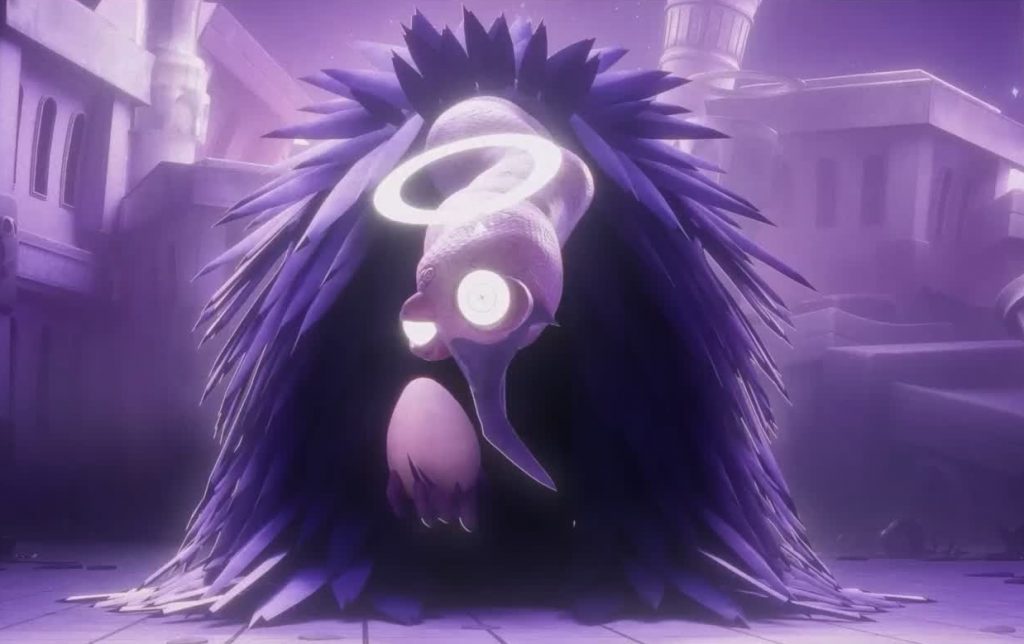
| Visual signature | Long beak, cathedral-sized wings, white feathers, ritual movement, and a constant halo. |
| Current status in the released story | Active, unresolved, and still looming over every open question about Mel, Ramiel, and Heaven’s claim on the city. |
Origin and first appearance of Angel Mother
However crowded the pilot is with gangs, guards, alarms, and ceremonial noise, Angel Mother arrives in the most protected space on the island: the stairway to Heaven above Paradise Lost. The mission that reaches her is driven by Melancholy Hill, who intends to steal an angel’s egg, present it as the feared “human egg,” and destroy it in public to prove the prophecy false. Angel Mother rewrites that plan the moment she appears. What looked like a cynical theft becomes a violation of lineage, and what looked like a stage-managed trick becomes the start of a custody war.
Her entrance is built for revelation rather than surprise. A giant avian silhouette glides out of darkness, halo first, then beak, then wings, until the whole frame belongs to her. She does not rush. She speaks as if the outcome has already been settled somewhere higher than the stair itself. That patience is one reason the scene lands so hard. It makes Angel Mother feel older than the plot around her, as though Mel has not simply stumbled into danger, but wandered back into an order that has been waiting to classify her.
The scene then condenses almost everything that makes Angel Mother memorable into a few beats: recognition, blood, ownership, resistance, survival, and pursuit. She draws black blood from Mel’s arm like a notary confirming identity. She declares the girl belongs to the angels. Mel refuses, stabs her, and runs. Angel Mother survives the blow, screams Heaven into motion, and changes the whole second half of the episode from heist logic into siege logic. From that point on, she is no longer just another obstacle in Paradise Lost. She is the force that reorganizes the episode around herself.
Why Angel Mother matters so much
Angel Mother is not merely “the mother of angels” in a mythic or decorative sense. In the pilot she operates as Heaven’s executive arm: the figure who identifies disputed bodies, declares the claim, and sends the swarm to enforce it. That makes her different from the city’s more familiar predators. Gangsters kill for territory. Virtues kill for procedure. Angel Mother kills, or threatens to kill, in the language of rightful return. Her violence is inseparable from the idea that Heaven already owns what it is coming to take back.
That mixture of intimacy and institution is why she lands so strongly. The scene with Mel is personal enough to feel familial, but broad enough to alter the politics of the entire island. Once Angel Mother says Mel belongs to the angels, everyone else’s vocabulary changes. Ken becomes an abductor in Heaven’s frame. The stolen egg becomes sacred evidence. The escape becomes a crime against cosmic order rather than another family stunt gone wrong. Even people who never stand on the stair with her end up living inside the categories she imposes.
- She turns family language into a legal weapon.
- She converts a private heist into a public theological emergency.
- She exposes the limits of Virtue authority whenever Heaven decides to move directly.
- She gives the series an antagonist who is both personal and systemic at the same time.
- She makes prophecy feel less like rumor and more like an active chain of command.
Angel Mother in the current canon
Subsequent material sharpens the stakes of her pilot appearance even without giving her a second released episode. The hatchling from Mel’s failed public spectacle is now identified in surrounding materials as Ramiel, which means the object of Angel Mother’s pursuit is no longer just a symbolic egg in fan discussion. It is a named child with a place inside Heaven’s family line. That makes her chase feel more specific, more personal, and more frighteningly justified from her point of view.
Later material on Diligence also matters for reading Angel Mother correctly. The Virtue survives the storm and rises again in the pilot’s coda, which means Angel Mother’s side of the map is not broken after the truck escape. Heaven still has an active, ground-level enforcer inside Paradise Lost. The sky may be Angel Mother’s domain, but the checkpoint, the reports, the inspections, and the institutional memory below the clouds still have a body to inhabit.
The same is true of Temperance. Lore around the citadel’s doctor implies that baby Mel once passed through Virtue custody, including a lab image that places the infant in Heaven-side hands. That does not solve the full mystery of Mel’s origin, but it changes the emotional weight of Angel Mother’s claim. What initially sounds like prophetic possession begins to read like interrupted custody. Angel Mother’s certainty is frightening partly because later material suggests it may not be invented on the spot.
Put together, those additions make Angel Mother larger, not smaller. The pilot introduced a terrifying mother. Later lore clarifies that she is also the head of a continuing Heaven-side system with a named newborn to retrieve, a surviving security enforcer, and an older medical history that may tie Mel to the gate long before she can remember it. With the show greenlit for more but the released episode count still anchored to the pilot, Angel Mother remains one of the biggest unresolved pressures in the story.
Personality and key traits of Angel Mother
Personality is where Angel Mother becomes more than a memorable monster design. The series could have made Heaven’s matriarch a shrieking beast or a silent icon. Instead, it gives her a ceremonial mode of threat. She weaponizes calm. Her pauses matter as much as her talons, and the unusual pacing of her speech makes even short lines feel like verdicts pronounced from somewhere older than the city below. She does not sound impatient because she does not act like she has anything to prove.
| Trait | How it appears on screen | Why it matters |
|---|---|---|
| Sovereign maternalism | She speaks as mother, but every maternal gesture is framed as possession and claim. | It makes family language frightening rather than comforting. |
| Command voice | Her lines are short, ritual, and immediately actionable. | Heaven feels organized around her speech, not merely inspired by it. |
| Instrumental compassion | She can sound tender and threatening in the same breath. | The audience is never allowed to relax into a simple reading of “loving mother.” |
| Oracular certainty | She does not ask questions; she declares outcomes. | That certainty gives even quiet moments the force of sentencing. |
| Punitive holiness | Her holiness is inseparable from punishment, pursuit, and correction. | Divinity in this series becomes enforcement rather than mercy. |
| Public rhetorical power | Her framing of events survives even after she leaves the scene. | She can win socially as well as physically. |
| Battle resilience | She survives a knife to the head and continues the pursuit. | The matriarch clearly sits above ordinary angels in durability and authority. |
- She speaks in decrees rather than negotiations.
- She treats recognition itself as capture; once Mel is identified, pursuit becomes moral duty.
- Her tenderness is always adjacent to threat, which keeps the horror emotional and physical at once.
- Even offscreen, her interpretation of events keeps shaping guilt and innocence in public space.
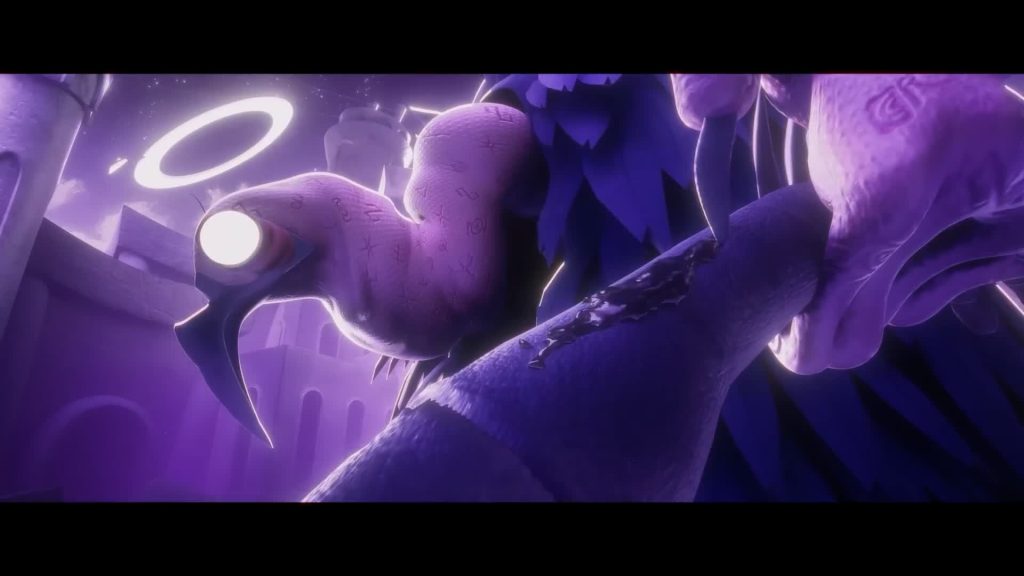
Blood test and custody claim: the moment Angel Mother turns belonging into evidence.
Powers, abilities, and methods of control
What makes Angel Mother especially effective is that her power never feels like random escalation for spectacle’s sake. Even in a pilot full of outsized action, including the ingredient-fueled chaos surrounding Breadhead, her abilities remain tightly linked to status, territory, and kinship. She does not just hit harder than everyone else. She commands more meaning than everyone else. Her strength lies in the fact that every action doubles as an act of classification.
| Ability | Evidence in the released story | Effect on the narrative |
|---|---|---|
| Swarm command | One cry pulls scattered angels into coordinated pursuit. | Heaven stops looking like wildlife and starts looking like centralized force. |
| Storm shaping | The air itself becomes violent after Mel escapes the nest. | Angel Mother turns geography into an obstacle course for the Smiling Dead. |
| Blood recognition | She draws Mel’s black blood with a talon and immediately escalates. | Identity becomes something she can confirm and act on physically. |
| Aerial dominance | Her height, flight, and position above the stair and road give her natural control of space. | She makes escape routes feel temporary and visible. |
| Durability | She survives a stab to the head without collapsing. | The protagonists cannot solve her with a single desperate move. |
| Public reframing | Her claims convert a heist into sacrilege and retrieval. | She can win scenes she does not physically remain inside. |
| Territorial pressure | She is strongest near Heaven’s threshold and in open sky. | The border between city and Heaven becomes a political weapon. |
| Prophetic authority | She speaks of destiny as settled fact. | The audience is pushed to treat her certainty as more than bluff or pageantry. |
Just as important are the limits the pilot implies rather than states outright. Angel Mother is overwhelming at the threshold to Heaven and across exposed sky, yet she still benefits from institutions, territory, and public belief to stabilize her claim on the ground. That is why the truck escape matters so much. The Smiling Dead cannot defeat her outright, but they can create enough motion, steel, and confusion to turn absolute power into delayed power. They escape the scene, not the problem.
- Jack the Rat exposes.
- Diligence audits and punishes.
- Temperance catalogs and maintains.
- Angel Mother claims, authorizes, and makes the others matter more.
Story arcs and timeline
Angel Mother’s arc in the released story is short in minutes but enormous in consequence. She enters as revelation, expands into weather, and exits as unresolved doctrine hanging over the city. Seen in sequence, she does not simply chase the protagonists. She progressively changes what kind of story they think they are living in.
| Phase | What Angel Mother does | Why it matters |
|---|---|---|
| Pre-pilot backstory | Exists as the Heaven-side force that makes containment around the gate necessary. | Paradise Lost reads as border management, not mere scenery. |
| Stairway encounter | Recognizes Mel, draws blood, and declares her Heaven’s property. | The heist turns into a custody conflict. |
| Escape response | Summons the angel storm and directs aerial pursuit. | The whole episode shifts from stealth to siege. |
| Truck gauntlet | Concentrates the swarm into a coordinated weapon. | Street-level family survival collides with Heaven’s organized force. |
| Ceremony fallout | Benefits from the hatch’s public revelation even while offscreen. | Her worldview gains civic force without requiring another entrance. |
| Current story position | Remains unresolved in the only publicly released episode. | She continues to define the stakes of future conflict. |
- She appears at the nest and turns trespass into return.
- She tests Mel’s blood and confirms the dispute is personal.
- She survives Mel’s defiance and answers with collective punishment.
- She transforms the sky itself into an extension of Heaven’s will.
- She indirectly wins the public argument once the egg hatches.
- She leaves the pilot with her claim unanswered rather than disproved.
Ancient settlement with the Virtues
Before the pilot begins, the world already suggests a long settlement between Heaven and the Virtues around the gate to Paradise Lost. Angel Mother is crucial to that backstory because she explains why the citadel needs to exist at all. If Heaven were only symbolic, there would be no reason for militarized inspection, no reason for medical maintenance of hybrid bodies, and no reason for the whole border to feel tense even in routine moments. The arrangement implied by the released material reads less like peace than containment: the Virtues run the stair, the lab, and the paperwork below, while Angel Mother remains the sovereign pressure above it. Her existence turns every polished surface in Paradise Lost into something reactive, as though the whole institution has been built not only to keep intruders out, but to remain legible to Heaven when one of its own is threatened.
Stairway encounter with Mel
The stairway scene is where Angel Mother becomes more than lore. The pilot frames the approach as a classic theft beat: secure the egg, get out, hold the lie together long enough for the public stunt to work. Angel Mother destroys that rhythm. She does not chase Mel immediately because she does not need to. First she identifies. Then she claims. Then she allows the emotional logic of the scene to become clear. Mel is not just a thief in the wrong room. She is, in Angel Mother’s eyes, a lost or stolen piece of Heaven itself. That is why the talon-draw matters so much. It is not casual cruelty. It is the moment where suspicion becomes conviction and conviction becomes enforcement. Mel’s stab buys movement, but it cannot unmake the classification that has just occurred.
Angel storm and the truck chase
Once the escape drops to street level, Angel Mother proves she does not need to stay in intimate range to dominate the scene. The family still has bodies, vehicles, and split-second improvisation on its side, especially the driving and dirty decision-making of Mud, but Angel Mother converts open sky into a weapon. Angels stop reading like scattered creatures and start reading like a single blade. That shift is crucial. The chase is no longer family versus individual pursuers; it is family versus coordinated Heaven. Even when her talons are not inside the truck, her will is. By the time Diligence is chewed up in the flock and the road turns into a gauntlet of wings, the episode has proven Angel Mother can scale a personal grievance into civic catastrophe almost instantly.
Public rupture at the Human Death Ceremony
Her most interesting victory may happen when she is offscreen. The Human Death Ceremony was designed to relieve a city already warped by the resurrection logic of the Black Hand and by terror over the one thing that system cannot safely absorb: a true human. When the egg hatches instead of breaking, Angel Mother’s worldview receives public confirmation without her needing another line. The crowd no longer sees a clever debunking. It sees sacrilege, proof, and a child of Heaven dragged into a fraud. That reversal is what makes Angel Mother larger than a chase villain. She does not merely lose the egg and hunt it down again; she acquires public narrative force. The streets can continue her accusation even after the truck has escaped.
Angel Mother in the current released story
Because the publicly released story is still concentrated in the pilot, Angel Mother remains in a dramatically privileged place. She has already announced the claim, already tested Mel, already sent the swarm, and already benefited from the hatch’s fallout. Yet none of the relationships that matter most to her have been resolved. Mel is still a refused daughter, the chick is still a retrieved-not-yet-retrieved child, the city has already seen proof, and Heaven’s institutional allies are damaged but not gone. That combination makes Angel Mother feel less like a completed obstacle and more like the long shadow the next chapter must eventually walk back into.
Relationships with other characters
The wider character guide for The Gaslight District makes something clear that the pilot only has time to imply: Angel Mother is dangerous not because she dominates one hero, but because she pressures every major institution around that hero at once. Family, security, medicine, faith, and public panic all bend around her claim.
| Character | Relationship to Angel Mother | Story effect |
|---|---|---|
| Melancholy Hill | Claimed daughter and disputed subject. | Turns the pilot’s heist into a custody fight. |
| Ken the Butcher | Rival parent and street-level protector. | Creates the series’ central clash between improvised family care and absolute heavenly claim. |
| Ramiel | Newborn angel kin. | Makes Angel Mother’s pursuit specific, emotional, and publicly legible. |
| Diligence | Ground-level executor of order near Heaven’s gate. | Shows how Angel Mother’s side of the world extends into procedure and enforcement. |
| Temperance | Medical gatekeeper inside the same Heaven-side system. | Deepens the sense that Mel’s history with Heaven predates the pilot. |
| The Smiling Dead | Egg thieves and de facto kidnappers in Heaven’s frame. | Forces the family to defend itself against divine language, not just brute force. |
| Virtue Corps Guards | Disposable enforcement layer. | Become collateral once Angel Mother’s priorities override ordinary protocol. |
| The Black Hand | Rival supernatural order. | Expands the conflict from one family to the whole metaphysical structure of the island. |
Her bond with Melancholy Hill is the key to the entire character. Angel Mother is frightening precisely because the claim does not sound symbolic to her. She does not treat Mel as a useful girl, a random intruder, or a prophecy mascot. She treats her as someone already classified. That makes Mel’s refusal more emotionally charged than a normal escape. She is not merely running from capture; she is rejecting an identity that Heaven speaks as if it were settled fact. The black blood, the stairway confrontation, and the later implication that baby Mel once passed through Paradise Lost all make the relationship feel older than the pilot itself.
Her conflict with Ken the Butcher is the pilot’s parental war. Ken protects through planning, motion, and ugly practical choices. Angel Mother protects, or claims to protect, through destiny, command, and retrieval. Both of them frame their violence as care. That is why the chase works so well. The episode is not secretly asking which side is cleaner. It is staging a fight between two incompatible forms of parenthood, one street-level and improvisational, the other cosmic and absolute. Ken can outrun her for a time, but he cannot make her stop being the authority that says Mel should never have been his to raise in the first place.
Ramiel expands Angel Mother’s emotional range. Up to the stairway, she can still be read as a terrifying claimant whose language may partly be prophetic theater. Once the hatchling exists as a visible child, that reading narrows. Angel Mother is not only guarding doctrine; she is trying to retrieve kin. The complication is that the show does not sentimentalize that fact. Her maternal status does not make her gentler. It makes her more total. The same figure who recognizes a child as family is still willing to weaponize a swarm and terrorize a city to get that child back, which keeps Heaven from softening into innocence.
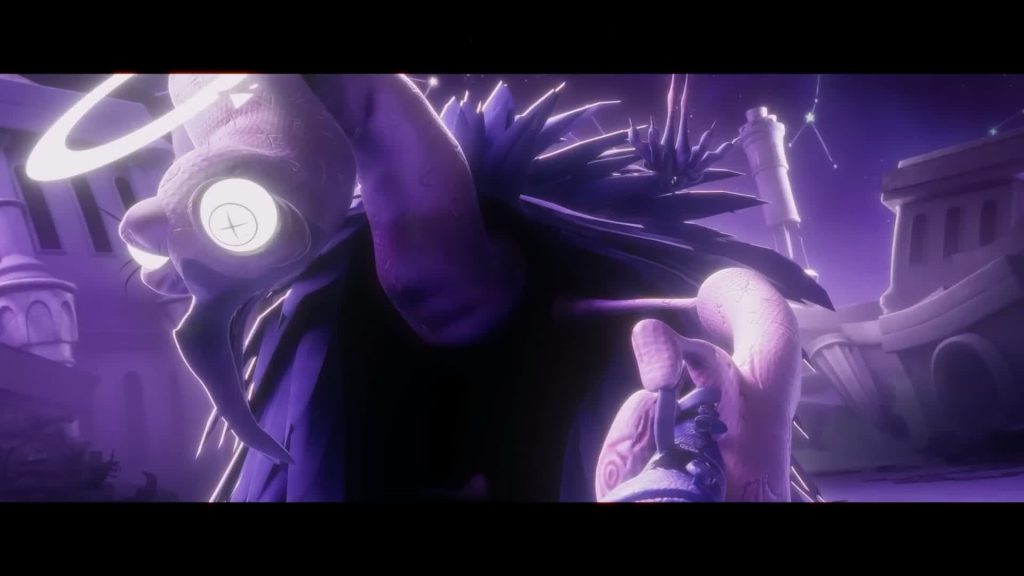
Seizure and pursuit: Angel Mother moves from recognition to enforcement in seconds.
Angel Mother and the language of custody
More than anything else, Angel Mother is the character who turns family words into legal weapons. She does not ask whether Mel wants Heaven, whether the egg can be taken, or whether the city deserves an explanation. She begins from possession. In that logic, motherhood is not nurture but title, and title carries the right to seize, classify, and punish. That is what makes her presence feel judicial instead of merely monstrous. She is not improvising rage. She is enforcing what she believes is already true.
That is also why her scenes do not play like ordinary villain entrances. A blood test becomes identification. A hatchling becomes property in dispute. A rescue truck becomes evidence of abduction. Even the crowd at the Human Death Ceremony, which never sees her in person, ends up reacting through the categories she imposes. Angel Mother is terrifying not only because she can kill, but because she can define what everyone else believes has happened. Once she enters the story, care and kidnapping become difficult to separate.
- The talon-draw turns blood into proof.
- The line about belonging turns prophecy into custody.
- The swarm makes retrieval feel like law enforcement.
- The hatch converts private theft into public sacrilege.
- The unresolved ending leaves care and capture deliberately entangled.
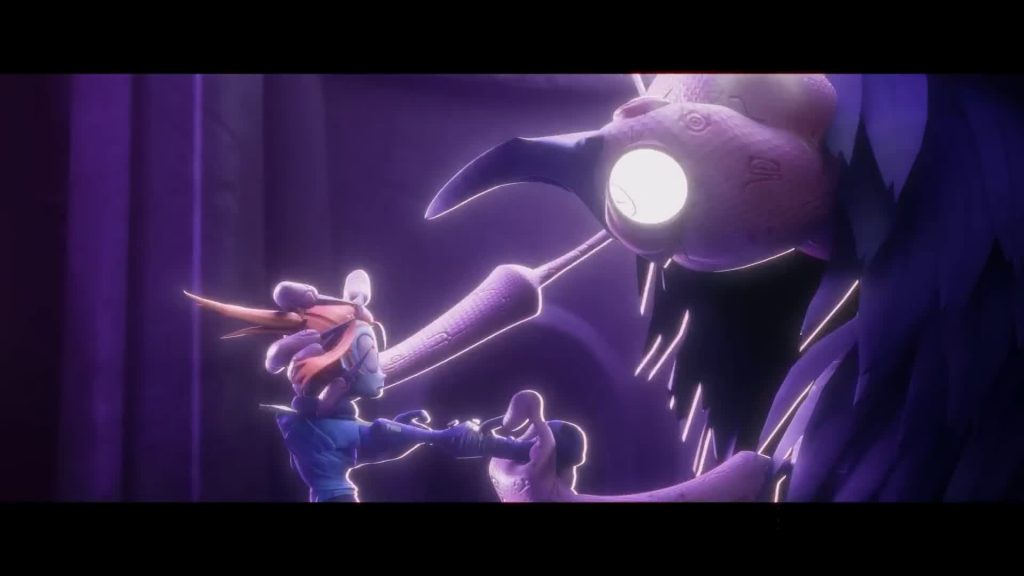
Close-quarters dominance gives Angel Mother a judicial quality that hangs over the whole citadel, from the highway wreckage to smaller casualties such as Joshua.
Angel Mother, Heaven, the Virtues, and the Black Hand
Angel Mother also works because she sits at the intersection of the show’s three largest governing systems: Heaven, the Virtues, and the Black Hand. She belongs fully to one, leans on another, and collides with the third. Reading her only as a giant angel mother misses how much of the setting she activates whenever she appears.
| System | Public face | Angel Mother’s role | Effect on the story |
|---|---|---|---|
| Heaven | Angels, eggs, prophecy, and divine claim | Sovereign maternal authority | Turns faith into active pursuit and retrieval |
| Virtues | Security, audits, medicine, and border enforcement | Higher pressure above the institution | Shows that procedure below still answers to a more absolute order above |
| The Black Hand | Resurrection rune, decay, civic ritual, and undead normalcy | Rival supernatural logic | Expands the conflict from one family to the island’s metaphysical structure |
| The Smiling Dead | Street family, logistics, violence, and improvisation | Targets of retrieval and resistance | Turns con artists into caretakers, thieves, or kidnappers depending on the frame |
| The public crowd | Ceremonies, chants, and rumor | Indirect field of influence | Lets Angel Mother keep winning even while offscreen |
The clearest ground-level extension of her authority is Diligence. The Virtue handles scanning, checkpoints, personnel, and violent procedure within Paradise Lost, but the pilot repeatedly shows that these systems become smaller when Angel Mother enters the frame. Diligence can audit a truck, terrorize guards, and pursue intruders with institutional confidence. Angel Mother can turn the entire sky into enforcement. Later material confirming Diligence’s survival sharpens the relationship rather than weakens it. Heaven’s matriarch is not losing her bureaucracy. She still has a functioning arm below the clouds.
The medical side of that order is embodied by Temperance, and the connection matters because Angel Mother’s claim is as much biological as spiritual. Temperance’s surrounding lore reframes Paradise Lost as a place where bodies are catalogued, repaired, upgraded, and remembered. Once a lab image places baby Mel in the doctor’s arms, Angel Mother’s words on the stair stop sounding like random revelation. They start sounding like the resurfacing of a documented history. Even if the full chain of custody remains hidden, the implication is clear: Heaven’s world did not discover Mel in the pilot. It recognized her.
Against all of that stands the Black Hand, the unseen law that keeps Rotlings returning from death while condemning them to decay. Angel Mother’s importance grows because she is the most vivid representative of the rival system above it. The Hand governs persistence in the streets. Angel Mother governs legitimacy from the sky. One says the island’s dead will keep getting back up. The other says Heaven still has the right to identify, claim, and retrieve what belongs to it. The conflict around Mel and the hatchling is therefore bigger than a gang war or a chase. It is a dispute between two supernatural orders over which bodies can be named, owned, and normalized inside the city.
- Jack the Rat exposes secrets.
- Diligence enforces procedure.
- Temperance manages bodies and records.
- The Black Hand writes the island’s resurrection rules.
- Angel Mother is the one who can turn all of those pressures into a single act of seizure.
Appearance, symbols, and recurring motifs of Angel Mother
Visually, Angel Mother reads as a raptor enlarged to cathedral scale. The long beak is both saintly iconography and predatory tool; the halo turns silhouette into doctrine; the wings create moving architecture. She does not merely enter a frame, she occupies it like weather or verdict. That design choice matters in a show where almost everyone else is built from patched flesh, porcelain shells, work coats, uniforms, and street grime. Angel Mother looks less like a resident of the district than a force above it, something whose anatomy has already become symbolic before the plot even reaches her.
Sound and movement finish the job. The drawn-out vowels and measured cadence keep her from reading like a shrieking monster, while the sudden switches into speed prevent her solemnity from becoming passive. One second she is hovering like an icon on stained glass; the next she is close enough to grip, choke, or rake a talon through skin. That rhythm mirrors the entire Heaven-side threat in the series: beauty first, then capture. Even when other large characters dominate with appetite, weight, or kinetic chaos, Angel Mother dominates with inevitability.
- Halo: not just holiness, but a badge of sanctioned ownership.
- Beak: a weaponized line that can point, accuse, and pierce.
- Wings: mobile walls that turn open space into controlled territory.
- Height: a constant reminder that Heaven’s view is vertical and supervisory.
- Egg imagery: lineage made tangible, portable, and contestable.
- Voice: the true trigger mechanism for mass action.
- Pale feathers against storm-dark skies: mercy and annihilation occupying the same image.
Fandom and alternative names for Angel Mother
Fan language around Angel Mother stays relatively consistent because the pilot gives her such a clean symbolic role. She is memorable enough to generate shorthand, but precise enough that most viewers keep circling back to the original name.
- Angel Mother — primary name in dialogue and writeups.
- The Mother — the most common shorthand.
- Angel Matriarch — recap-friendly descriptive label.
- Queen of Heaven — fan epithet emphasizing rank and command.
- Мать Ангелов — Russian-language usage.
- Madre de los Ángeles — Spanish-language paraphrase.
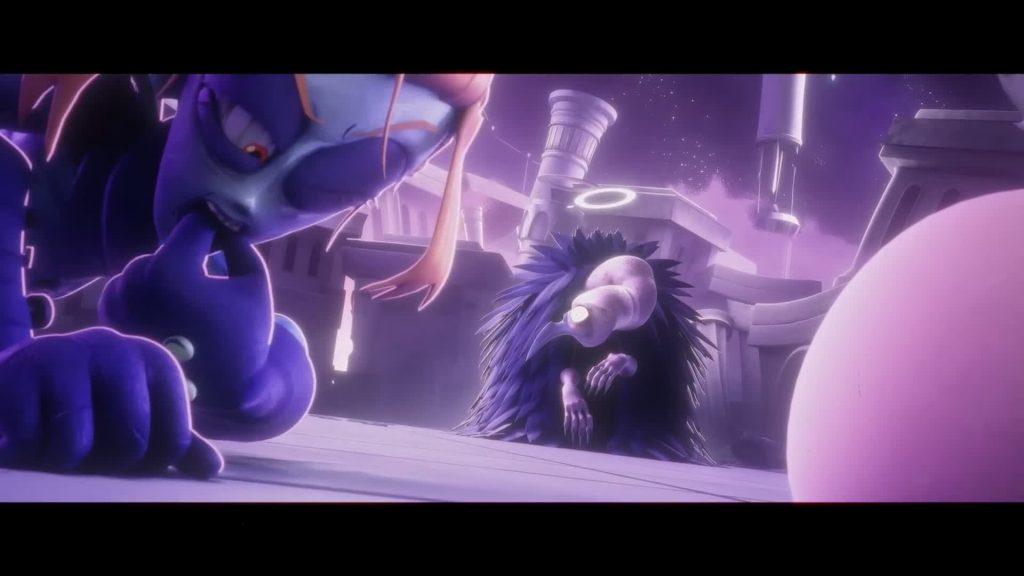
Eggs, lineage, and command define Angel Mother’s visual grammar long before the hatch changes everything.
Interesting details and quotes
The broader voice-cast hub and the newer character materials help clarify why Angel Mother feels larger than her minutes on screen. She sits at the intersection of performance, design, and lore compression: one sequence gives her a daughter, an egg, a chain of command, a city-level threat, and two of the pilot’s most quoted lines.
- Angel Mother is voiced by Margaret Ashley, whose delivery mixes lullaby softness with judicial command.
- Her first major appearance is in the pilot that debuted on April 18, 2025.
- The series is officially framed by GLITCH as a supernatural crime comedy created by Nick Szopko, which helps explain why Angel Mother can be horrifying and darkly theatrical at once.
- Later surrounding material identifies the hatched chick as Ramiel, making Angel Mother’s pursuit more specific and more personal.
- Later material on Diligence confirms the Virtue rises again after the storm, so Heaven’s enforcement arm is bruised rather than erased.
- Temperance-related lore implies baby Mel once passed through Heaven-side medical custody, which deepens Angel Mother’s claim without fully explaining it.
- Angel Mother survives a stab to the head and remains functional enough to continue the pursuit immediately.
- Her most distinctive power is not raw force but conversion: she can turn a rescue into a kidnapping, a prop into sacred evidence, and a crowd into indirect backup.
- Key quote:
You… belong… TO THE ANGELS!
- Key warning:
Touch not your feet upon the land to be razed! When your day of destiny arrives, we shall be there to guide you on silver wings!
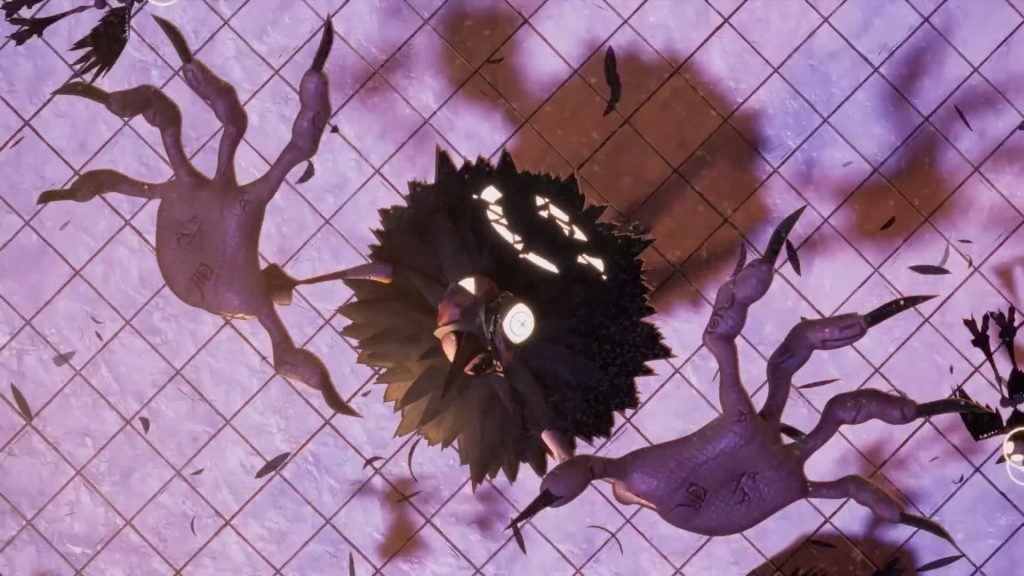
Overhead threat made literal: Angel Mother hangs above the district like a verdict still waiting to land.