

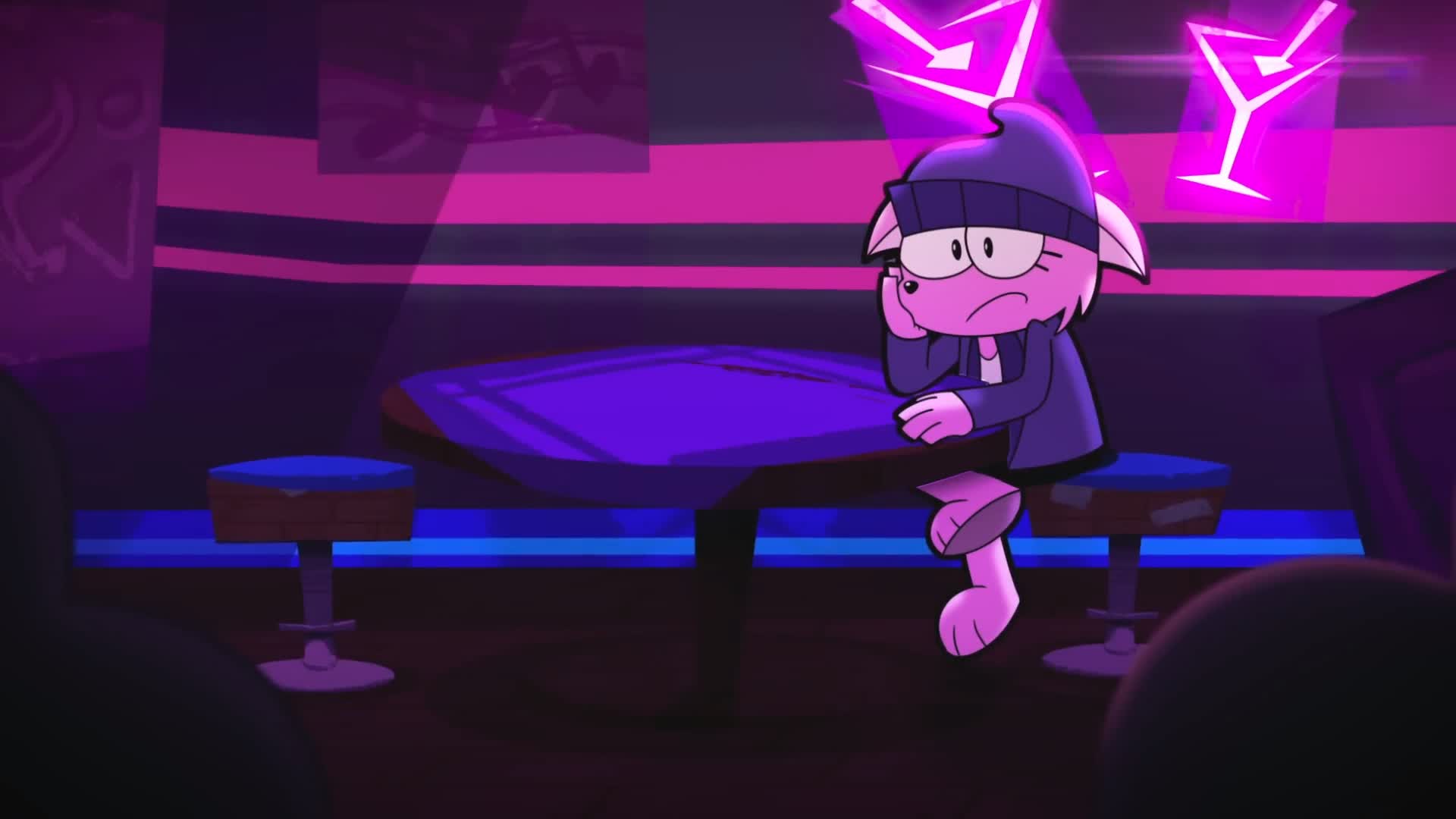
Jessica Jacobs is a bar-area regular and credited crowd figure in Catching Up. However, unlike a throwaway extra, she sits at the center of the pilot’s most telling social exchanges: a cool, pink-furred cat in a purple beanie who seems to understand LUUB’s unspoken rules better than the anxious leads do. Therefore, Jessica Jacobs works as a tonal anchor–her measured reactions tell you whether a moment is charming, awkward, or past the line. Then, because the series favors diegetic action over exposition, you learn who she is through behavior: a steady look across the counter, a clipped response when someone overplays confidence, and a brief, uncomfortable beat after Clay tries to talk and stumbles. As a result, she embodies the show’s core tension–teenagers performing adulthood under fluorescent reality–while giving the pilot a clear social center of gravity. In addition, character pages identify her as Snazzy Jacobs’ sister and Bully Guy’s girlfriend, which clarifies why her quiet authority carries so much weight in the room. Finally, the role is voiced by Vivian Reed, whose crisp, unfussy delivery fits the character’s economy of words.

Origin and first appearance
However you map the pilot, Jessica Jacobs first appears in “Clubbing” (), the episode that introduces LUUB as a community-center “club” where posted rules and peer pressure share equal billing. Then, as the camera triangulates the space–door enforcement, dance-floor churn, and the bar lane–Jessica settles into view as the calmest presence in the most social corner. The pink cat silhouette, purple beanie, and casual jacket read instantly in the neon palette, and the edit starts using her as a reference point: cut to Jessica when the mood needs a verdict, cut away when the scene knows where it’s headed. Next, the pilot positions her in a small circle that viewers later recognize as a hub (often near Snazzy Jacobs), and that proximity to the counter becomes the stage for quick interactions: she trades brief words with Clay after he sits down, he tries to play it cool, and he promptly embarrasses himself–her annoyed reaction landing harder than a rant ever would. Meanwhile, the door’s severity and DJ Mcnulty’s power to kill the music create an environment where a raised eyebrow matters as much as a raised voice. Consequently, Jessica’s debut is less a “meet-cute” than a thesis: confidence here is granted by the room, not claimed by whoever is talking. As a result, every later cut back to the bar reads through her posture.
Personality and key traits
| Trait | Description |
|---|---|
| Composed and economical | Jessica speaks when it matters and lets silence do the rest. Her short replies and steady gaze establish boundaries without theatrics, which fits LUUB’s no-nonsense vibe. |
| Social gatekeeper | By standing at the bar with easy confidence, she signals who gets time and when. She can end a conversation with a tilt of the head or reward one with a brief, genuine smile. |
| Low-tolerance for posturing | She reacts poorly to obvious try-hard energy. When Clay blunders or someone pushes a weak bit too long, annoyance replaces amusement and the moment dies on contact. |
| Status fluent | Jessica reads the room fast and rarely tests posted rules; instead, she enforces the unposted ones–don’t waste our time, don’t pretend you belong before you’ve listened. |
| Embedded in a network | As Snazzy’s sister and Bully Guy’s girlfriend, she sits at the intersection of calm judgment and blunt force. The relationships explain why her small choices carry big consequences. |
Story arcs and development
Arc 1 – Bar baseline and the Clay exchange. Start: LUUB’s geography is established–door, floor, bar–and the bar becomes the narrative checkpoint. Then: Jessica holds that space with an unfussed posture, and Clay, already running on fumes, tries to chat after sitting nearby. Her clipped replies and cool look meet his brave front, and he promptly says something that reads wrong aloud. As a result: The scene crystallizes Catching Up’s thesis: a single misread can curdle a night. Jessica doesn’t explode; she simply withholds approval, and Clay’s embarrassment fills the quiet.
Arc 2 – The sister dynamic. Start: Snazzy Jacobs appears in the same cluster, and the two operate like a practiced team. Then: Jessica often takes the verbal lead while Snazzy mirrors tone with micro-expressions; together they set the bar’s tempo, deciding which approaches breathe and which stall. As a result: The edit uses their tandem presence as a crowd metronome–if the sisters look done, the scene is done. Their unity also explains why Rob’s politeness rarely earns traction here.
Arc 3 – Indirect control through connections. Start: Bully Guy, credited as Jessica’s boyfriend, exists elsewhere in the room as a more overt source of pressure. Then: Jessica never has to name-drop him; the knowledge simply colors how suitors behave. Her disinterest can feel like a gentle “no,” but it also reads as a warning–this circle has backing, so don’t press your luck. As a result: The pilot shows how social capital works in tight spaces: you don’t need to raise your voice if everyone knows where you stand.
Arc 4 – After the blow-up (Spoiler). Start: Clay’s night finally tips into a brief shout, and DJ Mcnulty cuts the music to silence. Then: The bar freezes, and Jessica’s stillness–no eye roll, no smirk–functions as judgment. When the beat returns, conversation resumes, but the ledger changed. As a result: The story lands on its preferred rhythm: public embarrassment, quick reset, and a room that remembers. Jessica’s role is quiet but decisive in how that rhythm feels.

Relationships with other characters
| Name | Role vs. Jessica Jacobs | Dynamics |
|---|---|---|
| Snazzy Jacobs | Sister and co-anchor | Their synchronized reads (look, tilt, pause) make the bar feel like their turf. The duo’s unity is why small missteps land so hard here. |
| Bully Guy | Boyfriend | His blunt posture elsewhere contrasts with Jessica’s quiet control. Knowing they’re together shapes how others approach her, even when he’s off-screen. |
| Clay | Awkward interlocutor | They trade a few lines after he sits; his attempt to seem unbothered backfires. Her annoyance is surgical and ends the moment cleanly. |
| Rob | Hopeful outsider | Rob’s polite energy bounces off her cool. She doesn’t punish him; she simply declines to invest, which is a softer but effective “no.” |
| Roy | Ambient flirt | Roy drifts through the bar with easy patter. Jessica treats it as background noise, which reframes his swagger as performance rather than persuasion. |
| Jacket Girl | Bar neighbor | They share frames, but their roles differ; Jacket Girl drives the coat gag, while Jessica sets tone through timing and minimal words. |
| DJ Mcnulty | Ambient arbiter | His drops and sudden silences frame her reactions. When he kills the music, Jessica’s look becomes the room’s verdict. |
Appearance, symbols, and recurring motifs
Visually, Jessica Jacobs reads the instant she enters frame: pink fur, a purple beanie pulled low, and a casual jacket over a white top. Then, the design relies on clear shapes rather than fussy detail–a strong silhouette at the counter so micro-reactions will register under magenta-blue lights. Meanwhile, the beanie operates as a small emblem of autonomy, a rebellious note that matches a “rebellious, easily annoyed” personality tag without tipping into caricature. Therefore, posture does the heavy lifting: a squared stance when she’s heard this pitch before, a quiet lean-in when something finally earns attention, and a flat look when a line crosses from confident to obnoxious. Next, the camera places her where the room’s traffic converges; friends cycle in and out, but Jessica stays, and the bar remains consistent every time the story needs a temperature check. As a result, she becomes a visual motif for Catching Up’s social math–status is the sum of tiny choices, and the person who controls the counter controls the conversation.

Fandom and alternative names
- Jessica Jacobs
- Jessica (bar area)
- Pink Cat (Jessica)
- Jacobs (Jessica)
- Jessica J.
- JJ (fan shorthand)
- Bar Jessica
Interesting details and quotes
- Jessica’s first appearance is the pilot “Clubbing” (), where she anchors several bar-lane beats.
- Voice: Vivian Reed; the performance favors crisp, unhurried line reads that fit the character’s economy of speech.
- Family: Snazzy Jacobs is identified as her sister, which the staging reinforces by pairing them at the counter.
- Relationship: Character lists mark Bully Guy (Kellen Goff) as her boyfriend, a detail that explains why she rarely needs to posture.
- Her beanie-and-jacket combo keeps the face readable against the club’s neon wash so a single look can land like a line.
- She appears alongside other bar fixtures (Snazzy, Jacket Girl), but her function differs: Jessica sets tone, while the others drive specific gags.
- The pilot’s door severity and the DJ’s hard music cuts echo her approach–quick signals, no speeches, and immediate consequences.
No trainers.
– the door rule that establishes the night’s harsh baseline; it’s the backdrop for Jessica’s strict social boundaries inside.Now, try not to get TOO many girls.
– Rob’s dad’s curbside dare that the bar quickly reduces to size, especially through Jessica’s cool indifference.